NATO chief talks Arctic security with Rubio amid US Greenland push

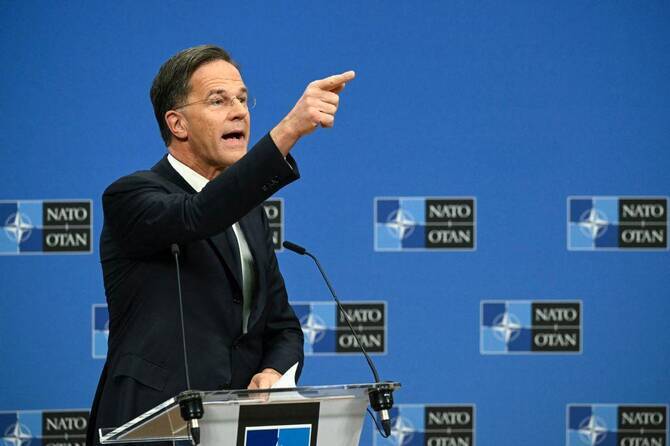
NATO’s Secretary General Mark Rutte. (AFP/File)
Short Url
Updated 09 January 2026
Follow

NATO chief talks Arctic security with Rubio amid US Greenland push

  • Trump says controlling the mineral-rich island is crucial for US national security
  • NATO has sought to deflect Washington’s interest in Greenland

BRUSSELS: NATO chief Mark Rutte on Friday discussed efforts to bolster Arctic security with US top diplomat Marco Rubio, after President Donald Trump insisted he wants to take control of Greenland.
The US leader has rattled allies by refusing to rule out using military force to take over the autonomous territory of fellow NATO member Denmark.
Trump says controlling the mineral-rich island is crucial for US national security given the rising threat of Russia and China in the Arctic.
NATO has sought to deflect Washington’s interest in Greenland by emphasising steps it is taking to bolster security in the region.
A NATO spokeswoman said Rutte spoke with Rubio “on the importance of the Arctic to our shared security and how NATO is working to enhance our capabilities in the High North.”
Danish Prime Minister Mette Frederiksen has warned that an armed US attack to take Greenland could spell the end for the 76-year-old Western military alliance.
But the head of NATO’s forces in Europe, US General Alexus Grynkewich, said Friday the alliance was far from being in “a crisis,” following President Donald Trump’s threats.


Philippines steps up security at newly found gas field near South China Sea

Updated 7 sec ago
Follow

Philippines steps up security at newly found gas field near South China Sea

  • New reservoir believed to contain enough gas to power 5.7m households per year
  • Philippines, China have been involved in a series of tense incidents in disputed waters

MANILA: The Philippine military and coastguard have stepped up security around a newly announced natural gas discovery, Malampaya East-1, off the island of Palawan, bordering the disputed South China Sea.

The undersea reservoir is estimated to contain about 2.8 billion cubic meters (98 billion cubic feet) of gas, enough to power about 5.7 million households per year.

It was discovered around 5 km east of the main Malampaya gas field, the Philippines’ most important natural gas field, which supplies fuel to major power plants on the main island of Luzon and was projected to decline considerably in a few years.

“Malampaya is not just an installation, it is a lifeline of our energy security,” Col. Francel Padilla, spokesperson of the Armed Forces of the Philippines, told reporters late on Tuesday.

“When we protect Malampaya, we are not only defending our territory. We are protecting the nation’s power source, economy, and future.”

A joint task force commanded by the AFP will conduct “continuous monitoring, readiness and presence to ensure that no (hostile) force will disrupt our critical infrastructure,” she added.

The new gas field discovery comes as the Philippines faces a growing Chinese presence in the South China Sea in recent years, with their coast guards and navy ships having been involved in a series of tense incidents.

President Ferdinand Marcos Jr. has ordered the Philippine Coast Guard to “keep a tight watch” over Malampaya to secure the country’s energy resources, Presidential Communications Office Undersecretary and Palace Press Officer Claire Castro said during a press briefing last week.

The PCG has since announced the deployment of its 97-meter offshore patrol vessel to secure Malampaya East, along with two 44-meter patrol vessels and aerial assets.

Malampaya East-1 lies within the Philippines’ exclusive economic zone, a 370 km stretch of water from the country’s coastline, where Manila has exclusive rights to explore and harness resources under the 1982 UN Convention on the Law of the Sea.

It is located near the disputed waters of the South China Sea, a strategic waterway and resource-rich area where the Philippines, China and several other countries have overlapping claims.

Beijing has continued to maintain its expansive claims of the area, despite a 2016 international tribunal ruling that China’s historical assertion to it had no basis.