

Philippines steps up security at newly found gas field near South China Sea

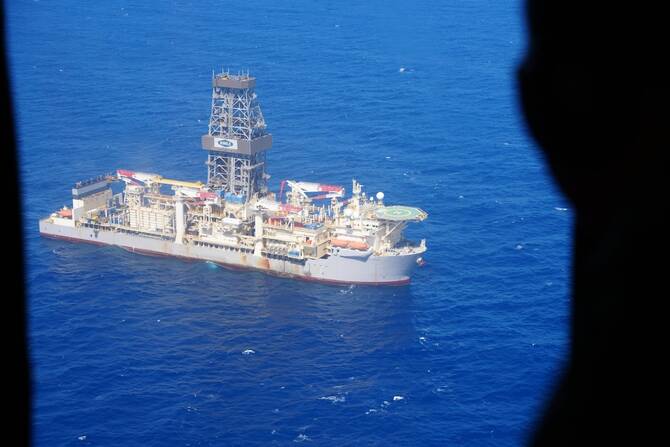
This photo taken on Jan. 23, 2026 shows an aerial view of the Malampaya Natural Gas Power Project, the Philippines’ most important source of indigenous natural gas. (Armed Forces of the Philippines)
Short Url
Updated 28 January 2026
Follow

Philippines steps up security at newly found gas field near South China Sea

  • New reservoir believed to contain enough gas to power 5.7m households per year
  • Philippines, China have been involved in a series of tense incidents in disputed waters

MANILA: The Philippine military and coastguard have stepped up security around a newly announced natural gas discovery, Malampaya East-1, off the island of Palawan, bordering the disputed South China Sea.

The undersea reservoir is estimated to contain about 2.8 billion cubic meters (98 billion cubic feet) of gas, enough to power about 5.7 million households per year.

It was discovered around 5 km east of the main Malampaya gas field, the Philippines’ most important natural gas field, which supplies fuel to major power plants on the main island of Luzon and was projected to decline considerably in a few years.

“Malampaya is not just an installation, it is a lifeline of our energy security,” Col. Francel Padilla, spokesperson of the Armed Forces of the Philippines, told reporters late on Tuesday.

“When we protect Malampaya, we are not only defending our territory. We are protecting the nation’s power source, economy, and future.”

A joint task force commanded by the AFP will conduct “continuous monitoring, readiness and presence to ensure that no (hostile) force will disrupt our critical infrastructure,” she added.

The new gas field discovery comes as the Philippines faces a growing Chinese presence in the South China Sea in recent years, with their coast guards and navy ships having been involved in a series of tense incidents.

President Ferdinand Marcos Jr. has ordered the Philippine Coast Guard to “keep a tight watch” over Malampaya to secure the country’s energy resources, Presidential Communications Office Undersecretary and Palace Press Officer Claire Castro said during a press briefing last week.

The PCG has since announced the deployment of its 97-meter offshore patrol vessel to secure Malampaya East, along with two 44-meter patrol vessels and aerial assets.

Malampaya East-1 lies within the Philippines’ exclusive economic zone, a 370 km stretch of water from the country’s coastline, where Manila has exclusive rights to explore and harness resources under the 1982 UN Convention on the Law of the Sea.

It is located near the disputed waters of the South China Sea, a strategic waterway and resource-rich area where the Philippines, China and several other countries have overlapping claims.

Beijing has continued to maintain its expansive claims of the area, despite a 2016 international tribunal ruling that China’s historical assertion to it had no basis.


In rare overlap, Chinese Muslims observe Ramadan with Lunar New Year

Updated 6 sec ago
Follow

In rare overlap, Chinese Muslims observe Ramadan with Lunar New Year

  • Lunar New Year started on Feb. 17 and is celebrated for another two weeks
  • Chinese Indonesians make up about 3 percent of the Indonesian population

JAKARTA: Every year, on the first day of Lunar New Year, Febriani visits relatives and gathers for a feast with her Chinese Muslim family, part of a long-standing tradition honoring their ethnic heritage.

But this year, as Thursday marks the beginning of Ramadan, she is celebrating two important occasions within the same week, in a rare overlap that last took place in 1995.

“I’m very happy and grateful that Lunar New Year and Ramadan are celebrated so closely. I observe both every year, so it’s truly special,” she told Arab News.

Widely observed across Asia, the Lunar New Year or Chinese New Year festival is believed to date back to the 14th century B.C., to the times of the Shang Dynasty, China’s earliest ruling dynasty, when people celebrated good harvests.

In 2026, it started on Feb. 17 and is celebrated for another two weeks. For many, celebrations typically involve elaborate feasts, giving children pocket money in red envelopes, and watching dragon dance parades.

In Indonesia, Chinese-descent citizens make up an estimated 3 percent of the country’s Muslim-majority population of more than 280 million. While most are either Buddhists or Christians, a small minority professes Islam.

For 25-year-old Febriani, both Lunar New Year and Ramadan are equally meaningful.

“The two celebrations teach us to strengthen bonds, to share with one another, and to become closer to family,” she said.

“They are both important to me because they happen only once every year and they’re always an occasion to gather with the extended family. It is also a chance to self-reflect and strengthen relationships with your loved ones.”

For Naga Kunadi, whose family lives in Central Java’s Cepu district, Chinese New Year is all about embracing his ethnic identity.

Earlier in the week, his family was busy preparing for the new year’s feast, which was a fusion of Chinese and Indonesian dishes, such as claypot tofu, meatball soup and shumai, or steamed dumplings.

“To celebrate Chinese New Year, we prepared halal Chinese food at home. It’s also a way to introduce to my children the traditions from our Chinese side, but there’s a bit of a fusion because my wife is Javanese,” Kunadi told Arab News.

Kunadi, an Islamic teacher at the Lautze Mosque in Jakarta, sees both Chinese New Year and Ramadan as opportunities to teach important life values for his two children. 

Upholding Chinese New Year traditions with his family is for him a way of preserving his ethnic heritage.

“We want to preserve cultural values as long as it does not clash with our religion,” he said.

“If we leave our culture behind, we might lose our identity, so this is something I want to teach my children.”

The fasting month of Ramadan, on the other hand, gives him a chance to teach and practice honesty.

“I want to focus on the religious and moral aspects during the holy month of Ramadan, when we practice honesty on a personal level,” Kunadi said.

“There’s always an opportunity to eat or snack in secret without anybody knowing, but we train ourselves not to do that. For me, Ramadan is a time for everyone to put honesty into practice, including myself and my children.”