

Greenland should hold talks with the US without Denmark, opposition leader says

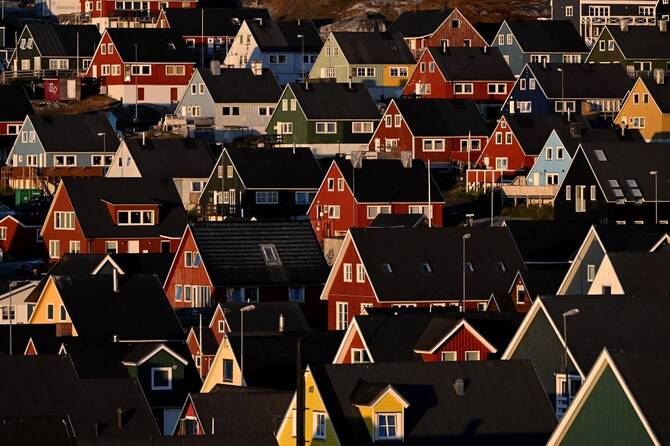
Trump has recently stepped up threats to take over Greenland. (AFP)
Short Url
Updated 08 January 2026
Follow

Greenland should hold talks with the US without Denmark, opposition leader says

  • All Greenlandic ‍parties want independence but differ on how, and when, to achieve it

COPENHAGEN: Greenland should hold direct talks with ​the US government without Denmark, a Greenlandic opposition leader told Reuters, as the Arctic island weighs how to respond to President Donald Trump’s renewed push to bring it under US control.
Trump has recently stepped up threats to take over Greenland, reviving an idea he first floated in 2019 during his first term in office.
Greenland is strategically located between Europe and North America, making it a critical site for the US ballistic missile defense system. Its rich mineral resources also fit Washington’s goal of reducing dependence on China.
The ‌island is ‌an autonomous territory of the Kingdom of Denmark. It has ‌its ⁠own ​parliament ‌and government, but Copenhagen retains authority over foreign affairs and defense.
“We encourage our current (Greenlandic) government actually to have a dialogue with the US government without Denmark,” said Pele Broberg, the leader of Naleraq, the largest opposition party and the most prominent political voice for Greenland’s independence.
“Because Denmark is antagonizing both Greenland and the US with their mediation.”
Naleraq, which strongly advocates a rapid move to full independence, doubled its seats to eight in last year’s election, winning 25 percent of the ⁠vote in the nation of just 57,000.
Although excluded from the governing coalition, the party has said it wants a ‌defense agreement with Washington and could pursue a “free association” ‍arrangement — under which Greenland would receive US ‍support and protection in exchange for military rights, without becoming a US territory.
All Greenlandic ‍parties want independence but differ on how, and when, to achieve it.
Government says direct talks not possible

Greenlandic Foreign Minister Vivian Motzfeldt said Greenland could not conduct direct talks with the US without Denmark because it is not legally allowed to do so.
“We must respect the law, and we ​have rules for how to resolve issues in the Kingdom,” she told Sermitsiaq daily late on Wednesday.
The Danish and Greenlandic governments did not immediately reply ⁠to requests for comment on Broberg’s remarks.
The comments come ahead of a planned meeting between the Danish and Greenlandic foreign ministers and US Secretary of State Marco Rubio next week to address tensions between NATO allies.
Motzfeldt said it was important to set Greenland’s relationship with Washington on a steady course.
“My greatest hope is that the meeting will lead to a normalization of our relationship,” she told Sermitsiaq.
Rubio appears not to favor a military operation, according to France’s foreign minister. But others in the Trump administration say the option is on the table.
“We are going to make sure we defend America’s interests,” US Vice President JD Vance told Fox News in an interview aired late on Wednesday. “And I think the president is ‌willing to go as far as he has to make sure he does that.”
(Reporting by Tom Little and Stine Jacobsen in Copenhagen; additional reporting by Soren Jeppesen; writing by Gwladys Fouche; Editing ‌by Ros Russell)


Top Australian writers’ festival canceled after Palestinian author barred

Updated 4 sec ago
Follow

Top Australian writers’ festival canceled after Palestinian author barred

SYDNEY: One of Australia’s top writers’ festivals was canceled on Tuesday, after 180 authors boycotted the event and its director resigned saying she could not ​be party to silencing a Palestinian author and warned moves to ban protests and slogans after the Bondi Beach mass shooting threatened free speech.
Louise Adler, the Jewish daughter of Holocaust survivors, said on Tuesday she was quitting her role at the Adelaide Writers’ Week in February, following a decision by the festival’s board to disinvite a Palestinian-Australian author.
The novelist and academic Randa Abdel-Fattah said the move to bar her was “a blatant and shameless act of anti-Palestinian racism ‌and censorship.”
Prime ‌Minister Anthony Albanese on Tuesday announced a national day ‌of ⁠mourning ​would ‌be held on January 22 to remember the 15 people killed in last month’s shooting at a Jewish Hanukkah celebration on Bondi Beach.
Police say the alleged gunmen were inspired by the Islamic State militant group, and the incident sparked nationwide calls to tackle antisemitism, and prompted state and federal government moves to tighten hate speech laws.
The Adelaide Festival board said on Tuesday its decision last week to disinvite ⁠Abdel-Fattah, on the grounds it would not be culturally sensitive for her to appear at the literary ‌event “so soon after Bondi,” was made “out of respect ‍for a community experiencing the pain ‍from a devastating event.”
“Instead, this decision has created more division and ‍for that we express our sincere apologies,” the board said in a statement.
The event would not go ahead and remaining board members will step down, it added.
Former New Zealand Prime Minister Jacinda Ardern, British author Zadie Smith, Australian author Kathy Lette, Pulitzer Prize-winning American Percival ​Everett and former Greek finance minister Yanis Varoufakis are among the authors who said they would no longer appear at the festival ⁠in South Australia state, Australian media reported.
The festival board on Tuesday apologized to Abdel-Fattah for “how the decision was represented.”
“This is not about identity or dissent but rather a continuing rapid shift in the national discourse around the breadth of freedom of expression in our nation following Australia’s worst terror attack in history,” it added.
Abdel-Fattah wrote on social media that she did not accept the apology, saying she had nothing to do with the Bondi attack, “nor did any Palestinian.”
Adler earlier wrote in The Guardian that the board’s decision to disinvite Abdel-Fattah “weakens freedom of speech and is the harbinger of a less free nation, where lobbying and political ‌pressure determine who gets to speak and who doesn’t.”
The South Australian state government has appointed a new festival board.