- Wednesday’s liftoff will make Zeeshan Ali the first foreign visitor to China’s Tiangong space station
- It follows expanding bilateral space cooperation, including Chinese launches of Pakistani satellites
ISLAMABAD: China on Tuesday unveiled the crew for its Shenzhou 24 spacecraft ahead of this week’s launch, with a Pakistani astronaut set to become the first foreign visitor to its Tiangong space station.
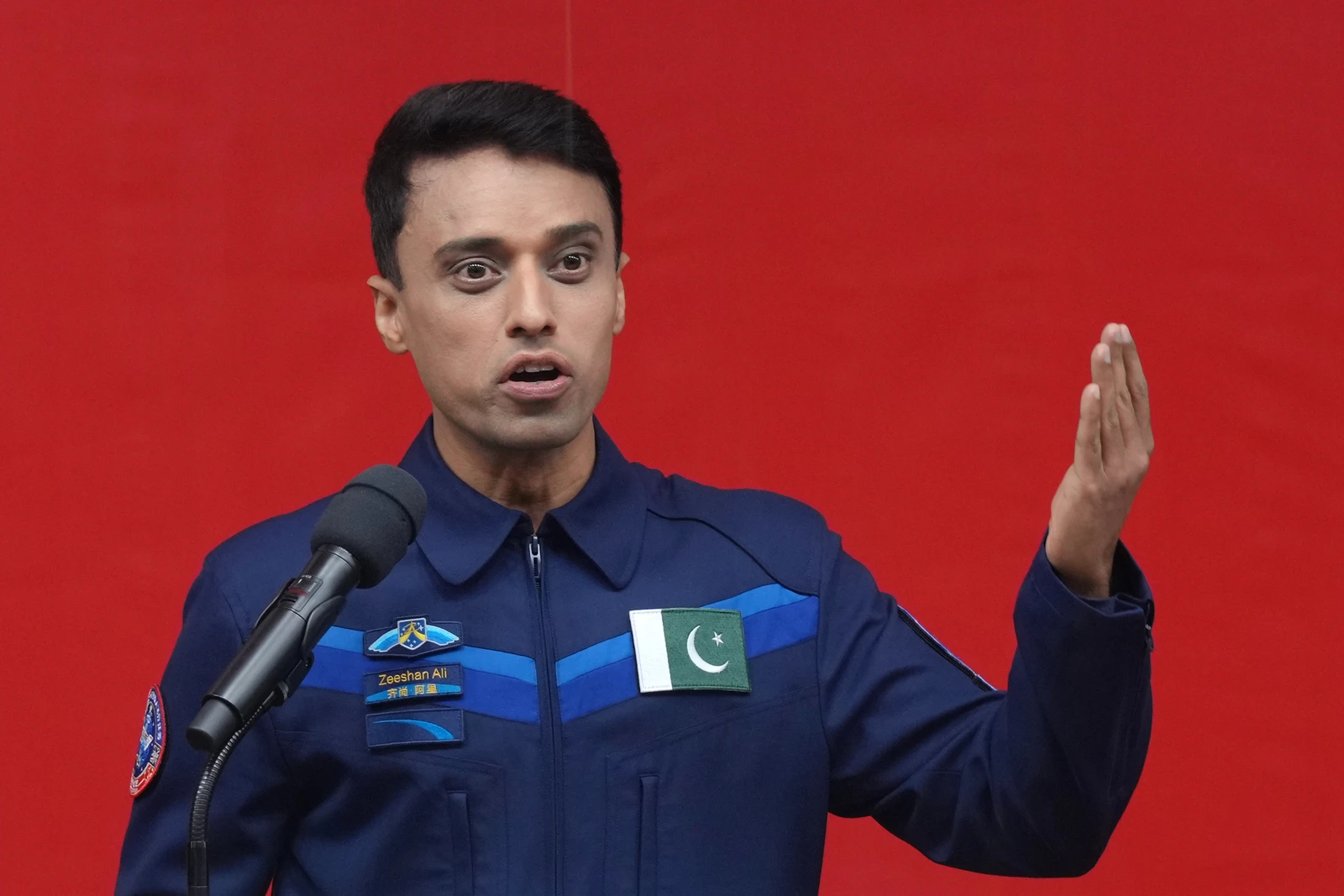
The China Manned Space Agency announced that Pakistani astronaut Muhammad Zeeshan Ali, 40, will carry out the mission with his Chinese colleagues Tang Hongbo, 51, and Wu Yi, 39, according to Chinese official news agency Xinhua. The agency said the spacecraft was scheduled to launch from the Jiuquan Satellite Launch Center in northwest China on Wednesday morning.
The mission will make Ali the first foreign visitor to China’s Tiangong space station, extending bilateral cooperation beyond satellite launches to human spaceflight. Pakistan and China signed an agreement in Feb. 2025 to train two Pakistani pilots, Ali and Khurram Daud, for the mission.
Ali would carry out a short-term mission as a payload specialist, according to Chinese state broadcaster CCTV. His mission will be to carry out four scientific projects in the fields of biotechnology and materials, and he is set to conduct an in-orbit experiment on photosynthetic microorganisms.
“I want to honor both of our astronauts, Muhammad Zeeshan Ali and Khurram Daud, selected for final training. They were chosen from among Pakistan’s finest pilots and scientists. They trained in centrifuges and simulators, in emergency drills and in a new language. Both performed exceptionally well in training,” Pakistani Planning Minister Ahsan Iqbal, who is currently in China, said on X.
“Though Zeeshan Ali will fly tomorrow both have already made Pakistan proud.”
The Shenzhou-24 spacecraft and its Long March-2F rocket were moved to the launch area on Nov. 17 for final preparations.
Pakistan’s space agency said on Sunday that China had successfully completed a launch rehearsal for the spacecraft at the Jiuquan Satellite Launch Center, where all three crew members successfully completed the required pre-flight procedures.
The mission follows years of expanding space cooperation between Pakistan and China, including Chinese launches of Pakistani satellites and plans to send a Pakistani-built rover aboard China’s Chang’e-8 lunar mission around 2028.
China completed construction of its Tiangong space station in 2022 and has sought to expand international participation in its space program as it works toward landing astronauts on the Moon by 2030.