- Minister Ahsan Iqbal says Islamabad aims to achieve a lunar landing by 2035
- He says Pakistan needs space technology to tackle climate, water challenges
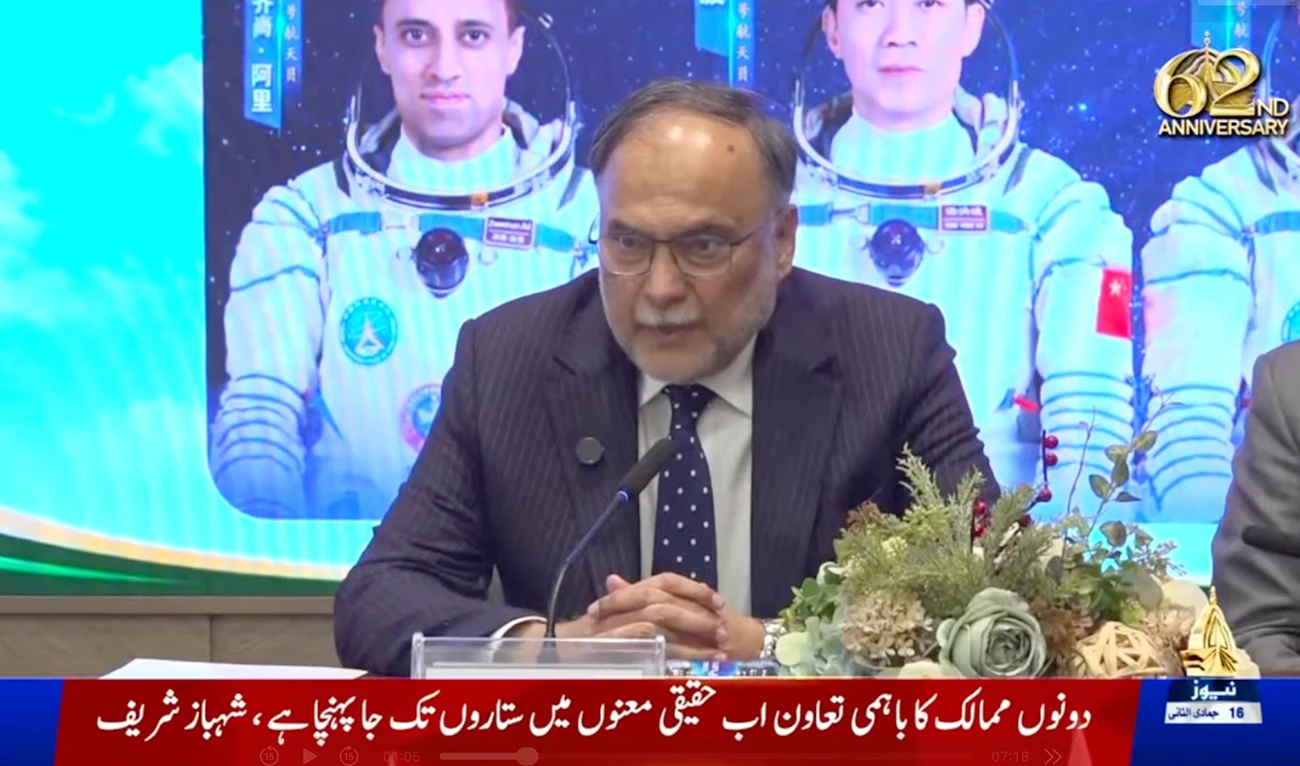
ISLAMABAD: Pakistan is looking to send a rover to the moon with Chinese assistance as part of its longer-term ambition to achieve a lunar landing by 2035, Planning Minister Ahsan Iqbal said on Thursday, a day after the country’s first astronaut successfully entered orbit.
The remarks come as Pakistan seeks to build on decades of space cooperation with China, moving beyond satellite development and its first human spaceflight toward acquiring the scientific and technological capabilities needed for its own lunar exploration mission.
Pakistani astronaut Muhammad Zeeshan Ali arrived at China’s Tiangong space station on Wednesday aboard the Shenzhou-24 spacecraft, becoming the first foreign astronaut to enter the Chinese orbital facility.
Pakistan also plans to send a domestically developed rover aboard China’s Chang’e-8 lunar mission, expected around 2028, to gain experience in operating scientific equipment on the moon’s surface ahead of its own planned landing.
“With, again, help of China, we hope that we will be able to actualize our lunar ambitions,” Iqbal said during a televised news conference at the Pakistani embassy in Beijing.
The minister said Pakistan hoped to send a rover aboard the next Chinese lunar mission, adding: “That will be critical for our own lunar program to land on moon by 2035.”
Pakistan and China signed an agreement in February 2025 to train Pakistani astronauts, expanding a partnership that had previously focused largely on satellite launches. China, meanwhile, is working toward landing its own astronauts on the moon by 2030.
Iqbal said space cooperation represented a new phase in bilateral relations following years of Chinese investment in Pakistan’s energy, transport and communications infrastructure under the multibillion-dollar China-Pakistan Economic Corridor.
“This is not the finish line, this is the beginning of a new partnership for us to advance space exploration,” he said.
Beyond lunar exploration, Iqbal said Pakistan needed to develop its space capabilities to address immediate economic and environmental challenges, particularly its vulnerability to climate change.
Referring to the devastating floods of 2022 and 2025, he said satellite technology could help Pakistan improve early warning systems, coordinate relief operations and strengthen its disaster response capabilities.
“Likewise, because of climate change, we are facing serious challenges to our food security,” he said, stressing the need to modernize agriculture, develop weather-resistant crop varieties and manage water resources more efficiently.
Iqbal also pointed to tensions with neighboring India over the Indus Waters Treaty, saying Pakistan faced the twin challenges of climate change and uncertainty over its water supplies.
He said satellite technology could also help Pakistan manage its growing urban centers and improve transport, logistics and communications.