- Islamabad says Israeli diplomat’s credentials were received under UN procedures, not through bilateral engagement
- Foreign Office says Pakistan, Saudi Arabia and Türkiye to review defense pact at Islamabad meeting later this month
ISLAMABAD: Pakistan said on Friday its position on Israel remained unchanged after its envoy in Geneva received the credentials of an Israeli diplomat in his capacity as president of a UN disarmament forum, while confirming plans to host Saudi Arabia and Türkiye for talks on their trilateral defense pact later this month.
The clarification followed questions over an interaction between diplomats from Pakistan and Israel, which have no formal diplomatic relations. Islamabad does not recognize Israel and has long supported the establishment of an independent Palestinian state, making even procedural contact between their representatives a sensitive matter.
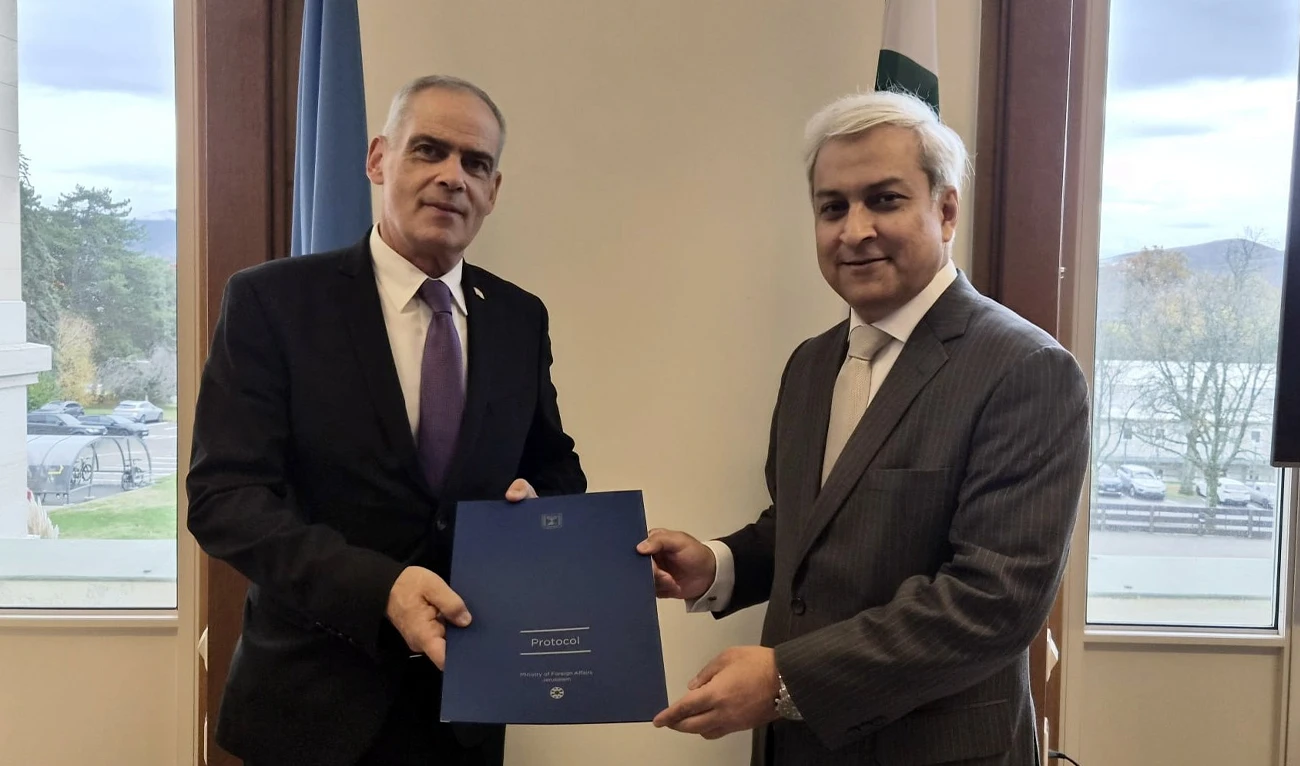
Foreign Office spokesperson Sajjad Haider Khan said Tahir Hussain Andrabi, Pakistan’s permanent representative to the United Nations in Geneva, had received the credentials of Israel’s incoming representative, Jonathan Peled, solely in his official capacity as president of the Conference on Disarmament.
“It was purely a procedural act undertaken on behalf of the conference,” he told reporters at a weekly briefing in Islamabad. “There was no bilateral engagement involved, and the exchange was entirely procedural in the context of the Conference on Disarmament, with no bearing on Pakistan’s national position.”
The Conference on Disarmament, established in 1979, is a 65-member multilateral forum tasked with negotiating international arms control and disarmament agreements. Its presidency rotates among member states, with the presiding representative responsible for receiving credentials from newly appointed diplomats.
Khan said representatives from Croatia, Ireland, Germany, Malaysia and Bangladesh had also presented their credentials under the same procedures.
“Under the established rules and practices of the conference, newly appointed permanent representatives accredited to the CD present their credentials to its incumbent president, whoever holds that position at the time,” he said.
The spokesperson reiterated Pakistan’s longstanding position in favor of a sovereign Palestinian state based on pre-1967 borders, with East Jerusalem as its capital.
His clarification came as Islamabad condemned renewed Israeli military operations in Gaza, accusing Israel of violating the ceasefire and undermining international efforts to secure lasting peace.
Israeli tanks advanced into central Gaza earlier this week, with the Israeli military saying it was targeting Hamas infrastructure outside areas under its control. The ceasefire has faced repeated strains amid accusations of violations by both Israel and Hamas.
“Pakistan strongly condemns the Israeli military incursions into central Gaza,” Khan said. “Military escalation constitutes a serious violation of the ceasefire agreement and undermines ongoing international efforts to consolidate peace in Gaza.”
He said Deputy Prime Minister and Foreign Minister Ishaq Dar had joined his counterparts from 14 other countries on November 19 in calling for an end to the escalation and full implementation of the peace plan.
Pakistan also supported Iran’s call for an extraordinary meeting of foreign ministers of the Organization of Islamic Cooperation on Gaza, with Khan saying Islamabad and Tehran shared a common position on the Palestinian issue.
“Both the countries have been staunch supporters of the Palestinian cause, and Pakistan will be there in any way that is possible,” he said.
MAKKAH DEFENSE PACT
Separately, the spokesperson confirmed that Pakistan, Saudi Arabia and Türkiye were preparing to meet in Islamabad toward the end of November to review progress on their trilateral defense agreement and strengthen coordination on its implementation.
The three countries signed the Makkah Joint Defense Agreement in the Saudi holy city on August 7, committing to treat an armed attack on one member as an attack on all, in a significant step toward collective security cooperation.
The planned meeting follows an announcement earlier this week by Deputy Prime Minister Dar that the agreement’s top-level security committee would convene in Islamabad before the end of the month.
“The meeting will provide an opportunity to review progress under the agreement, strengthen institutional coordination — because you are aware that it’s in the process of evolution still — and discuss matters of mutual interest,” Khan said.
He said the meeting had been agreed upon by the three participating countries, although its exact date, program and detailed agenda had yet to be announced.
The pact comes amid heightened regional security concerns and reflects efforts by Pakistan, Saudi Arabia and Türkiye to deepen defense cooperation and establish mechanisms for responding to shared threats.
Khan reiterated that the agreement was intended for collective defense rather than confrontation with other countries.
“The agreement is defensive in nature,” he said. “It is not directed against any country. We have been repeating this. Pakistan remains fully committed to this agreement.”