Saudi Arabia regulates grazing to preserve nature, boost rural economies

https://arab.news/pdffu
In a strategic move that underscores the Kingdom’s commitment to safeguarding its natural resources and preserving one of its most significant cultural legacies, Saudi Arabia is advancing with determination the regulation of its grazing sector, as part of a national approach aimed at achieving a balanced integration of environmental, economic and social development.
Grazing is no longer regarded as simply a traditional activity; it has emerged as a fundamental component of national sustainability policies. Natural rangelands account for approximately 73 percent of the Kingdom’s land area and represent a critical resource for the support of livestock production and the rural economy.
This transition comes at a time when rangelands are confronted with serious environmental challenges. Studies indicate that nearly 70 percent of rangelands are affected by degradation resulting from unregulated practices and climate factors. There is therefore a need for scientific, systematic interventions to restore balance to these vital ecosystems, transforming them from vulnerable resources into the foundations of sustainable development.
Reflecting the commitment of the wise Saudi leadership, a directive has been issued to designate 26 grazing sites across the Kingdom’s regions, covering a total area of approximately 8 million hectares (80,000 sq. km).
This decision represents a qualitative shift in rangeland management, with the aim of protecting vegetation cover from unregulated grazing, regulating the movement of herders, and localizing grazing activities in a manner that ensures the sustainability of natural resources.
The National Center for Vegetation Cover Development and Combating Desertification aspires to play a vital role in helping to realize this ambitious vision, by safeguarding these sites and conducting rigorous scientific studies to assess the condition of vegetation cover and determine grazing capacity — that is to say, the ideal number of livestock an area can sustain without compromising its regenerative ability.
To date, these studies have been completed at 10 sites and serve as the scientific foundation for issuing grazing permits, and defining authorized grazing periods and designated areas.
Grazing regulation in the Kingdom is implemented within specific seasons that respect the natural life cycle of vegetation. Grazing is permitted only after plants have dispersed their seeds, ensuring the completion of their natural reproduction cycles and their ability to regenerate and grow during the following season. During sensitive growth periods, grazing is suspended to protect vegetation cover from depletion.
In practice, the regulation of grazing has delivered notable outcomes that affirm its economic and social viability.
Meshal Al-Harbi
This scientific approach to grazing management enhances the sustainability of rangeland and helps achieve a careful balance between the benefits of grazing and the preservation of natural resources for future generations.
In practice, the regulation of grazing has delivered notable outcomes that affirm its economic and social viability.
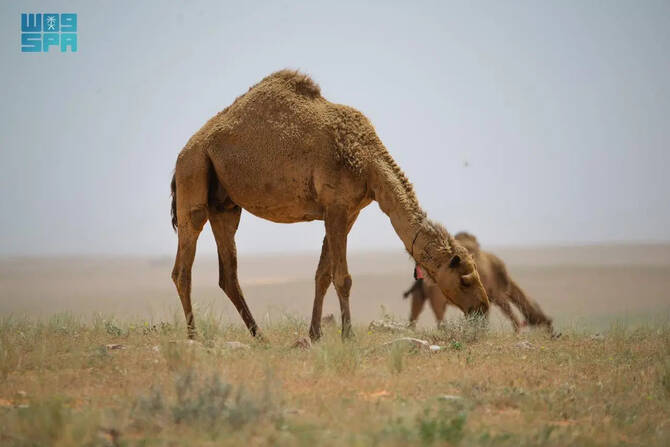
In Jabla National Park, located in Al-Dawadmi governorate in Riyadh region, a pioneering experiment was carried out to regulate camel grazing through the issuance of official permits to their owners. After only one grazing season, a field survey indicated a 76 percent reduction in the cost of manufactured feed as a result of the increased reliance on rich, natural rangelands and improved productivity.
In the Ma’ila rangelands of the Northern Borders Province, sheep grazing was organized for approximately 7,000 animals. This resulted in a 100 percent reduction in feed costs during the grazing season; in other words, complete grazing self-sufficiency through the use of local natural resources.
Such models have strengthened the trust between herders and the center, by demonstrating that environmental protection can result in direct economic benefits for local communities.
The concept of grazing regulation extends to include preventive grazing in natural rangelands, natural parks, valleys and mountain forests, where dry vegetation accumulates during certain seasons.
By permitting organized grazing in these areas, the excess biomass is utilized to lower the risk of fires, positioning grazing as an effective environmental-protection tool that contributes to the conservation of biodiversity and a reduction in emissions as a result of burning vegetation.
As part of the technological transformation of the sector, the center has launched an electronic system for issuing grazing permits through its “Nabati” platform, marking a step forward in the comprehensive automation of grazing-regulation processes.
The platform enables herders to submit applications electronically and monitor the status of their permits, while linking geographic and environmental data to ensure regulatory compliance and allocate grazing activities in line with the capacities of each site.
This digital transformation represents a qualitative shift toward the smart and sustainable management of natural rangelands.
The regulation of grazing in the Kingdom is not merely an environmental project; it is an integrated national vision aimed at protecting nature, supporting the rural economy, strengthening food security, and preserving a rich pastoral legacy.
Through scientific plans, digitization and partnerships with local communities, the Kingdom is steadily advancing in its efforts to become a regional model for rangeland sustainability and development, in line with the objectives of Saudi Vision 2030 and the Saudi Green Initiative.
• Meshal Al-Harbi is director general of the General Department of Natural Rangelands at the National Center for Vegetation Cover Development and Combating Desertification.