


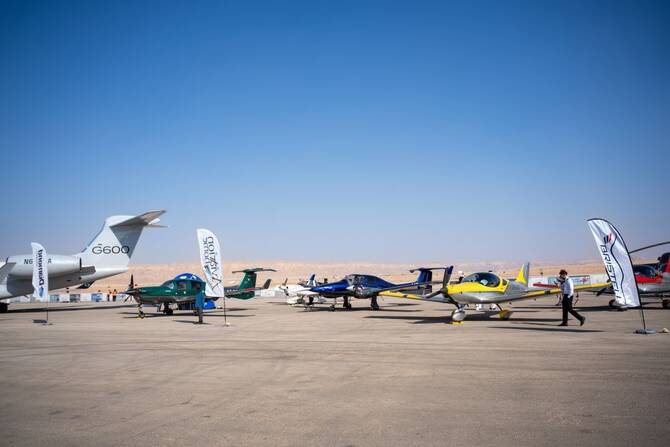


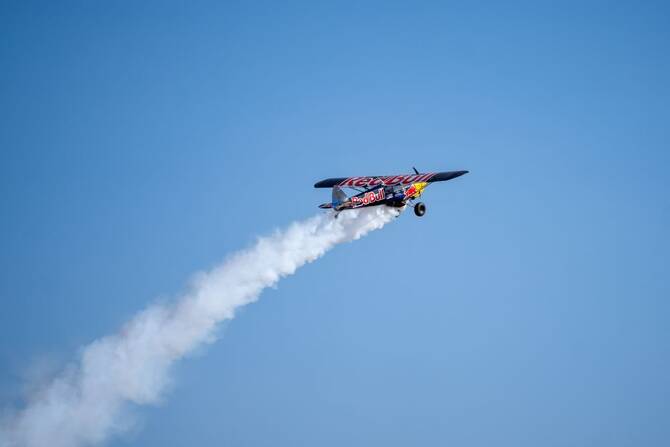
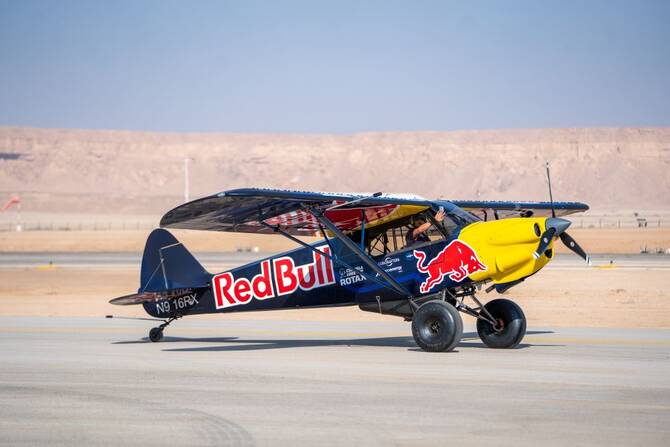

RIYADH: The Sand and Fun General Aviation Airshow has started at Thumamah Airport, putting the full range of Saudi Arabia’s aviation sector in the spotlight until Nov. 29.
Fully equipped air ambulances sit alongside urban air mobility vehicles, highlighting the evolution of aviation to support emergency response teams and the future of city transport.
It presents a vision of the sky as a space serving multiple needs, showing how aviation plays a role in improving quality of life while supporting the Kingdom’s economic transformation.
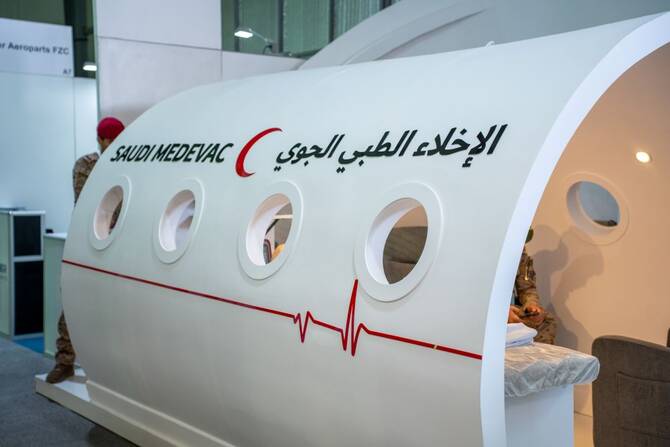
As aerial displays entertain the crowds, other stories are told on the ground — particularly in the Alpha Star Aviation Services pavilion, where the company’s approach to air medical evacuation is explained.
Abdullah Alshammari, general manager of medical evacuation, emphasized its aim of providing safe, high-quality evacuation services to citizens and residents across the Kingdom.
“Our vision at Alpha Star goes beyond merely transporting a patient from one point to another,” he said. “We also possess the capability to perform international medical evacuation flights.”
All medical crew members receive comprehensive instruction to handle in-flight emergencies, in line with Saudi General Authority of Civil Aviation regulations.
“We work hand in hand with the most important health and emergency response bodies in the Kingdom. We have effective strategic partnerships with the Saudi Red Crescent Authority and the Ministry of Health,” said Alshammari.
The company’s fleet ranges from fully equipped aircraft like the Airbus A320, functioning as a flying ICU, to smaller planes suited for remote airports. “All our aircraft are not merely means of transport; they are fully integrated intensive care units flying in the sky,” he added.
Flight Paramedic Khalid Al-Ghamdi said the team operated around the clock. Their average response time “does not exceed three hours from the moment the emergency call is received until the aircraft's takeoff,” including preparation and flight planning.
For neonatal or highly specific cases, specialized flight incubators can be installed quickly within the three-hour window. Crews are trained to manage a range of scenarios, from multi-trauma injuries to cardiac and neurological emergencies.
“We do not merely transport patients; we transport hope and contribute to enhancing the Kingdom's position as a regional and global hub for healthcare,” Al-Ghamdi added.
Across the air show a different vision of the future is emerging, focused on quiet, sustainable mobility in urban areas.
At a neighboring booth, FlyNow Arabia presents its electric vertical take-off and landing aircraft, the eCopter, marketed as a practical, affordable alternative to the more complex and often costly “flying car” concept.
CEO Yvonne Winter told Arab News: “The eCopter is engineered for a specific purpose — to be a practical workhorse, not a science-fiction fantasy.”
The modular helicopter’s design means manufacturing costs are up to 10 times lower than competing eVTOL models, with the lightweight carbon fiber structure improving energy efficiency and extending flight duration.
Winter said one of the eCopter’s immediate advantages was its low noise level, key to its use in urban environments: “At just 55 decibels, the eCopter is quieter than a household dishwasher running in your kitchen.”
Unlike companies developing autonomous, multi-modal vehicles, FlyNow uses proven autopilot systems.
Prioritizing certified technologies helped navigate regulatory processes more efficiently, Winter told Arab News. “We are building the sky’s utility vehicle, not a luxury toy,” she added.
The current eCopter model is fully electric, has no operational emissions, and can fly up to 50 km at 130 km/h while carrying two passengers or 200kg of cargo.
“This zero-emission capability aligns perfectly with the environmental pillars of Saudi Arabia’s Vision 2030,” she said, adding plans were already under way for a longer-range hybrid aircraft.
“We are actively establishing local manufacturing here in Saudi Arabia with support from the National Industrial Development Center and the Ministry of Investment,” she said. “Our goal is to position the Kingdom not just as a consumer, but as a regional hub and exporter of climate-friendly air mobility solutions.”


