

New Zealand defers vote on rare suspension of Indigenous lawmakers

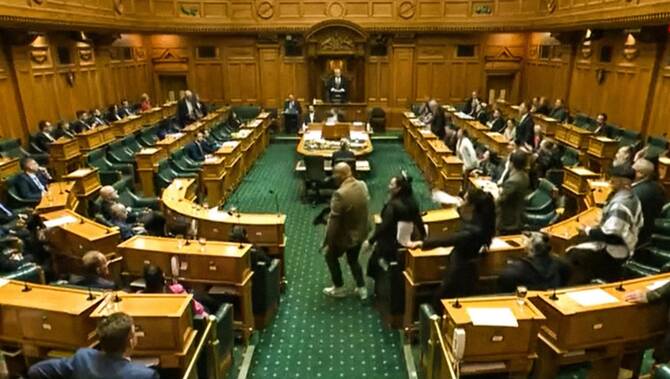
The haka was traditionally a way for Maori to welcome visiting tribes or to invigorate warriors ahead of battle. (FILE/AFP)
Short Url
Updated 20 May 2025
Follow

New Zealand defers vote on rare suspension of Indigenous lawmakers

  • The Te Pati Maori members performed the haka last November

SYDNEY: The New Zealand government on Tuesday deferred a vote over the rare suspension of three Indigenous lawmakers from parliament for performing a haka, the Maori ceremonial dance, during the reading of a contentious bill last year.

A parliamentary privileges committee last week recommended temporarily suspending three Te Pati Maori parliamentarians for acting in “a manner that could have the effect of intimidating a member of the house.”

The Te Pati Maori members performed the haka last November ahead of a vote on a controversial bill that would have reinterpreted a 184-year-old treaty between the British and Indigenous Maori that still guides policy and legislation.

Co-leaders Debbie Ngarewa-Packer and Rawiri Waititi should be suspended for 21 days and representative Hana-Rawhiti Maipi-Clarke for seven days, the committee said.

Chris Bishop, the leader of the house, said delaying the vote would allow the suspended members to participate in the federal budget on Thursday. The vote will take place following the budget, he said.

“Deferring consideration of the debate means all members will have the opportunity to debate and vote on the budget,” Bishop said.

Several protesters gathered outside the parliament in Wellington for the vote over the suspensions, and New Zealand media reported they might perform a haka in support of the Maori lawmakers.

Judith Collins, who heads the privileges committee and serves as attorney-general, told parliament that the haka forced the speaker to suspend proceedings for 30 minutes and that no permission had been sought to perform it.

“It’s not about the haka ... it is about following the rules of parliament that we are all obliged to follow and that we all pledged to follow,” Collins said.

Suspending lawmakers is rare in New Zealand’s parliament, with the last occasion in 1987, according to media reports.

The opposition Labour party called for a compromise and proposed censure instead of suspension.

The committee’s proposal is “totally out of line with existing parliamentary practice and is disproportionate to the allegations,” opposition leader Chris Hipkins said.

“We have never seen a sanction of this nature in New Zealand’s history before ... it is disproportionate. A sanction is appropriate, this level of sanction simply is not.”

The haka was traditionally a way for Maori to welcome visiting tribes or to invigorate warriors ahead of battle. It is now performed at important events as well as ahead of matches by New Zealand’s rugby teams.


Ex-Syrian intelligence officer appears in UK court charged with crimes against humanity

Updated 5 sec ago
Follow

Ex-Syrian intelligence officer appears in UK court charged with crimes against humanity

LONDON: A former member ‌of Syria's Air Force Intelligence attended a British court hearing via videolink on Tuesday charged with crimes against humanity and torture relating to the suppression of pro-democracy demonstrations ​in Damascus in 2011.
Salem Michel Al-Salem, 58, who now lives in Britain, appeared virtually at the hearing at London's Westminster Magistrates' Court from his home. He was wearing a breathing apparatus mask and the court was told he suffered from degenerative motor neurone disease.
Al-Salem is charged with three counts of murder as a crime against humanity relating to deaths in April and July 2011 "as part of ‌a widespread or ‌systematic attack against a civilian population with ​knowledge ‌of ⁠the attack".
He ​is ⁠also accused of three charges of torture relating to incidents in 2011 and 2012, and one of conduct ancillary to murder as a crime against humanity. He did not speak during the hearing and there was no indication as to how he would plead.
His lawyer Sean Caulfield told the court that Al-Salem was too unwell to confirm his ⁠name.
The seven charges were brought under a British ‌law that allows the prosecution of serious ‌international crimes committed abroad. The Crown Prosecution ​Service said it was the ‌first time it had brought charges of murder as crimes against ‌humanity.
In 2005, Afghan warlord Faryadi Zardad was convicted by a British court of torture that had taken place in Afghanistan.
Al-Salem, who has sought indefinite leave to remain in Britain, was a colonel in the Syrian Air Force ‌Intelligence department with oversight of the Information Branch in the district of Jobar, to the east of ⁠central Damascus, British prosecutors ⁠say.
He is accused of leading a group tasked with quelling the demonstrations, which mostly occurred during Friday afternoon prayers. Prosecutors say he gave his men orders to open fire on protesters, which led to the deaths of some individuals.
Prosecutors say he was also present at, or took part in, the torture of men at the Information Branch building.
Al-Salem was first arrested in central England in December 2021. His lawyer had sought an order to withhold his name, arguing it could pose a risk to his safety. England's ​Chief Magistrate Paul Goldspring rejected the ​application but ordered that his address not be made public.
He will next appear on Friday at London's Old Bailey court.