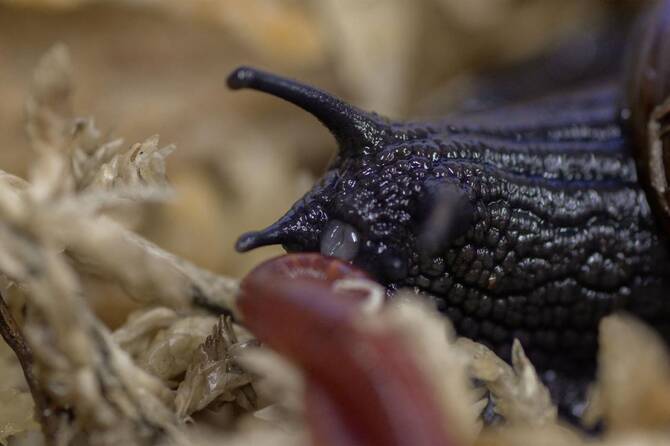
WELLINGTON: The strange reproductive habits of a large, carnivorous New Zealand snail were once shrouded in mystery. Now footage of the snail laying an egg from its neck has been captured for the first time, the country’s conservation agency said Wednesday.
What looks like a tiny hen’s egg is seen emerging from an opening below the head of the Powelliphanta augusta snail, a threatened species endemic to New Zealand.
The video was taken at a facility on the South Island’s West Coast, where conservation rangers attempting to save the species from extinction have cared for a population of the snails in chilled containers for nearly two decades.
The conditions in the containers mimic the alpine weather in their only former habitat — a remote mountain they were named for, on the West Coast of the South Island, that has been engulfed by mining.
Observing their habits
Lisa Flanagan from the Department of Conservation, who has worked with the creatures for 12 years, said the species still holds surprises.
“It’s remarkable that in all the time we’ve spent caring for the snails, this is the first time we’ve seen one lay an egg,” she said in a statement.
Like other snails, Powelliphanta augusta are hermaphrodites, which explains how the creatures can reproduce when encased in a hard shell. The invertebrate uses a genital pore on the right side of its body, just below the head, to simultaneously exchange sperm with another snail, which is stored until each creates an egg.
A long but slow reproductive life
Each snail takes eight years to reach sexual maturity, after which it lays about five eggs a year. The egg can take more than a year to hatch.
“Some of our captive snails are between 25 and 30 years old,” said Flanagan. “They’re polar opposites to the pest garden snail we introduced to New Zealand, which is like a weed, with thousands of offspring each year and a short life.”
The dozens of species and subspecies of Powelliphanta snails are only found in New Zealand, mostly in rugged forest and grassland settings where they are threatened by habitat loss.
They are carnivores that slurp up earthworms like noodles, and are some of the world’s largest snails , with oversized, distinctive shells in a range of rich earth colors and swirling patterns.
A political storm
The Powelliphanta augusta was the center of public uproar and legal proceedings in the early 2000s, when an energy company’s plans to mine for coal threatened to destroy the snails’ habitat.
Some 4,000 were removed from the site and relocated, while 2,000 more were housed in chilled storage in the West Coast town of Hokitika to ensure the preservation of the species, which is slow to breed and doesn’t adapt well to new habitats.
In 2011, some 800 of the snails accidentally died in a Department of Conservation refrigerator with faulty temperature control.
But the species’ slow survival continues: In March this year, there were nearly 1,900 snails and nearly 2,200 eggs in captivity, the conservation agency said.


![]()

Rare New Zealand snail is filmed for the first time laying an egg from its neck
Short Url
https://arab.news/ywz2c
Rare New Zealand snail is filmed for the first time laying an egg from its neck
- The habits of the threatened Powelliphanta augusta snail were once shrouded in mystery
- The video was taken at a facility on the South Island’s West Coast


Latest updates


© 2026 SAUDI RESEARCH & PUBLISHING COMPANY, All Rights Reserved And subject to Terms of Use Agreement.