
BEIRUT: About one in four people in Lebanon are expected to face acute food insecurity this summer as Israel’s military campaign in the south enters its third month, deepening a humanitarian crisis in a country already reeling from economic collapse and dwindling aid.
A new assessment by the Integrated Food Security Phase Classification, the global standard for measuring hunger and malnutrition, found that 1.24 million people, or nearly one-quarter of the population assessed, are expected to face high levels of acute food insecurity through August. The report classifies them as IPC Phase 3 or higher.
Published on April 29, the report said the situation was “worse than previously anticipated” due to the “rapid escalation of hostilities.” It raised the earlier projection of 961,000 people expected to be in IPC Phase 3 or above during the same period under an October 2025 analysis.
That warning has sharpened fears that Lebanon’s crisis is no longer just economic or political, but increasingly a matter of survival.

Aid groups distribute food and basic supplies to displaced families, in Bachoura neighbourhood in Beirut. (Reuters)
The deterioration has been driven by a widening conflict.
Since March 2, when the Lebanese armed group Hezbollah launched attacks on northern Israel in retaliation for the joint US-Israeli attacks on Iran on Feb. 28 that killed Supreme Leader Ali Khamenei, Israel has carried out a bombing campaign across Beirut’s southern suburbs, southern Lebanon and the eastern Bekaa Valley.
As the fighting has intensified, many in southern Lebanon, Hezbollah’s stronghold, have begun to fear the region is starting to resemble Gaza in the scale of destruction and displacement.
Even a US-mediated ceasefire announced on April 16 has offered little relief. Israeli attacks have continued, further eroding the basics of daily life for more than 1.2 million displaced Lebanese, including at least 390,000 children.
The displaced fled nearly one-quarter of Lebanon’s territory. About half sought shelter in public schools or tents set up in designated displacement areas. But as those sites became overcrowded, hundreds of others pitched tents along Beirut roadsides in scenes many described as catastrophic.
FASTFACTS
• Israeli attacks on Lebanon have killed at least 2,715 people and wounded 8,353 since March 2, according to the Lebanese Health Ministry.
• Despite a ceasefire in place since mid-April, Israel issued new evacuation orders on May 3 for villages in southern Lebanon beyond the Litani River.
The strain has been compounded by the collapse of basic services, a weak government response and international aid that remains far short of soaring needs, according to UN agencies. As a result, pressure on public services has only intensified.
For Hassan Harb, 73, the crisis is deeply personal. After fleeing his hometown of Kherbet Selem in southern Lebanon, he and his family spent 27 hours on the road trying to reach relatives in Beirut.
“When we arrived, we discovered that our relatives in Beirut’s southern suburbs had themselves become displaced,” he told Arab News.
The family now lives in a tent on the roadside near the Tayouneh roundabout at the entrance to Beirut’s southern suburbs.

A woman prepares food at the makeshift encampment in Beirut, Lebanon. (Reuters)
“We had no choice except to set up a small tent beside the wall of Beirut’s pine forest. It neither protects us from winter rain nor from the scorching sun,” Harb said.
While he and his wife sleep in the tent, their two daughters sleep in the family car. “We have been living like this for more than two months now,” he said.
The hardship has also cost Harb his livelihood. Before the war, he ran a small kiosk in his village selling tea and coffee.
“Now I am unemployed,” he said. “I used what little money I had left to buy this tent, and part of what remained was stolen. No one is helping us. We receive neither hot meals nor medical assistance. Since we were displaced, we have received only one box of canned food.
“No political party has checked on us — neither Hezbollah nor even the state itself,” he said. “We live only with the hope of returning home, and we pray that Israel has not destroyed our house.”
His daughter Fatima described the daily humiliations of displacement as she cooked potatoes in the tent.
“Meat has become a luxury,” she told Arab News. “We have no refrigerator, no kitchen, not even a bathroom.

A volunteer participates in the process for delivering meals for the displaced in a school-turned-shelter in Beirut. (Reuters)
“I go to the public restroom inside the park to wash my face, and when I want to shower, I go to a friend’s home nearby.”
For many families, however, returning home may not be an option. The scale of destruction has been immense.
A BBC Verify analysis found that more than 1,400 buildings were destroyed in less than two months, from March 2 to April 15. But BBC Verify said the real number is likely higher because access is restricted and satellite coverage is incomplete.
That destruction had been mounting even before the latest escalation. Looking at the period from Oct. 1, 2024, to Jan. 26, 2025, Amnesty International said more than 10,000 structures were severely damaged or destroyed in 26 Lebanese municipalities along the Israeli border.
Israel said in late March that it would occupy the area below the Litani River, about 19 miles from the Israel-Lebanon border, and destroy homes along the frontier to create a “buffer zone” in southern Lebanon and protect northern Israel from Hezbollah’s attacks.
Human Rights Watch said statements by Israeli Defense Minister Israel Katz, who vowed to destroy homes “in accordance with the Rafah and Beit Hanoun model in Gaza,” could amount to forced displacement and wanton destruction, which are war crimes.
But Israel’s military operations recently moved beyond that area.
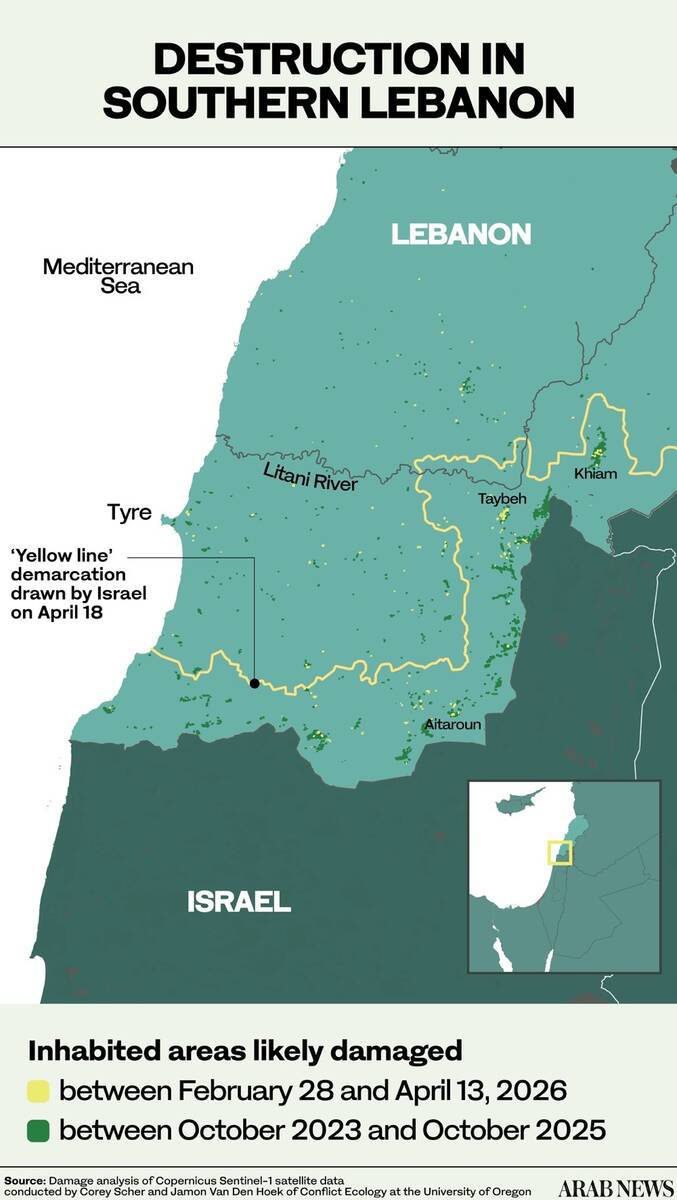
In early May, Israel issued new displacement orders in Lebanese towns and villages outside its current zone of occupation. Its operations have continued well beyond the Litani River, striking villages to which many displaced families had fled because they believed they were safer.
Entire households in Lebanon have lost their jobs and livelihoods, with many now surviving on charity.
The IPC assessment warns that the country now faces a compounding crisis, with food security being eroded from several directions at once.
Livelihoods have collapsed. Local markets in conflict-affected areas have been disrupted. Food and fuel prices are rising. Humanitarian food assistance is expected to fall short of demand.
The broader regional conflict, the report said, is also likely to pile pressure on fuel and transport costs, import prices, remittance flows, agricultural inputs, fertilizer costs and overall market confidence. Together, those pressures are expected to further hollow out household purchasing power across the country.
Some regions are being hit harder than others. The assessment singled out Baalbek and Hermel in the east, Akkar in the north, and the southern districts of Bint Jbeil, Marjayoun, Nabatieh and Tyre, along with Syrian and Palestinian refugee communities.
“The displaced found themselves overnight with no jobs, no homes, and no horizon,” Ziad Abdel Samad, executive director of the Arab NGO Network for Development, told Arab News.
“Those surviving on aid cannot be accurately counted,” he said. “We do not know exactly how to reach them all. There are several programs under the ministry of social affairs, but the assistance is extremely limited.”
Civil society groups have begun adapting to the scale of the crisis, he said, and coordination among NGOs, the ministry and international organizations has improved. Still, he said, the ministry is operating far beyond its means.
Abdel Samad said the risks extend beyond hunger alone.
“A social catastrophe is coming,” he warned. “The economic situation is fragile and the central bank has started sending signals of financial instability.”
Even as Arab and foreign donors have stepped up and relief efforts have become more organized, he said food security cannot be reduced to food availability alone.

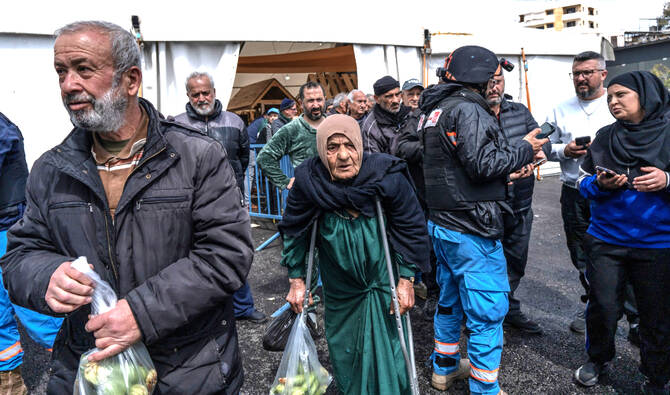
A man carries bags with food and basic supplies from an aid distribution to displaced families, in Bachoura neighbourhood in Beirut. (Reuters)
“Food security is not just about having food available,” he said. “It is about whether that food is safe. Is the quality healthy? Is drinking water clean? What about sanitation?”
UNHCR spokesperson Dalal Harb described the IPC report as a wake-up call.
“It signals that we could be heading toward acute food insecurity,” Harb told Arab News.
Displacement has become fluid and unpredictable, she said. Some families are considering whether to return, while others briefly go back for belongings before fleeing again. Some even commute daily between home and a shelter, unsure what the next day will bring.
There is no firm count of those back-and-forth movements, she said, but one figure stands out — in just three days during the ceasefire, Israeli strikes destroyed 428 homes in southern Lebanon and western Bekaa.
Harb said UNHCR has flexible programs and is working closely with the ministry of social affairs on the emergency response.
“All funds are channeled through the ministry, and under the SRSN program, 490,883 displaced people have benefited from cash assistance,” she said.
She added that UNHCR was among the parties involved in the Lebanese government’s urgent relief appeal to secure $300 million from the international community to meet the needs of about 1 million displaced people.
“UNHCR expects to receive $61 million from that assistance to help 600,000 people,” she said, adding that 40 percent of the relief aid had been received so far.
Rasha Abou Dargham, a spokeswoman in Lebanon for the World Food Program, said the country is facing one of the gravest food insecurity crises in its history.
“Lebanon is confronting a refugee crisis alongside economic fragility, soaring food prices, growing pressure on host communities and regional instability that continues to drive food costs even higher,” she told Arab News.
She said Lebanon had long been vulnerable to repeated shocks, but that the current crisis was especially devastating because of its deep impact on daily life.

Volunteers prepare food packages in the kitchen of a school-turned shelter in Beirut. (Reuters)
“Food security has been under threat since 2019, leaving the country in an extremely fragile position and poorly equipped to absorb any new shock,” she said.
The displacement crisis, she added, has become a major driver of need.
“Despite generous donor support, the needs remain immense and the crisis continues to deepen,” she said.
The Food and Agriculture Organization has also warned that the crisis is being worsened by disrupted livelihoods and heavy damage to the agricultural sector, which has yet to recover from the 2024 conflict.
FAO data shows the crisis is affecting all segments of society, with especially severe consequences for refugees and internally displaced people. Many, it said, are being forced to cut back on meals or adopt desperate coping strategies, including borrowing money or selling essential assets to survive.
According to the agency, many families are replacing meat with pasta and potatoes because the cost of nearly everything has become prohibitively high.
To meet urgent needs, the Lebanese government is considering reorganizing budget priorities, including redirecting loans originally allocated to infrastructure projects, after curbing public sector salary increases a few weeks ago.
Agriculture Minister Nizar Hani said that Lebanon has entered an “exceptionally dangerous phase.”

People receive food packages and other aid at the municipality center in Tyre, south Lebanon. (Reuters)
“Conflict, combined with mounting economic pressures, has pushed national food security into an unprecedentedly critical situation,” he told Arab News.
He said the share of people experiencing food insecurity and requiring a rapid, coordinated humanitarian response had risen from 18 percent to 24 percent.
Despite the difficulties facing agricultural production in southern Lebanon, along with the livestock and poultry sectors, Hani said other parts of the country were still producing enough to help maintain an acceptable level of food security.
He noted, however, that “opening Arab markets to Lebanese products and reopening the land corridor have become urgent priorities.”
“Safeguarding food security in Lebanon is now a shared national and international responsibility,” he said, adding that investment in agriculture is central to stability and to strengthening communities’ resilience in the face of successive crises.