

Israeli authorities raid East Jerusalem bookstore for second time in a month, arrest owner

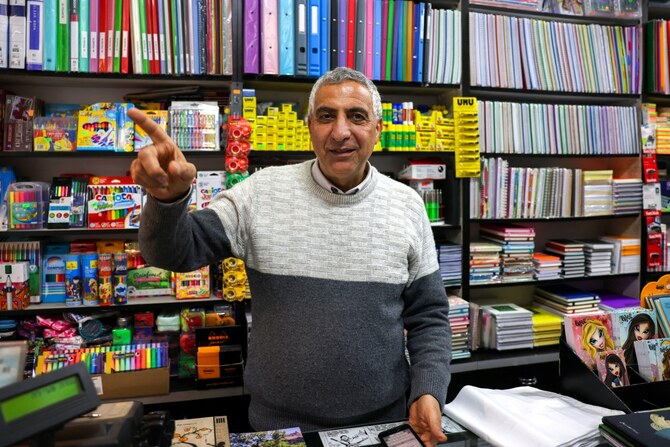
Imad Muna, owner of the Educational Bookshop in the Israeli-annexed east Jerusalem, said police confiscated about 50 books after searching the stock using Google Translate. (AFP/File)
Short Url
Updated 12 March 2025
Follow

Israeli authorities raid East Jerusalem bookstore for second time in a month, arrest owner

  • Police said raid followed a complaint from a man who visited the bookstore, claiming to have seen books containing inciting content
  • Educational Bookshop in East Jerusalem was raided in February amid similar accusation, sparking international outcry

LONDON: Israeli police have raided a prominent Palestinian bookstore in East Jerusalem for the second time in a month, seizing dozens of books and arresting one of the owners.

Local reports said 61-year-old co-owner Imad Muna was detained for several hours after Israeli officers arrived at the Educational Bookshop on Tuesday morning without a warrant. During the raid, they confiscated about 50 books after searching the stock using Google Translate.

“At 11:15 a.m., the police arrived at the store, and my parents were there at the time,” Muna’s son, Ahmad, said. “The police asked for the business licenses and reviewed the account books. I arrived, but they wouldn’t let me in. They went through the books, stacked a pile of books that they took.”

In February, police arrested Ahmad and Muna’s brother, Mahmoud, holding them for several days without the State Attorney’s office approval to launch an investigation. They were later placed under house arrest for five days but have not been charged.

During the first raid, police cited a children’s coloring book as evidence of incitement to terrorism.

Similar to the latest incident, authorities confiscated books based on titles, appearance, and authors, including works by British artist Banksy, Israeli historian Ilan Pappé, and US academic Noam Chomsky. Books containing visual elements associated with Palestine were also seized.

“They chose books by the cover, taking books that had a Palestinian flag, or just the word Palestine in the title,” another one of Muna’s brothers, Morad, said. “They were using Google Translate and took photos to send to their bosses.”

Police said the second raid followed a complaint from a man who visited the bookstore earlier that day, claiming to have seen books containing inciting content. Officers detained Muna “to verify his identity and details of the store,” police said, adding that they are reviewing three books seized during the operation.

“Based on the findings, a determination will be made on whether to refer the matter to the State Attorney’s office for further investigation into the suspected sale of inciting materials,” the statement said.

After Muna was released on Tuesday afternoon, most of the books were returned and the shop reopened.

However, the bookstore’s owners said the raids are part of an escalating effort by Israeli authorities to suppress Palestinian culture and should not be seen as isolated incidents.

Rights groups and intellectuals condemned the first raid as an attempt to create a “culture of fear” among Palestinians and an attack on freedom of expression.


Saudi Arabia ‘ideal partner’ in shaping next wave of intelligent age, communication minister tells WEF

Updated 23 January 2026
Follow

Saudi Arabia ‘ideal partner’ in shaping next wave of intelligent age, communication minister tells WEF

  • Abdullah Al-Swaha said aim was to “help the world achieve the next $100 trillion by energizing the intelligence age”

DAVOS: Saudi Arabia has accelerated efforts in “energizing the intelligent age,” making the Kingdom the world’s ideal partner in shaping the next wave of the technological age, said the minister of communication and information technology.

Speaking during a panel discussion at the World Economic Forum in Davos, Abdullah Al-Swaha said the aim was to “help the world achieve the next $100 trillion by energizing the intelligence age.”

He said the Kingdom was expanding global partnerships for the benefit of humanity and highlighted both local and international achievements.

“We believe the more prosperous the Kingdom, the Middle East, is, the more prosperous the world is. And it is not a surprise that we fuel 50 percent of the digital economy in the kingdom or the region,” he told the audience. He added the Kingdom fueled three times the tech force of its neighbors and, as a result, 50 percent of venture capital funding.

Al-Swaha said Saudi Arabia was focused both on artificial intelligence acceleration and adoption. At home, he said, the Kingdom was doubling the use of agentic AI in the public and private sector to increase worker productivity tenfold. He also cited the world’s first fully robotic heart transplant, which was conducted in Saudi Arabia.

“If we double down on talent, technology, and build trust with partners, we can achieve success,” he said. “And we are following the same blueprint for the intelligence age.”

He said the Kingdom aimed to be a “testbed” for innovators and investors. Rapid technological adoption and investment have boosted Saudi Arabia’s non-oil economy, with non-oil activities accounting for 56 percent of GDP and surpassing $1.2 trillion in 2025, ahead of the Vision 2030 target.

In terms of adoption, Al-Swaha said the Kingdom had introduced the Arabic-language AI model, Allam, to be adopted across Adobe product series. It has also partnered with Qualcomm to bring the first hybrid AI laptop and endpoints to the world.

“These are true testimonies that the kingdom is not going local or regional; we are going global,” he said.