‘Peace and stability are ultimate prerequisites for growth and prosperity,’ Indonesia’s president tells WEF

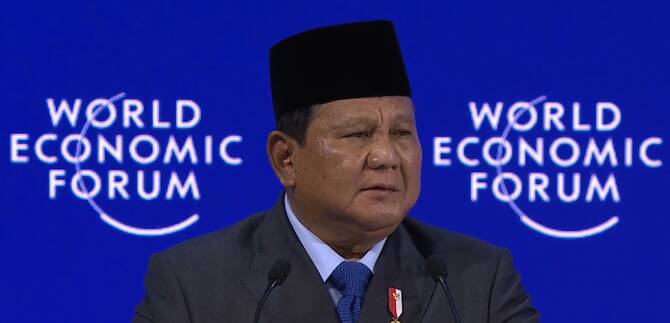
Indonesian President Prabowo Subianto during a special address before the World Economic Forum in Davos on Jan. 22, 2026. (Screengrab)
Short Url
Updated 22 January 2026
Follow

‘Peace and stability are ultimate prerequisites for growth and prosperity,’ Indonesia’s president tells WEF

  • While world faces tightening financial conditions, trade tensions, political uncertainty, ‘Indonesia continues to grow,’ says Prabowo Subianto
  • He says country does not fear economic integration

BEIRUT: History teaches us that “peace and stability are our most valuable assets” and the “ultimate prerequisites for growth and prosperity” as there will be no prosperity without peace, Indonesia’s president said on Thursday.
Prabowo Subianto, in his special address before the World Economic Forum, said: “We gather here in Davos at a time of great uncertainty; a time when wars continue to break out … a time when trust between nations, between institutions, between peoples is fragile.”
According to Subianto, the International Monetary Fund recently described Indonesia as “a global bright spot with strong economic growth amid a challenging external environment.”
While the world faced tightening financial conditions, trade tensions and political uncertainty, “Indonesia continues to grow,” Subianto said, adding that his country’s economy had grown by more than 5 percent every year over the last decade.
“I am confident that this year our growth will be higher,” he said, noting that inflation remained at about 2 percent, while the government deficit had been kept below 3 percent of gross domestic product.
He said that international institutions did not praise Indonesia because of unfounded optimism, but because of evidence. “They recognized that Indonesia’s economy is resilient,” he said, emphasizing that “peace and stability in Indonesia over the years” did not happen by chance.
He added that his country had always chosen unity over fragmentation, and friendship and collaboration over confrontation. He stressed “friendship over enmity.”
Subianto explained that his country had never defaulted on paying its debts and “succeeding regimes always pay the debts of the preceding regime.”
Regarding the economy, the Indonesian president said his country did not fear economic integration, adding: “We have been a trading nation for hundreds of years, and we now conclude trade agreements, not because it is fashionable but we consider it necessary.
“We believe in the concept of win-win. Last year we signed free trade agreements and comprehensive economic partnership agreements with Europe, the EU, Canada (and) Peru, and I have just visited the UK to sign our new strategic partnership and also an economic growth agreement.” He hopes that by 2027 Indonesia has in place a comprehensive economic partnership agreement with the UK.
Its policy is part of the country’s strategy to deepen productivity, reduce barriers and unlock private sector growth for Indonesia, ASEAN (the Association of Southeast Asian Nations) and the Global South, he said.
Subianto added in a session chaired by Borge Brende, WEF’s president and CEO: “We believe that trade integration, when done fairly, is not a threat to sovereignty. We believe trade is a tool for prosperity.
“Indonesia has a clear vision, as we are determined to become a modern country integrated with the global economy (while) providing (a) good quality of life for its citizens, living free of poverty and hunger.”
He further highlighted the importance of political and economic stability as a prerequisite for investments.
Toward the end of his address, the Indonesian president reiterated that “peace and stability is a long and arduous program.”
He added: “Indonesia chooses peace versus chaos. We want to be a friend to all, and an enemy to none. We want to be a good neighbor and a good, responsible citizen of the world, protecting the environment and protecting nature. We must not destroy nature, and live with it.
“Let us build the world we want to live in together. Let us continue the journey to improve the quality of life for all to live in peace, freedom, friendship, tolerance, coexistence, and (with) cooperation for all races, ethnicities, and religions.
“Let us continue our pursuit of justice for all, and security and freedom for all.”



Federal agents must limit tear gas for now at protests outside Portland ICE building, judge says

Updated 04 February 2026
Follow

Federal agents must limit tear gas for now at protests outside Portland ICE building, judge says

  • The ruling came in response to a lawsuit filed by the ACLU of Oregon on behalf of protesters and freelance journalists covering demonstrations at the flashpoint US Immigration and Customs Enforcement building

PORTLAND, Oregon: A judge in Oregon on Tuesday temporarily restricted federal officers from using tear gas at protests at the US Immigration and Customs Enforcement building in Portland, just days after agents launched gas at a crowd of demonstrators including young children that local officials described as peaceful.
US District Judge Michael Simon ordered federal officers not to use chemical or projectile munitions on people who pose no imminent threat of physical harm, or who are merely trespassing or refusing to disperse. Simon also limited federal officers from firing munitions at the head, neck or torso “unless the officer is legally justified in using deadly force against that person.”
Simon, whose temporary restraining order is in effect for 14 days, wrote that the nation “is now at a crossroads.”
“In a well-functioning constitutional democratic republic, free speech, courageous newsgathering, and nonviolent protest are all permitted, respected, and even celebrated,” he wrote. “In helping our nation find its constitutional compass, an impartial and independent judiciary operating under the rule of law has a responsibility that it may not shirk.”
Ruling follows a lawsuit filed by the ACLU of Oregon
The ruling came in response to a lawsuit filed by the ACLU of Oregon on behalf of protesters and freelance journalists covering demonstrations at the flashpoint US Immigration and Customs Enforcement building.
The suit names as defendants the Department of Homeland Security and its head Kristi Noem, as well as President Donald Trump. It argues that federal officers’ use of chemical munitions and excessive force is a retaliation against protesters that chills their First Amendment rights.
The Department of Homeland Security said federal officers have “followed their training and used the minimum amount of force necessary to protect themselves, the public, and federal property.”
“DHS is taking appropriate and constitutional measures to uphold the rule of law and protect our officers and the public from dangerous rioters,” spokesperson Tricia McLaughlin said.
Courts consider question of tear gas use
Cities across the country have seen demonstrations against the administration’s immigration enforcement surge.
Last month, a federal appeals court suspended a decision that prohibited federal officers from using tear gas or pepper spray against peaceful protesters in Minnesota who aren’t obstructing law enforcement. An appeals court also halted a ruling from a federal judge in Chicago that restricted federal agents from using certain riot control weapons, such as tear gas and pepper balls, unless necessary to prevent an immediate threat. A similar lawsuit brought by the state is now before the same judge.
The Oregon complaint describes instances in which the plaintiffs — including a protester known for wearing a chicken costume, a married couple in their 80s and two freelance journalists — had chemical or “less-lethal” munitions used against them.
In October, 83-year-old Vietnam War veteran Richard Eckman and his 84-year-old wife Laurie Eckman joined a peaceful march to the ICE building. Federal officers then launched chemical munitions at the crowd, hitting Laurie Eckman in the head with a pepper ball and causing her to bleed, according to the complaint. With bloody clothes and hair, she sought treatment at a hospital, which gave her instructions for caring for a concussion. A munition also hit her husband’s walker, the complaint says.
Jack Dickinson, who frequently attends protests at the ICE building in a chicken suit, has had munitions aimed at him while posing no threat, according to the complaint. Federal officers have shot munitions at his face respirator and at his back, and launched a tear-gas canister that sparked next to his leg and burned a hole in his costume, the complaint says.
Freelance journalists Hugo Rios and Mason Lake have similarly been hit with pepper balls and tear gassed while marked as press, the complaint says.
“Defendants must be enjoined from gassing, shooting, hitting and arresting peaceful Portlanders and journalists willing to document federal abuses as if they are enemy combatants,” the complaint states.
The owner and residents of the affordable housing complex across the street from the ICE building has filed a separate lawsuit, similarly seeking to restrict federal officers’ use of tear gas because its residents have been repeatedly exposed over the past year.
Local officials have also spoken out against use of chemical munitions. Portland Mayor Keith Wilson demanded ICE leave the city after federal officers used such munitions Saturday at what he described as a “peaceful daytime protest where the vast majority of those present violated no laws, made no threat, and posed no danger to federal forces.”
“To those who continue to work for ICE: Resign. To those who control this facility: Leave,” Wilson wrote in a statement Saturday night.
The protest was one of many similar demonstrations nationwide against the immigration crackdown in cities like Minneapolis, where in recent weeks federal agents killed two people, Alex Pretti and Renee Good.