

West Bank booksellers say arrests reflect intensifying Israeli crackdown on Palestinian culture

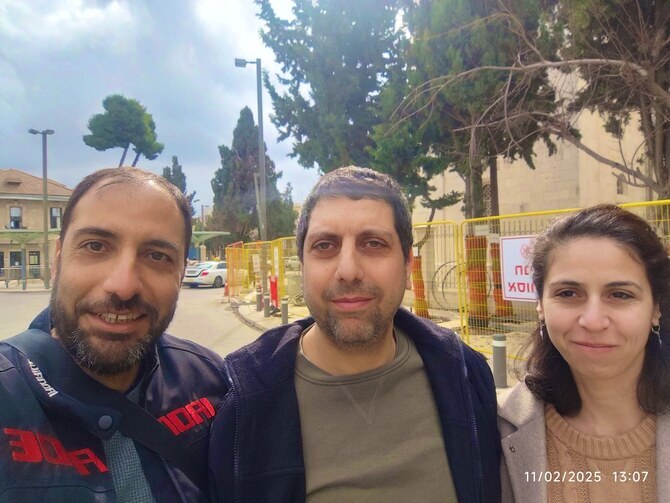
Mahmoud Muna (center) with his wife and cousin after his release from Israeli detention in Jerusalem, Feb. 11, 2025 (Screengrab)
Short Url
Updated 15 February 2025
Follow

West Bank booksellers say arrests reflect intensifying Israeli crackdown on Palestinian culture

  • Mahmoud Muna and his nephew Ahmed were arrested on Sunday after Israeli police raided the family-owned bookshops on accusation of selling books that supported terrorism
  • “Case is not isolated event, but part of series of attack against Palestinian cultural institutions,” Mahmoud said

LONDON: Two booksellers from the West Bank, recently arrested by Israeli police, say their detention is part of an escalating effort by Israeli authorities to suppress Palestinian culture.

In an interview with The Guardian, Mahmoud Muna and his nephew Ahmed, whose family has owned the Educational Bookshop in East Jerusalem for more than 40 years, described the raid on their store as part of a broader campaign to stifle Palestinian identity and free expression.

“We should not look at this as an isolated event,” Mahmoud said. “There have been a series of attacks on cultural institutions in Jerusalem and beyond. I think there is an awareness in the Israeli establishment that cultural institutions are playing a role in galvanising and protecting Palestinian cultural identity.”

The raid occurred last Sunday when plainclothes officers entered two branches of the bookshop on Salah Eddin Street — one specializing in Arabic books, the other in English and foreign-language publications. Mahmoud and Ahmed were arrested and detained for two days.

Israeli police accused the men of “selling books containing incitement and support for terrorism,” claiming officers found materials with “nationalist Palestinian themes,” including a children’s coloring book that contained the Israeli-contested sentence “From the river to the sea.”

The two men said that police confiscated about 300 books for examination, but all were eventually returned except for eight, including the coloring book, which they said had been sent for review and was not on sale.

After appearing in Jerusalem Magistrates Court on Monday, the charges against them were downgraded to a public order offense, but they were ordered to spend another 24 hours in detention, followed by five days of house arrest.

Their arrest sparked international condemnation, with journalists and diplomats closely following the case. In Israel, the incident also drew criticism, with journalist Noa Simone calling the raid a “fascist act” that “evokes frightening historical associations with which every Jew is very familiar.”

Recalling their time in detention, the booksellers described the conditions as “simply unfit for a human to live in.” They said they were held in overcrowded, windowless cells without heating, forced to sleep on mats on a concrete floor in near-freezing temperatures — treatment they likened to psychological torture.

While their experience was harsh, they acknowledged that their situation could have been far worse without international attention and support.

“If we were not working in a bookstore with an international outreach with good international connections, what would have happened?” Mahmoud asked. “Probably the case would have been manipulated against us.”

He also warned of the broader implications of their arrest. “The question is how far are they going to go? If they’re attacking Palestinian bookstores now, they will be attacking Israeli bookstores next.”


To infinity and beyond: Grendizer’s 50 years of inspiring Arabs

Updated 27 December 2025
Follow

To infinity and beyond: Grendizer’s 50 years of inspiring Arabs

  • ⁠ ⁠50 years after its creation, the Grendizer anime series continues to capture Arab imagination
  • ⁠ ⁠⁠Arab News Japan speaks to creator Go Nagai, Middle Eastern fans and retells the story behind the UFO Robot tasked with protecting our planet

LONDON: Few cultural imports have crossed borders as unexpectedly, or as powerfully, as Grendizer, the Japanese giant robot that half a century ago became a childhood hero across the Arab world, nowhere more so than in Saudi Arabia.

Created in Japan in the mid-1970s by manga artist Go Nagai, Grendizer was part of the “mecha” tradition of giant robots. The genre was shaped by Japan’s experience during the Second World War, and explored themes of invasion, resistance and loss through the medium of science fiction.

But while the series enjoyed moderate success in Japan, its true legacy was established thousands of kilometers away in the Middle East.

By the early 1980s, “Grendizer” had spread across the Middle East, inspiring fandoms in Saudi Arabia, Kuwait, Iraq and beyond. (Supplied)

The anime “UFO Robot Grendizer” arrived on television in the region in 1979, dubbed into Arabic and initially broadcast in Lebanon during the Lebanese civil war. The story it told of the heroic Duke Fleed, a displaced prince whose planet had been destroyed by alien invaders, struck a chord with children growing up amid regional conflict and occupation by Israel.

Its themes of defending one’s homeland, standing up to aggression and protecting the innocent were painfully relevant in the region, transforming the series from mere entertainment into a kind of emotional refuge.

Much of the show’s impact came from its successful Arabization. The powerful Arabic dubbing and emotionally charged voice-acting, especially by Lebanese actor Jihad El-Atrash as Duke Fleed, lent the show a moral gravity unmatched by other cartoons of the era.

While the series enjoyed moderate success in Japan, its true legacy was established thousands of kilometers away in the Middle East. (Supplied)

The theme song for the series, performed by Sami Clark, became an anthem that the Lebanese singer continued to perform at concerts and festivals right up until his death in 2022.

By the early 1980s, “Grendizer” had spread across the Middle East, inspiring fandoms in Saudi Arabia, Kuwait, Iraq and beyond. For many, it was not only their first exposure to anime, it also delivered lessons on values such as justice and honor.

Grendizer was so influential in the region that it became the subject of scholarly research, which in addition to recognizing the ways in which the plight of the show’s characters resonated with the audience in the Middle East, also linked the show’s popularity to generational memories of displacement, particularly the Palestinian Nakba.

By the early 1980s, “Grendizer” had spread across the Middle East, inspiring fandoms in Saudi Arabia, Kuwait, Iraq and beyond. (Supplied)

Half a century later, “Grendizer” remains culturally alive and relevant in the region. In Saudi Arabia, which embraced the original version of the show wholeheartedly, Manga Productions is now introducing a new generation of fans to a modernized version of the character, through a video game, The Feast of The Wolves, which is available in Arabic and eight other languages on platforms including PlayStation, Xbox and Nintendo Switch, and a new Arabic-language anime series, “Grendizer U,” which was broadcast last year.

Fifty years after the debut of the show, “Grendizer” is back — although to a generation of fans of the original series, their shelves still full of merchandise and memorabilia, it never really went away.


Grendizer at 50
The anime that conquered Arab hearts and minds
Enter
keywords