

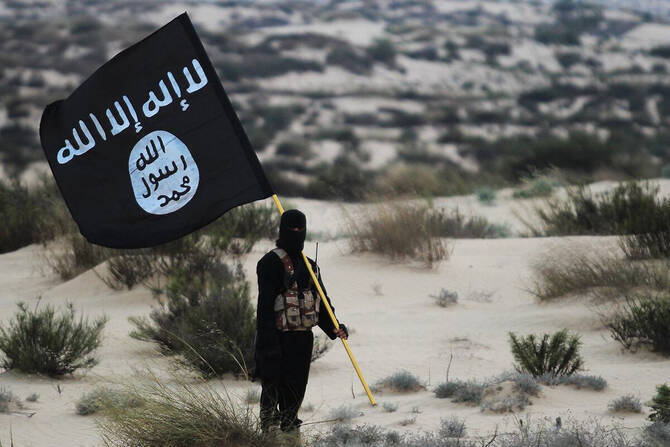

RAQQA, Syria: Europeans were among 150 senior Daesh group detainees transferred this week by the US military from Kurdish custody in Syria to Iraq, whose premier urged EU countries to repatriate their nationals.
They were among an estimated 7,000 militants due to be moved across the border to Iraq as the Kurdish-led force that has held them for years relinquishes swathes of territory to the advancing Syrian army.
In 2014, Daesh swept across Syria and Iraq, committing massacres and forcing women and girls into sexual slavery, but backed by a US-led coalition, the Kurdish-led Syrian Democratic Forces (SDF) ultimately defeated the militants in Syria five years later.
This month, the United States said the purpose of its alliance with the Kurds had largely expired, as Syria’s new authorities pressed an offensive to take back territory long held by the SDF, which agreed to withdraw from swathes of territory in the north and east.
The EU said Friday that alleged breakouts by detained Daesh foreign fighters in Syria were of “paramount concern” and was monitoring the transfer of prisoners to Iraq, “including foreign terrorist fighters.”
An Iraqi security official said the 150 detainees, which the US military transferred to Iraq on Wednesday, were “all leaders of the Daesh group, and some of the most notorious criminals,” and included “Europeans, Asians, Arabs and Iraqis.”
Another Iraqi security source said the group included “85 Iraqis and 65 others of various nationalities, including Europeans, Sudanese, Somalis, and people from the Caucasus region.”
They “all participated in Daesh operations in Iraq,” including the 2014 offensive that saw the militant group seize large areas of Iraq and neighboring Syria “are all at the level of emirs,” he said.
They are now held at a prison in Baghdad.
- ‘Take responsibility’ -
US Secretary of State Marco Rubio has said that “non-Iraqi terrorists will be in Iraq temporarily.”
In a telephone call Friday with French President Emmanuel Macron, Iraqi Prime Minister Mohammed Shia Al-Sudani urged European countries to take back and prosecute their nationals.
The SDF jailed thousands of suspected militants and detained tens of thousands of their relatives in camps as it pushed out Daesh.
The militant group’s onslaught came during the peak of Syria’s civil war, which was sparked by longtime ruler Bashar Assad’s crackdown on pro-democracy protests.
After toppling Assad just over a year ago, President Ahmed Al-Sharaa is now seeking to consolidate the government’s control over all of Syria.
Despite repeated Kurdish and US appeals, foreign governments have generally avoided repatriating their nationals, fearing security threats and political backlash.
US President Donald Trump told the New York Post on Tuesday that he had helped stop a prison break of European militants in Syria, a day after the army accused the SDF of releasing Daesh detainees from the Shadadi prison.
The Kurds said they lost control of the facility after an attack by Damascus.
Syrian authorities later said they had arrested “81 of the fugitives.”
In north Syria’s Raqqa province, an AFP correspondent saw Kurdish forces who formerly controlled the Al-Aqtan prison housing Daesh detainees being bussed out Friday under a deal with the government.
- Al-Hol camp -
In northeast Syria, UN refugee agency (UNHCR) spokesperson Celine Schmitt said it had been unable to enter Al-Hol camp — the biggest facility housing suspected Daesh relatives including foreigners — for three days due to “the volatile security situation.”
Kurdish forces withdrew from Al-Hol on Tuesday and the following day Syria’s army entered the camp where thousands of men, women and children have lived in squalid conditions for years.
“UNHCR is returning to Al-Hol today, with the hope of resuming the bread delivery that had stopped for the past three days,” Schmitt told AFP.
The camp houses some 23,000 people — mostly Syrians but also including around 2,200 Iraqis and 6,200 other foreign women and children of various nationalities, according to the camp’s former administration.
Two former employees of organizations working at the site said an unspecified number of its residents fled during an hours-long security vacuum between when the SDF withdrew and the army took control, without saying how many people.
“The camp is fenced, but without security, anyone can easily cross it and flee,” one of the employees said, requesting anonymity.
On Sunday, Sharaa announced a deal with SDF chief Mazloum Abdi that included a ceasefire and the integration of the Kurds’ administration into the state, which will take responsibility for Daesh prisoners.
A fresh four-day ceasefire agreed after tensions escalated is set to expire on Saturday evening.


