

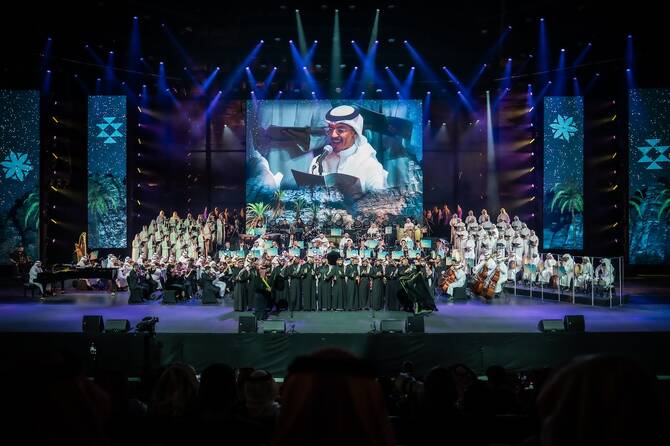
‘Masterpieces of Saudi Orchestra’ shine at Maraya in AlUla

1 / 2
The “Masterpieces of Saudi Orchestra” concert opened at Maraya Concert Hall in AlUla on Thursday. (Supplied)
2 / 2
The “Masterpieces of Saudi Orchestra” concert opened at Maraya Concert Hall in AlUla on Thursday. (Supplied)
Short Url
Updated 23 January 2026
Follow

‘Masterpieces of Saudi Orchestra’ shine at Maraya in AlUla

  • The concert on its opening night presented a seamless artistic journey, where orchestral works met Saudi musical identity
  • It underlined the Music Commission’s aim to present Saudi artistry at a high professional level

RIYADH: The “Masterpieces of Saudi Orchestra” concert opened at Maraya Concert Hall in AlUla on Thursday under the patronage of the Kingdom’s Minister of Culture and Chairman of the board of the Music Commission Prince Bader bin Abdullah.

Organized by the Music Commission, the concert on its opening night presented a seamless artistic journey, where orchestral works met Saudi musical identity.

The Saudi National Orchestra and Choir, conducted by Maestro Hani Farhat, led audiences through carefully curated pieces reflecting heritage and modern creativity.

The repertoire combined traditional influences with orchestral scoring, offering listeners heritage-based compositions alongside recent arrangements.

Regional rhythms and layered musical textures were used to echo the Kingdom’s history, while pieces rooted in Saudi classical music tradition connected audiences with familiar cultural references in a fresh format.

The concert underlined the Music Commission’s aim to present Saudi artistry at a high professional level.

The series seeks to honor national heritage while encouraging contemporary artistic engagement, and its growing local and international presence was highlighted throughout the evening.

The program also featured a visual dimension led by the Theater and Performing Arts Commission, which staged live performances of Saudi folk arts. 

Audiences saw presentations of Samri, Dahha, Rafeihi, Yanbawi, Zair and Khabeeti, synchronized with the orchestra to create one integrated artistic experience.

These folk elements were arranged to complement the orchestral sound, reinforcing the richness and variety of Saudi cultural identity. The combination of music and movement aimed to show how traditional forms can engage with large-scale concert settings while retaining their historical character and community roots.

This performance is an extension of the series of successes achieved by the Saudi Orchestra’s masterpieces both locally and internationally, and reaffirms the Music Commission’s commitment to showcasing Saudi music in its finest form.


Saudi Arabia, Estonia strengthen cyber defense cooperation

Updated 09 February 2026
Follow

Saudi Arabia, Estonia strengthen cyber defense cooperation

  • Renowned for its leadership in digital governance, Estonia sees cybersecurity as central to its partnership potential with Saudi Arabia, building on years of regional engagement through its technology firms

RIYADH: Estonia aims to deepen defense, cybersecurity, and artificial intelligence cooperation with Saudi Arabia as both nations look to advance technology‑driven defense and cybersecurity capabilities.

Hanno Pevkur, Estonia’s minister of defense, told Arab News at the World Defense Show in Riyadh on Monday that Estonia’s defense industry is eager to contribute to the Kingdom’s fast‑growing defense ecosystem.

“In the modern world, cooperation built on trust and technology is the best defense,” he said. “It is important for us to be here because we clearly see there is a possibility to increase cooperation, not only bilaterally between Saudi Arabia and Estonia, but across the region.”

At Estonia’s pavilion, a cooperation agreement was signed between an Estonian company and a Saudi firm during the show, he noted.

Pevkur also said Estonia’s defense sector has expanded rapidly in recent years, driven by technological innovation and partnership.

“Our defense industry is growing very rapidly, and we continue to see strong momentum,” he said.

He said Estonia’s strengths lie in digital and smart‑system integration rather than large‑scale weapons production.

“We will not build airplanes or tanks, but what we can do is integrate robotics, automation and drones to make existing systems smarter,” he said.

The minister said effective defense collaboration must link businesses and governments to achieve meaningful results.

“When we want to have real cooperation, we need it on all levels,” he said. “The biggest client for any defense company is the government, so we must treat this as one ecosystem where the public and private sectors work hand in hand.”

Renowned for its leadership in digital governance, Estonia sees cybersecurity as central to its partnership potential with Saudi Arabia, building on years of regional engagement through its technology firms.

Pevkur said several Estonian companies, including Nortal, have already assisted Gulf governments in developing open IT and digital‑service systems.

“As the most digitalized nation in the world, almost every service in Estonia can be done online, except getting married,” he said. “But with such digitalization, we also need strong cyberdefense.”

He said data protection and digital resilience are treated as matters of national sovereignty in Tallinn, the capital of Estonia.

“Data is what we own. When someone steals that data, it becomes a serious threat,” he added. “That is why cyberdefense is not just about technology, it is about trust, sovereignty and protection.”

Pevkur said Saudi Arabia’s advances in AI offer promising opportunities for collaboration.

“I know that Saudi Arabia is doing great work when it comes to AI,” he said. “For us, as a small country with limited human resources, AI is essential not just for defense but for everyday life.”

Pevkur added that Estonia has launched a national AI strategy to promote responsible development and closer coordination between government and industry. One Estonian company, he said, has developed a system that allows a single operator to control hundreds of drones through AI.

“It is quite easy to put a weapon into the hands of a robot, but we also need to define who is accountable for its actions,” he said.

“The big question for the future is whether we can allow a war to be fought entirely by AI, or if humans must always make the final ethical decisions.”

He said in his conclusion that governments must reach a common understanding on how AI will be used and regulated on the battlefield.