

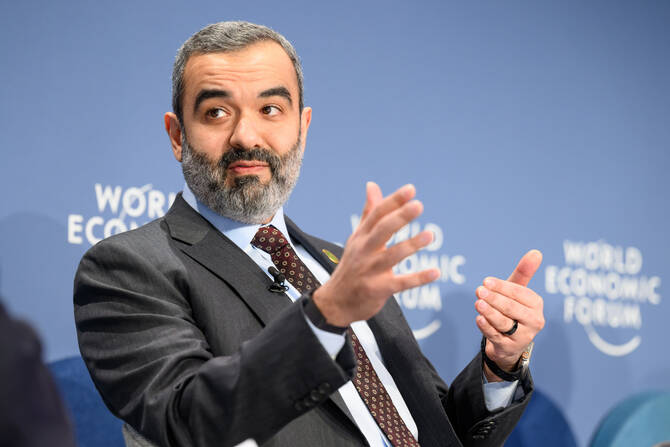
Saudi Arabia ‘ideal partner’ in shaping next wave of intelligent age, communication minister tells WEF

Abdullah Al-Swaha, Saudi minister of communication and information technology, was speaking during a panel discussion at the World Economic Forum in Davos. (WEF/SBlaser)
Short Url
Updated 23 January 2026
Follow

Saudi Arabia ‘ideal partner’ in shaping next wave of intelligent age, communication minister tells WEF

  • Abdullah Al-Swaha said aim was to “help the world achieve the next $100 trillion by energizing the intelligence age”

DAVOS: Saudi Arabia has accelerated efforts in “energizing the intelligent age,” making the Kingdom the world’s ideal partner in shaping the next wave of the technological age, said the minister of communication and information technology.

Speaking during a panel discussion at the World Economic Forum in Davos, Abdullah Al-Swaha said the aim was to “help the world achieve the next $100 trillion by energizing the intelligence age.”

He said the Kingdom was expanding global partnerships for the benefit of humanity and highlighted both local and international achievements.

“We believe the more prosperous the Kingdom, the Middle East, is, the more prosperous the world is. And it is not a surprise that we fuel 50 percent of the digital economy in the kingdom or the region,” he told the audience. He added the Kingdom fueled three times the tech force of its neighbors and, as a result, 50 percent of venture capital funding.

Al-Swaha said Saudi Arabia was focused both on artificial intelligence acceleration and adoption. At home, he said, the Kingdom was doubling the use of agentic AI in the public and private sector to increase worker productivity tenfold. He also cited the world’s first fully robotic heart transplant, which was conducted in Saudi Arabia.

“If we double down on talent, technology, and build trust with partners, we can achieve success,” he said. “And we are following the same blueprint for the intelligence age.”

He said the Kingdom aimed to be a “testbed” for innovators and investors. Rapid technological adoption and investment have boosted Saudi Arabia’s non-oil economy, with non-oil activities accounting for 56 percent of GDP and surpassing $1.2 trillion in 2025, ahead of the Vision 2030 target.

In terms of adoption, Al-Swaha said the Kingdom had introduced the Arabic-language AI model, Allam, to be adopted across Adobe product series. It has also partnered with Qualcomm to bring the first hybrid AI laptop and endpoints to the world.

“These are true testimonies that the kingdom is not going local or regional; we are going global,” he said.


Meta to charge Arab advertisers extra fee for reaching European audiences

Updated 11 March 2026
Follow

Meta to charge Arab advertisers extra fee for reaching European audiences

  • US tech giant told advertisers it will add fees ranging from 2 to 5 percent on image and video ads delivered on its platforms to offset digital service taxes
  • Charges are determined by where the audience is located, not where the advertiser is based

LONDON: Meta will from July 1 impose location-based surcharges on advertisers targeting audiences in six European countries, a move that will directly affect Arab businesses that run campaigns across the continent.

The US tech giant announced it will add fees ranging from 2 to 5 percent on image and video ads delivered on its platforms, including Facebook, Instagram and WhatsApp, to offset digital service taxes imposed by individual governments.

Crucially, the charges are determined by where the audience is located, not where the advertiser is based.

That means Saudi, Emirati, Egyptian or other Arab companies paying to reach consumers in the UK, France or Italy will face the additional costs regardless of their own country’s tax arrangements with Meta.

Fees will apply at 2 percent for ads reaching UK audiences, 3 percent for France, Italy and Spain, and 5 percent for Austria and Turkiye.

“If you deliver $100 in ads to Italy, where there is a 3% location fee, you will be charged $100 (ad delivery), plus $3 (location fee), for $103 total,” the company wrote in an email to an advertiser initially reported by Bloomberg. “Note that any applicable VAT will be calculated on top of the total amount.”

The taxes have been introduced at different points, starting with France in 2019, though not the EU as a bloc.

Many tech companies report substantial sales in Europe and millions of users but pay minimal tax on profits. The goal is to claw back locally derived economic value, Bloomberg reported.

The move follows similar decisions by Google and Amazon, which have also begun passing European digital tax costs on to advertisers.

For Arab brands with growing European footprints, particularly in fashion, travel, hospitality and media, the new fees add another layer of cost to campaigns already subject to currency and targeting complexities.

Digital services taxes, levied as a percentage of revenues earned by major tech platforms in individual countries, have drawn criticism from Washington, which argues they unfairly target US companies.

Meta has been reached for comments.