


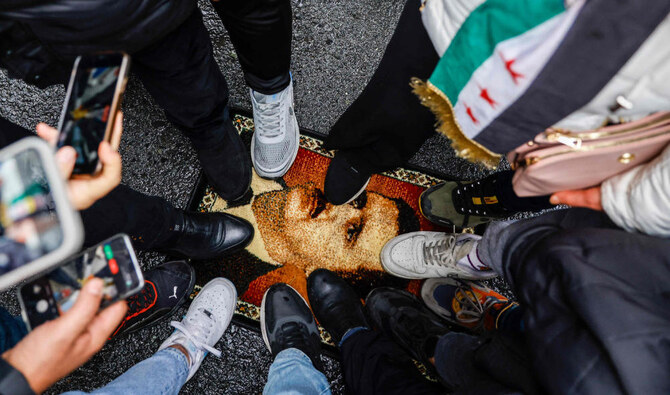

LONDON: In scenes reminiscent of every violent regime change in the Middle East’s recent history, on Saturday afternoon jubilant crowds in the Jaramana suburb of Damascus toppled a statue of Hafez Assad, founder of the family regime that, until this weekend, had ruled Syria for over half a century.
The beheading of the larger-than-life bust, captured in shaky smartphone footage, spoke volumes about the roots of the crisis that is now engulfing Syria.
President Bashar Assad, who fled Syria and was granted asylum along with his family by Russia on Sunday, inherited an autocratic system that his father had forged out of the chaos that was the Syrian political landscape for two decades after the country gained its independence in 1949.
Together with Lebanon, Syria, an Ottoman province since the early 16th century, was occupied by France in 1919 after the defeat of the empire in the First World War, and in 1923 became a French mandate under the auspices of the League of Nations.
The mandate triggered a multifactional revolt against French rule, which raged from 1925 to 1927 until it was finally put down by overwhelming French military force.

Bashar Assad fled to Russia on Saturday as rebels took the Syrian capital. (AFP/File)
A complex but relatively peaceful two decades followed until, in the wake of the Second World War, Syria finally won its long-promised independence in 1946.
But the golden era anticipated by Syrians failed to dawn. From 1949 to 1970, the country was wracked by a series of 20 military coups, or attempted coups.
To Syrians and international observers alike, it seemed that Syria was doomed to basket-case status. But waiting in the wings was a man who, in time, would appear to be the answer to the troubled nation’s prayers.
By all accounts, Hafez, born on Oct. 6, 1930, one of 11 children of a poor Alawite farming family, never wanted to be a dictator, or even be involved in politics.
Instead, he wanted to become a doctor, a dream that foundered on the inability of his father, Ali Sulayman, to pay for his tuition (Sulayman would later adopt his local nickname, Al-Assad, “the lion,” as his family’s surname.)
Instead, in 1950 Hafez enrolled in the fee-free Homs Military Academy, learned to fly, joined the Syrian Air Force — and found himself embroiled in the febrile atmosphere of plot and counterplot that prevailed within the military establishment.

Hafez Al-Assad and his wife Anisseh posing for a family picture with his children (L to R) Maher, Bashar, Bassel, Majd and Bushra. (AFP)
In 1955, President Adib Al-Shishakli was overthrown in a military coup that saw the return of civilian government in Syria. For the next few years, Hafez saw active service, training on MiG fighters in Russia and flying air defense missions during the Suez crisis.
Following the formation by Syria and Egypt of the short-lived United Arab Republic in 1958, the air force officer became increasingly politicized, so much so that in March 1963 he played a prominent role in the Ba’athist military coup against Syrian President Nazim Al-Kudsi.
By now, Hafez was in charge of the Syrian Air Force and a member of both the Syrian Regional Command of the Ba’ath Party and the Military Committee, a powerful Ba’athist group within the Syrian military establishment.
KEY DATES OF ASSAD FAMILY RULE
• Oct. 6, 1930: Hafez Assad, son of a poor farmer, is born in Qardaha in northwest Syria.
• 1950: Hafez Assad enters Homs Military Academy.
• February 1966: Hafez Assad appointed defense minister after military coup.
• Nov. 12, 1970: Hafez Assad leads bloodless coup, becoming president of Syria in March 1971.
• June 10, 2000: Hafez Assad dies and is succeeded by his son, Bashar Assad.
• 2012: Protests against Assad’s oppressive regime escalate into civil war.
• Dec. 6, 2024: Era of Assad dynasty ends as Damascus is seized by rebels and Bashar flees to Russia.
In February 1966, the Military Committee overthrew the Ba’ath Party’s ruling National Command, and Hafez was appointed minister of defense by coup leader Salah Jadid, chief of staff of the Syrian army.
For Jadid, the appointment would prove to be a disastrous miscalculation. On Nov. 12, 1970, Hafez mounted his own bloodless coup. At first, at least, his “Corrective Revolution” (Al-Thawra Al-Tashihiyya) appeared to promise a fresh start for all Syrians.
In the words of Patrick Seale, author of the 1988 biography “Assad of Syria: The Struggle for The Middle East,” Hafez’s rule began “with an immediate and considerable advantage: the regime he displaced was so detested that any alternative came as a relief.

Hafez’s basic accomplishment “was to transform the Syrian political order from a coup-ridden, postcolonial, semi-state into a veritable model of all authoritarian stability.” (AFP/File)
“As it was an open secret that he was more liberal than Salah Jadid, his victory ushered in a political honeymoon. People were long to breathe more freely.”
Hafez’s basic accomplishment, according to an assessment of his legacy published in 2005 by the Brookings Institution, “was to transform the Syrian political order from a coup-ridden, postcolonial, semi-state into a veritable model of all authoritarian stability.”
In the process, he established a power structure that defined “fundamental political choices” for his son.
By the time of his death in June 2000, the victim of a cardiac arrest at the age of 69, for 30 years Syria had been in the grip of “a highly developed and coercive police state apparatus,” designed to “put down perceived, potential, and real threats to the regime.”
Opinion
This section contains relevant reference points, placed in (Opinion field)
As a result, “an ongoing record of brutal repression remains an important and inescapable part of Assad’s legacy” — and one that his son would inherit and build upon.
Like his father before him, Bashar sought a career in medicine, studying in Damascus and working as a doctor in the Syrian army before moving to the UK in the 1990s to train as an ophthalmologist.
He was never expected to enter the family business. His father was grooming his eldest son, Bassel, as his successor, but this plan was derailed when Bassel died in a car crash in 1994.

Syrian fighters set alight a picture of Bashar Al-Assad. (AFP)
Bashar was recalled to Syria, where he entered the military academy in Homs and spent the next six years preparing to succeed his father, surrounding himself with loyal Ba’athist and Alawite supporters in the party and the military.
As the only candidate for the presidency after his father’s death on June 10, 2000, 34-year-old Bashar was a shoo-in — once the Syrian constitution had been amended to lower the age limit for the job from 40.
From the outset, Bashar followed his father’s lead. His first task was to prove himself equal to the job by cracking down ruthlessly on the outbreak of dissent that followed his father’s death.
The demands of protesters, characterized as the “Damascus Spring,” were articulated by the “Statement of 99,” a manifesto signed by intellectuals calling for a new era of freedom of speech and an end to state oppression and imprisonment of political opponents.
Multiple arrests and crackdowns brought about the demise of the Damascus Spring, but the seeds it had sown were only dormant, not dead.

Hafez Al-Assad's sons Maher (R) and Majed (3rd R), his brother Jami (2nd R), son-in-law Syrian General Assef Shawkat (2nd L), and Syrian Baath Party Deputy Secretary General Abdallah al-Ahmar (L). (AFP)
In March 2011, as part of the so-called Arab Spring, a series of mass pro-democracy protests broke out across Syria, with demonstrators demanding the end of the Assad regime.
The protests were met with a brutal crackdown, prompting a descent into what the UN officially declared to be a civil war in June 2012 — a war that has drawn in multiple different players, including Daesh and Al-Qaeda.
According to the Syrian Observatory for Human Rights, by March this year, 13 years on from the start of the seemingly endless war, Syria’s war has killed more than half a million people. Among them are more than 164,000 civilians, including over 15,000 women and 25,000 children, with millions more displaced from their homes.
In its desperate bid to cling on to power, the Assad regime had used a range of barbaric weaponry, including crude but indiscriminately deadly “barrel bombs,” dropped on civilians from helicopters.
In breach of international law, the regime had also regularly deployed chemical weapons, including the neurotoxin sarin, against civilians and armed factions alike.
In 2012, in a deal to stave off threatened air attacks by the US, brokered by his ally Russia, Assad promised to give up his chemical weapons and join the Chemical Weapons Convention.

Portraits of people allegedly killed during the 1982 Hama massacre. (AFP/File)
But only the following year, in August 2013, shocking photographs emerged of child victims of chemical attacks that had been carried out against areas held by militant groups in the eastern suburbs of Damascus.
Last month, the Organization for the Prohibition of Chemical Weapons revealed that Assad’s pledges to hand over all such weapons had still not been met.
As Western sanctions imposed in the wake of state violence in 2011 bit deeper, the Assad regime became, in effect, a narco-state, increasingly dependent for cash flow on sales of the drug Captagon, which has devastated the lives of so many young people and their families across the Middle East.
As an Arab News Deep Dive published in February 2023 revealed, “the vast majority of the tens of millions of pills flooding the Arabian Peninsula every year are manufactured on the doorstep, mainly in Syria and with the active involvement of the regime of President Bashar Assad.”
Caroline Rose, a senior analyst at New Lines, told Arab News there was no doubt that Captagon was “being produced and trafficked by an array of individuals that are very close to the Assad regime, some of them cousins and relatives of regime members.”
Most notable among them, she said, was Bashar’s brother, Maher, affiliated with production and smuggling efforts in his role as commander of the Fourth Armored Division, a military unit whose primary mission was to protect the Syrian regime from internal and external threats.

People celebrate with anti-government fighters at Umayyad Square in Damascus. (AFP)
Since the start of the Syrian civil war a decade ago, what had begun as a trickle of captagon into the region had turned into a flood. Facing global sanctions that have left it desperate for revenue, the Syrian regime has gone into the drug-manufacturing business, working with Iranian-backed militias in Syria and Lebanon to smuggle industrial quantities of captagon into Saudi Arabia and the other Gulf states, by land, sea and air.
According to a report published in April 2022 by Washington think tank the New Lines Institute for Strategy and Policy, war-torn Syria had become “the hub for industrial-sized production.” It added that “elements of the Syrian government are key drivers of the Captagon trade, with ministerial-level complicity in production and smuggling, using the trade as a means for political and economic survival amid international sanctions.”

Era of Assad dynasty ends as Damascus is seized by rebels and Basher Assad flees to Russia. (AFP/File)
In a statement in August 2012, US President Barack Obama said Bashar “has lost legitimacy (and) needs to step down. So far, he hasn’t gotten the message, and instead has doubled down in violence on his own people.”
He added: “The international community has sent a clear message that rather than drag his country into civil war he should move in the direction of a political transition. But at this point, the likelihood of a soft landing seems pretty distant.”
Today, with Bashar showing up in Moscow and Damascus in the hands of the rebels, Syrians can only pray that, with the Assad dynasty seemingly out of power after half a century of tyranny, their traumatized country’s long overdue soft landing is, finally, imminent.


