


DIRIYAH: The third edition of the Diriyah Contemporary Art Biennale, titled “In Interludes and Transitions,” begins today. More than 70 artists are participating in the event at JAX — Diriyah’s creative district. In a statement released at the announcement of the event in October, the artistic directors Nora Razian and Sabih Ahmed said: “Thinking of the world (as) a braiding of movements … allows an understanding of cultural forms through exchange and transmissions; itineraries of travel, intersections, and mutations; and the retelling of fragments of exiled stories that have persisted through bodies, materials, rhythms, and cadences.”
Here, we present a few works from some of the Saudi artists participating in this year’s biennale.
Abdelkarim Qassem

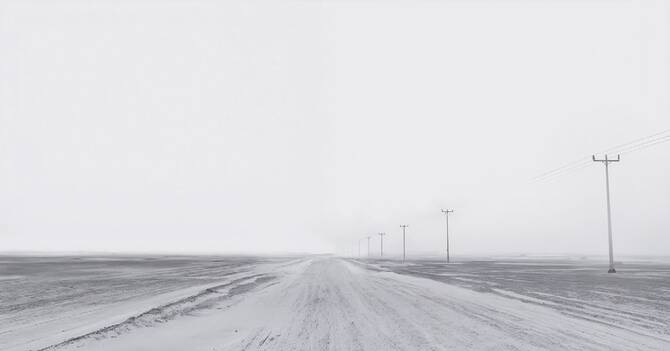
'The Final Scene'
The Saudi artist and psychologist’s short film is inspired, according to the biennale catalogue, by his time in the armed forces. Like the majority of his practice since being enlisted in 2009, it “addresses how war and trauma make marks at personal and collective levels.” The video, created in 2017, was shot on the artist’s phone and later rendered in gray and white. It documents a journey down an empty road in a heavy vehicle “with large wheels that can be heard scraping against the arid path,” the catalogue states. “On the seemingly endless road, a sense of uncertainty is omnipresent, as if the vehicle’s movement is guided less by the anticipation of its destination and rather by an ambivalence around how long the journey may take. Over the video’s course the vehicular sound dissolves into a tinnitus-like one — perceiving a ringing sound is a common condition among soldiers — while the visuals eventually fade into pure white. The short length of the video reinforces the fragmented nature of the work — a moment stolen from the endless conflicts that pervade today.”
Lulua Alyahya

'Untitled'
The Washington-born, Manama-based Saudi artist, the catalogue says, “creates open-ended narratives that feel at once familiar and slightly strange.” Her work is “observational, bearing witness to the behavior of men in society and their ways of inhabiting space … The results can be playful, melancholic, or unresolved — holding contradictions that mirror lived experience.” This untitled 2024 painting depicts a man, seated, wearing a white thobe, who appears to be dissolving. “He hovers between presence and disappearance, his face and hands softly fading as if time itself was brushing them away … The figure seems caught between meditating and vanishing, stillness and drift.”
Faisal Samra

'Immortal Moment III'
The Bahrain-born Saudi artist is, according to the biennale organizers, “considered a pioneer of conceptual art in the Middle East,” who “has tested the unconventional functions of media through works guided by experimentation and research.” In a new piece commissioned for the exhibition, Samra “captures an accretion of moments from his life and art practice, contemplating the place of his own life within cosmic time.” The work is a video of improvised choreography in which the artist “performs gestures that galvanize shocks onto a surface, using air, gravity, and various measures of impact.”
Mohammed Alhamdan

'Folding the Tents'
The Riyadh-born artist — known as 7amdan — will contribute to a series of live performances during the biennale’s opening weekend with this caravan of Chasse vehicles which pays homage to the ancient caravan processions of desert travelers, and the Arabic poetic meter known as rajaz, which mimics the footfall of camels and, the catalogue notes, “provided a structure for memory and improvisation, turning … travelers into spontaneous chanters, who composed verses on their … journeys.” Alhamdan’s modern-day caravan, “which explores the notion of the procession, its transformation, and the inventiveness of an ancient practice in the age of … electronic and digital culture,” will cross Wadi Hanifah before giving way to a series of live music and poetry recitals.
Shadia Alem

'Transformation: Jinniyat Lar'
This print by the Saudi multidisciplinary artist is one of a series of new works featured in the exhibition that revisit drawings she first made in 1996, inspired by Arabian folklore, specifically the female spirits (Jinniyat) of the Lar River, mentioned in Ptolemy’s second-century atlas, but believed to have disappeared. “These strong-willed beings would one day revive the legendary river, bringing prosperity and abundance to the ‘empty quarter,’ which is less a reference to the physical desert and more a metaphor for the silent, timeless expanse within us awaiting revival through imagination and art,” the catalogue says.


