

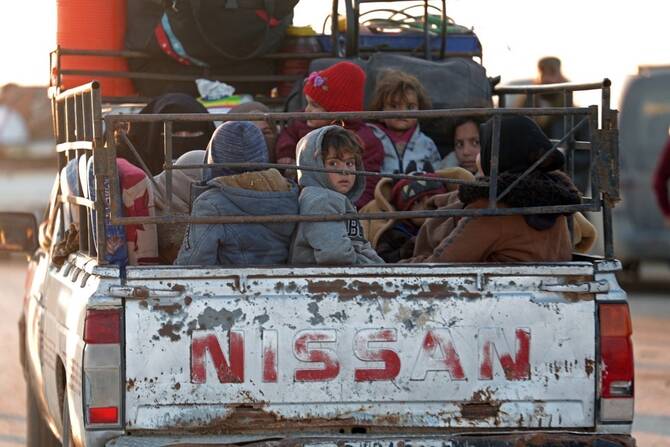

LONDON: A decree by Syria’s interim president has cast a light on a long-marginalized population in the country’s northeast, where hundreds of thousands of Kurds have for generations been denied basic civil and cultural rights.
The announcement, made on Jan. 16, came amid heightened tensions between Syrian government forces and the Kurdish-led Syrian Democratic Forces in the northern Aleppo governorate.
It also comes as interim authorities in Damascus seek to implement a reintegration deal with the SDF, which would see the central government reestablish control over Syria’s northeast and Kurdish-led forces incorporated into the national army.
Interim President Ahmad Al-Sharaa said citizenship would be restored to all Kurdish Syrians, their language formally recognized, and Nowruz, the Kurdish New Year, declared a national holiday — a move suggesting renewed respect for Syria’s minorities.

The Ministry of Interior began implementing the decree on Jan. 29. (Reuters)
The move “breaks decisively” with a legacy of “Arab nationalist exclusion that denied Kurds” in Syria their rights, Ibrahim Al-Assil, a senior research fellow at Harvard’s Middle East Initiative, told The New York Times on Jan. 16.
The Ministry of Interior began implementing the decree on Jan. 29, as government forces pushed into northeastern areas previously controlled by the SDF. But questions remain: who will truly benefit, and how does this measure differ from a similar 2011 decree issued by the now-deposed ruler Bashar Assad?
For more than six decades, many Kurds in Syria’s northeastern Hasakah province have been deprived of citizenship and basic rights following a controversial 1962 census that stripped more than 120,000 residents of nationality. The decision upended lives and erased legal identities.
That number grew over time as statelessness was passed down to descendants. According to the Hasakah civil registry, more than 517,000 people experienced statelessness between 1962 and 2011, including descendants.

Interim President Ahmad Al-Sharaa said citizenship would be restored to all Kurdish Syrians, their language formally recognized, and Nowruz, the Kurdish New Year, declared a national holiday. (X)
Kurds today are Syria’s largest non-Arab ethnic group, numbering about 2.5 million, according to the World Population Review. Most hold Syrian citizenship, except for the descendants of those rendered stateless by the 1962 census.
Amnesty International estimated in 2005 that between 200,000 and 360,000 Kurds remained without nationality.
Their exclusion can be traced back to Aug. 23, 1962, when then-President Nazim Al-Qudsi issued Legislative Decree No. 93 ordering an “exceptional census” in Hasakah to identify what his government described as “alien infiltrators.”
At the time, officials said the aim of the census was to determine how many people had crossed into Syria following Kurdish uprisings in Turkiye in the 1920s.
However, Human Rights Watch later said the measure was part of a deliberate effort to Arabize Syria’s resource-rich northeast — home to the country’s largest concentration of non-Arabs.
Carried out in a single day on Oct. 5, 1962, the census was widely described as arbitrary and lacking legal safeguards. It even divided members of the same households into three different categories: Syrian nationals, unregistered persons and foreigners.

A member of Syrian military police stands guard in Raqqa, Syria. (Reuters)
According to a 2009 Human Rights Watch report, census teams visited towns and villages, and registered only those physically present in their homes that day.
To retain citizenship, families were required to produce proof of residence in Syria prior to 1945, such as property deeds or ration cards. Those documents were largely inaccessible to rural residents given weak registration systems and the limited timeframe.
Those classified as foreigners — or Ajaneb in Arabic — were issued red identity cards. Others, known locally as Maktoumeen, were denied any legal recognition of their existence.
INNUMBERS
• 2.5m Kurds constitute Syria’s largest non-Arab ethnic group.
• 517k+ Syrian Kurds rendered stateless between 1962 to 2011.
(Source: World Population Review/Hasakah’s civil registry)
The loss of citizenship deprived generations of Kurds of fundamental rights, including access to education, employment, property ownership, marriage and child registration, and freedom of movement.
Maktoumeen could obtain only informal documents, known as Shahadat Taarif, with prior police approval through community leaders.

Kurds today are Syria’s largest non-Arab ethnic group, numbering about 2.5 million, according to the World Population Review. (Reuters/File)
Locals from Hasakah’s city of Qamishli told Arab News these papers could be used to enroll children in school or register informal marriages, but were difficult to secure and offered limited protection.
The census affected even prominent figures.
According to accounts cited by Human Rights Watch in 1996, Tawfiq Nizam Eddin, a Syrian Kurd from Qamishli who once served as army chief-of-staff prior to Syria’s unity with Egypt in 1958, was stripped of his citizenship and reclassified as a foreigner.
Discrimination persisted after Al-Qudsi was overthrown in a 1963 coup that brought the Baath Party to power.
The party proposed demographic engineering in the northeast, aiming to displace Kurds from border areas with Turkiye and replace them with Arab families from Raqqa and the Aleppo countryside, according to the Syrian-Kurdish North Press Agency.
That policy took shape in 1973 under then-President Hafez Assad, Bashar Assad’s father, through the establishment of the so-called “Arab Belt,” which Human Rights Watch said displaced Kurdish communities and weakened Kurdish control of resource-rich areas.
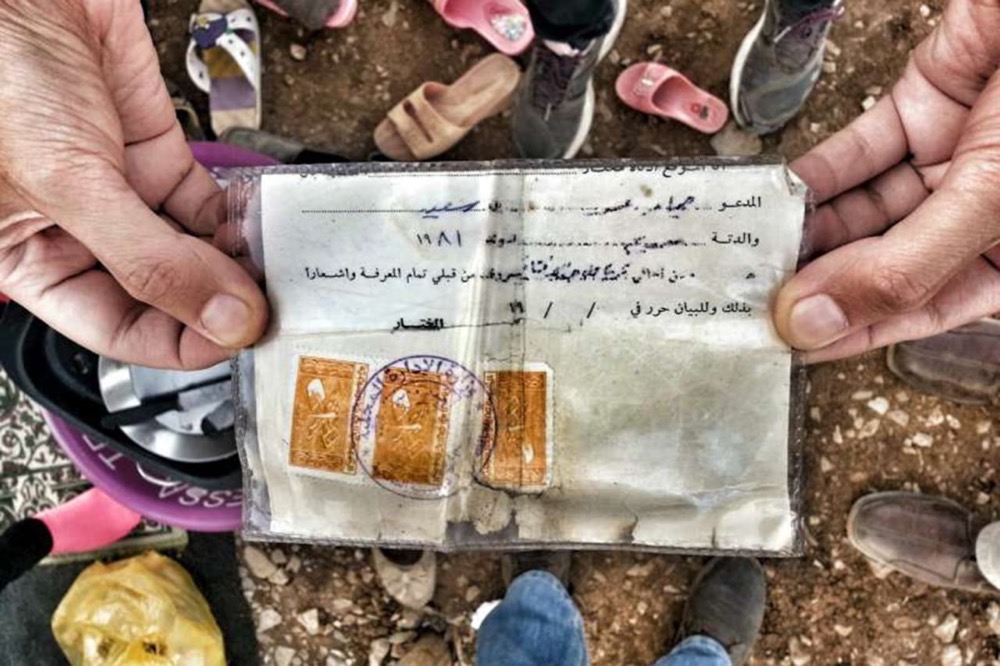
A Syrian refugee shows his “maktoumeen” card, which confers no rights or status and was issued to unregistered stateless Kurds. (UNHCR)
The outbreak of Syria’s civil war in 2011 prompted limited reforms. In April that year, following demonstrations in Hasakah, Bashar Assad issued Decree 49, granting citizenship to some stateless Kurds in the northeastern governorate.
However, the measure applied only to those registered as foreigners. By mid-2013, about 104,000 Kurds in Hasakah had acquired nationality, according to the UN refugee agency, UNHCR.
Al-Sharaa’s Jan. 16 decree reportedly goes further than this, extending citizenship to remaining foreigners as well as the Maktoumeen.
The announcement has been cautiously welcomed by Kurds in Syria.
“While the decree comes decades too late, there is hope it will benefit Syria’s Kurds, particularly as recent developments in the north have raised concern,” Newroz Shivan, a Damascene Kurd, told Arab News.
“We have to wait and see what the future brings, but I’m grateful to have lived to see this decree. Our grandparents and parents never expected to witness such a moment.”
Kurds have long been determined to fight for their rights, but many doubted they would ever see them realized, she added.
For families like Shivan’s, the decree carries symbolic weight more than immediate legal impact. While her family already holds Syrian citizenship and full civil rights, they have long lacked formal recognition of their cultural identity.

“Declaring Nowruz a national holiday is a significant step and a meaningful gesture, even though it overlaps with Mother’s Day, which has been a national holiday in Syria for decades,” she said.
“Most Kurdish families have preserved the Kurdish language by teaching it to their children at home. Even without formal teaching in schools, the language has endured — living in homes and in the hearts and minds of Kurdish people.”
Still, she added, “official recognition of the language would mark a meaningful and positive shift.”
The decree, however, drew a muted response in areas under SDF control, where skepticism persists.
In a Jan. 17 statement, the Kurdish-led Autonomous Administration of North and East Syria said “the issuance of any decree, regardless of its intentions, cannot constitute a genuine guarantee of the rights of Syria’s communities unless it is part of a comprehensive constitutional framework that recognizes and safeguards the rights of everyone without exception.”
Al-Assil of Harvard’s Middle East Initiative said “mistrust runs deep, and many Kurds are cautiously welcoming this while remaining skeptical.

The loss of citizenship deprived generations of Kurds of fundamental rights. (Reuters/File)
“Ultimately, the decree will be judged by behavior, not words,” he told The New York Times.
While Al-Sharaa’s decree has raised cautious hopes among Syria’s Kurds, its true significance will be measured not by its language, but by whether it reshapes daily life for a community long denied true belonging.


