Across Europe, Syrians celebrate being ‘free’ of Assad

1 / 4
Lareen, 8, looks on as people gather in Trafalgar Square, after Syrian militants announced that they have ousted Syria's Bashar al-Assad, in London, Britain December 8, 2024. (Reuters)
2 / 4
A person holds a Syrian opposition flag with words “Freedom” on it during a demonstration celebrating the fall of Bashar Assad regime outside the Syrian embassy in Madrid, Spain, December 8, 2024. (Reuters)
3 / 4
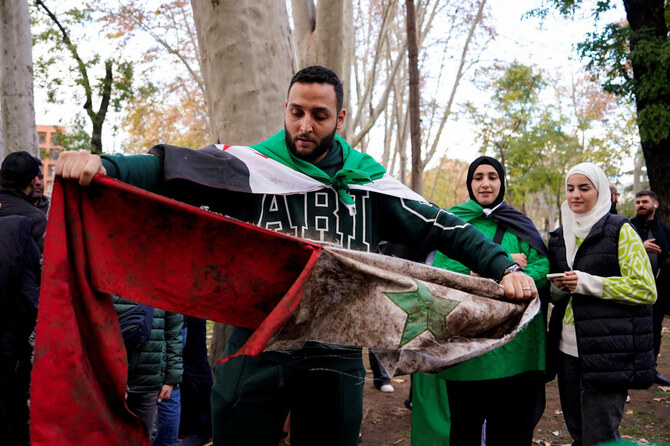
A person tears apart a Bashar Al-Assad government flag during a demonstration celebrating the fall of his regime outside Syrian embassy in Madrid, Spain, December 8, 2024. (Reuters)
4 / 4
Syrian Association in Denmark demonstrates, after Syrian militants announced that they have ousted Syria’s Bashar Assad, at City Hall Square, in Copenhagen, Denmark December 8, 2024. (Reuters)
Short Url
Updated 08 December 2024
Follow

Across Europe, Syrians celebrate being ‘free’ of Assad

  • Syrians in Athens, Belgrade, Istanbul, London, Paris, Stockholm, Vienna also waved flags in the green, red, black and white colors of the Syrian opposition

BERLIN: Thousands of jubilant Syrians rallied in Berlin and cities across Europe on Sunday, waving flags and barely able to contain their joy at the downfall of president Bashar Assad.
“Finally we are free!” exclaimed Bassam Al-Hamada, 39, among 5,000 people at an exuberant rally in the capital of Germany, where the one million-plus Syrians makes it the largest diaspora in Europe.
But Syrians in Athens, Belgrade, Istanbul, London, Paris, Stockholm, Vienna also waved flags in the green, red, black and white colors of the Syrian opposition and made clear their hostility to Assad.
Berlin police said more than 5,000 Syrians gathered in a square in the Kreuzberg district.
Many waved flags and banners that read “Free Syria” and “Freedom,” flashed “V” for victory signs and chanted “Allahu Akbar!” (God is Greatest!).
Despite a cold drizzle, many came with their families. Children’s faces were painted in the Syrian colors. Passing cars honked their horns.
Most Syrians in Germany fled their country after civil war erupted in 2011. A big community now lives in Berlin’s Neukoelln district.
“We’re happy. The dictatorship is over. Assad has gone,” said 39-year-old Berlin resident Ahmed, who preferred not to give his last name.
“All Syrians are together now,” said the railway technician, who fled the Syrian city of Aleppo in 2015.
Ahmad Al-Hallabi, a 27-year-old mechanic from Aleppo, arrived in Germany through Turkiye and Greece in 2015 at the peak of the migrant influx into Europe.
“Ten years ago, I was in Syria and saw things no-one should have to see, things that are impossible to wipe from your memory,” he said.
“Assad is the worst terrorist imaginable ... I hope there’ll be peace and everything Assad and his men destroyed will be rebuilt.”
Germany’s far-right, which has gained popularity on the back of its opposition to the arrival of Syrians and other migrants quickly raised its fears about more arrivals.
“The frontiers are closed, we will not accept any any more,” said Alternative for Germany co-leader Alice Weidel on the X social platform.
Anti-immigrant parties have also made gains in other European countries. “The top priority must be to ensure that the Syrian civilian population has prospects on the ground again and that refugees can return,” Austria’s foreign ministry said in a statement on Assad’s defeat.
Many Syrian say they want to return to their war-battered nation.
“Like many Syrians, I would like to return to my country to help rebuild it,” said Bassam Al-Hamada, a social worker who arrived in Germany in early 2016.
Sabreen, 36, an architect, said she planned to help from Germany.
“They mainly need expertise and money. All of that, we can gather here for the moment,” added the woman.
Like many of the stunned exiles in Berlin, Sabreen called for Assad to answer for the killing and torture of his people in the past 13 years. “He must be tried in the international court in The Hague,” she said.
Hundreds of ecstatic Syrians celebrated the fall of Assad on London’s Trafalgar Square, hugging each other and chanting “Mabrouk!” (Congratulations!).
Syrians greeted each other, many with the opposition flag, and singing: “Syria is ours, not the Assad family’s.”
Hundreds took part in joyous scenes outside the Fatih Mosque in Istanbul, one of the focal points for their 500,000-strong Syrian community in the Turkish city.
Several hundred Syrians also gathered outside parliament in central Athens. “Allah, Syria, freedom!” and “together, together, together,” they chanted.
“I am happy after these 13 years of displacement, massacres and tens of thousands of people killed in prisons,” said Adel Batal, 29.
“I am in Greece because of this regime,” said the man from Aleppo. “My city has been destroyed by this regime.”
Thousands also gathered in Stockholm, Copenhagen and Vienna. Sweden has Europe’s second biggest Syrian diaspora.
“I lost my homeland. My home, my family and my friends, and we fought for 14 years — so yes, today I am happy,” Noura Bittar told Danish local television.
“Of course, we are worried about what the next step will be, what kind of government will be put in place? But for now, we are just happy.”


Syria moves military reinforcements east of Aleppo after telling Kurds to withdraw

Updated 3 sec ago
Follow

Syria moves military reinforcements east of Aleppo after telling Kurds to withdraw

ALEPPO: Syria’s army was moving reinforcements east of Aleppo city on Wednesday, a day after it told Kurdish forces to withdraw from the area following deadly clashes last week.
The deployment comes as Syria’s Islamist-led government seeks to extend its authority across the country, but progress has stalled on integrating the Kurds’ de facto autonomous administration and forces into the central government under a deal reached in March.
The United States, which for years has supported Kurdish fighters but also backs Syria’s new authorities, urged all parties to “avoid actions that could further escalate tensions” in a statement by the US military’s Central Command chief Admiral Brad Cooper.
On Tuesday, Syrian state television published an army statement with a map declaring a large area east of Aleppo city a “closed military zone” and said “all armed groups in this area must withdraw to east of the Euphrates” River.
The area, controlled by Kurdish forces, extends from near Deir Hafer, around 50 kilometers (30 miles) from Aleppo, to the Euphrates about 30 kilometers further east, as well as toward the south.
State news agency SANA published images on Wednesday showing military reinforcements en route from the coastal province of Latakia, while a military source on the ground, requesting anonymity, said reinforcements were arriving from both Latakia and the Damascus region.
Both sides reported limited skirmishes overnight.
An AFP correspondent on the outskirts of Deir Hafer reported hearing intermittent artillery shelling on Wednesday, which the military source said was due to government targeting of positions belonging to the US-backed, Kurdish-led Syrian Democratic Forces.

’Declaration of war’

The SDF controls swathes of the country’s oil-rich north and northeast, much of which it captured during Syria’s civil war and the fight against the Daesh group.
On Monday, Syria accused the SDF of sending reinforcements to Deir Hafer and said it would send its own personnel there in response.
Kurdish forces on Tuesday denied any build-up of their personnel and accused the government of attacking the town, while state television said SDF sniper fire there killed one person.
Cooper urged “a durable diplomatic resolution through dialogue.”
Elham Ahmad, a senior official in the Kurdish administration, said that government forces were “preparing themselves for another attack.”
“The real intention is a full-scale attack” against Kurdish-held areas, she told an online press conference, accusing the government of having made a “declaration of war” and breaking the March agreement on integrating Kurdish forces.
Syria’s government took full control of Aleppo city over the weekend after capturing its Kurdish-majority Sheikh Maqsud and Ashrafiyeh neighborhoods and evacuating fighters there to Kurdish-controlled areas in the northeast.
Both sides traded blame over who started the violence last week that killed dozens of people and displaced tens of thousands.

PKK, Turkiye

On Tuesday in Qamishli, the main Kurdish city in the country’s northeast, thousands of people demonstrated against the Aleppo violence, with some burning pictures of Syrian President Ahmed Al-Sharaa, an AFP correspondent said, while shops were shut in a general strike.
Some protesters carried Kurdish flags and banners in support of the SDF.
“Leave, Jolani!” they shouted, referring to President Sharaa by his former nom de guerre, Abu Mohammed Al-Jolani.
“This government has not honored its commitments toward any Syrians,” said cafe owner Joudi Ali.
Other protesters burned portraits of Turkish Foreign Minister Hakan Fidan, whose country has lauded the Syrian government’s Aleppo operation “against terrorist organizations.”
Turkiye has long been hostile to the SDF, seeing it as an extension of the Kurdistan Workers’ Party (PKK) and a major threat along its southern border.
Last year, the PKK announced an end to its long-running armed struggle against the Turkish state and began destroying its weapons, but Ankara has insisted that the move include armed Kurdish groups in Syria.
On Tuesday, the PKK called the “attack on the Kurdish neighborhoods in Aleppo” an attempt to sabotage peace efforts between it and Ankara.
A day earlier, Ankara’s ruling party levelled the same accusation against Kurdish fighters.
The Britain-based Syrian Observatory for Human Rights reported 45 civilians and 60 soldiers and fighters from both sides killed in the Aleppo violence.
Aleppo civil defense official Faysal Mohammad said Tuesday that 50 bodies had been recovered from the Kurdish-majority neighborhoods after the fighting.