

At Gulfood expo, minister urges Pakistani firms to boost exports to end reliance on foreign debt

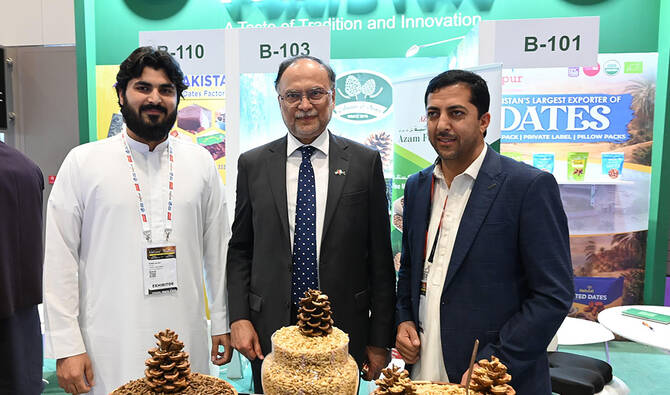
The picture taken on January 29, 2026, Pakistan's Planning Minister Ahsan Iqbal (center) visits a stall at the 31st edition of Gulfood in Dubai, UAE, which features over 1.5 million food and beverage products from 8,500 exhibitors worldwide. (PakinUAE_/X)
Short Url
Updated 30 January 2026
Follow

At Gulfood expo, minister urges Pakistani firms to boost exports to end reliance on foreign debt

  • The Dubai expo brought together more than 8,500 exhibitors from 195 countries, showcasing over 1.5 million food and beverage products
  • Planning Minister Ahsan Iqbal says Islamabad is committed to promoting productivity, quality and innovation within the private sector 

ISLAMABAD: Planning Minister Ahsan Iqbal on Thursday urged Pakistani companies participating in the Gulfood food and beverage exhibition in Dubai to expand exports and focus on value-added products, saying it was the only way for Pakistan to end reliance on foreign debt.

Gulfood’s 31st edition, being held in Dubai from Jan. 26 till Jan. 30, has brought together more than 8,500 exhibitors from 195 countries, showcasing over 1.5 million food and beverage products across 12 sectors, making it one of the most influential platforms for global agri-food trade.

Pakistan has made its largest-ever showing at the world’s leading food and beverage trade exhibition, with a total of 142 Pakistani companies participating in the 2026 edition, according to a statement from the Ministry of Information released this week.

On Thursday, Iqbal visited toured various stalls and interacted with exhibitors at Pakistan Pavilion at the exhibition and encouraging them to focus on enhancing exports and value-addition, Pakistan’s Press Information Department (PID) said.

“If we are to permanently free ourselves from reliance on the IMF (International Monetary Fund) and foreign debt, there is only one way forward, promoting and expanding our exports,” he was quoted as saying. “I am particularly encouraged to see that Pakistani exporters are now focusing on value added products.”

Pakistan has struggled with boom-bust cycles for decades and secured 22 IMF bailouts since 1958. The country is currently navigating a long, tricky path to economic recovery under a $7 billion IMF program secured in Sept. 2024.

Pakistan has been increasingly using global trade exhibitions to promote value-added food exports, particularly to Gulf and Middle Eastern markets, which remain among the country’s largest destinations for rice, meat and processed food products.

Of the 142 Pakistani firms, 67 companies are participating under the Trade Development Authority of Pakistan (TDAP), while 75 companies are taking part independently, across four specialized pavilions covering rice, pulses and grains, world food, beverages, and meat and poultry. Notably, 30 rice exporters are participating under TDAP, underlining Pakistan’s position as one of the world’s leading rice suppliers.

Iqbal visited the Biryani Festival stall at Pakistan Pavilion and appreciated the initiative to showcase and promote Pakistani Basmati rice.
“We are committed to promoting productivity, quality, and innovation within the private sector so that ‘Made in Pakistan’ becomes a global symbol of quality, and Pakistani products are visible on every stall, in every shop, and on every shelf across international markets,” he said.


Pakistan stocks tumble 2.3% as Middle East conflict rattles investors

Updated 6 sec ago
Follow

Pakistan stocks tumble 2.3% as Middle East conflict rattles investors

  • KSE-100 posts weekly loss of 6.3% as geopolitical tensions trigger sell-off
  • Foreign investors dump $25.5 million in equities amid global energy supply fears

ISLAMABAD: Pakistan’s benchmark stock index fell 2.3% on Friday as investors sold shares ahead of the weekend amid growing fears that the escalating conflict involving Iran could disrupt global energy supplies and trade routes.

The KSE-100 index closed down 3,714.57 points at 157,496.10, after touching an intraday high of 161,435.83 and a low of 157,072.64, according to the Pakistan Stock Exchange (PSX) data. Trading volume stood at about 196 million shares with a value of roughly Rs18.8 billion ($67 million).

The decline capped a volatile week for Pakistani equities, with the benchmark index falling 6.3% week-on-week as geopolitical tensions between Iran, the United States and Israel unsettled investors and triggered risk-off sentiment across regional markets.

“KSE-100 Index declined by -6.3% on a week-on-week basis, and this decline can be attributed to the Middle East conflict (US-Israel vs. Iran), where investors sold their positions in the backdrop of increasing risk to global energy supply and trade routes,” brokerage house Topline Securities said in its weekly review.

Topline said foreign corporate investors were among the largest sellers during the week, offloading equities worth $25.5 million, while mutual funds sold shares worth $54.5 million amid investor redemptions.

Banks, insurance companies and local corporates partly cushioned the sell-off, buying equities worth $36 million, $15.7 million and $14.3 million respectively during the week, according to the review.

Other economic developments during the week included Pakistan’s consumer price inflation for February rising to 6.98% from 5.80% in January and the country’s trade deficit widening to $2.98 billion for the month, up 8% from the previous month and 25% year-on-year.

Average daily trading volumes during the week stood at around 658 million shares, with average daily value reaching about Rs36.2 billion ($130 million), Topline said.