

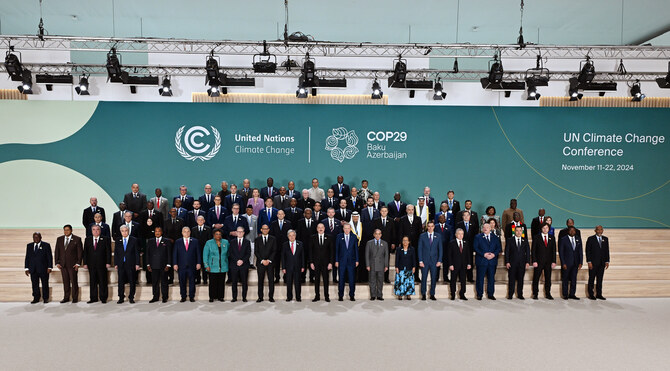
COP29 Day 2: World leaders gather in Baku for UN climate conference

World leaders gather for COP29. Supplied
Short Url
Updated 13 November 2024
Follow

COP29 Day 2: World leaders gather in Baku for UN climate conference

  • Top priority at COP29 is landing a hard-fought deal to boost funding for climate action in developing countries
  • African leaders shared national-level initiatives aimed at bolstering climate stability and economic prosperity

RIYADH: Dozens of world leaders convened in Azerbaijan on Tuesday for COP29 as the UN Secretary-General warned of the clock ticking for action to limit global temperature rises.

Speaking at the gathering in Baku, Antonio Guterres said the world is in the “final countdown” to limit global temperature rise to 1.5 degrees Celsius.

He added that 2024 is “almost certain” to be the hottest year on record.

His comments came as leading figures from governments around the world arrived for the summit, although many top politicians are not attending this year’s summit.

US President Joe Biden, China’s Xi Jinping, India’s Narendra Modi and French leader Emmanuel Macron are among G20 leaders missing the event.

The top priority at COP29 is landing a hard-fought deal to boost funding for climate action in developing countries.

Here are some of the key points from day 2 of COP29

African leaders warn of economic toll


Ethiopian President Taye Atske Selassie. Screenshot

During COP29, African leaders shared national-level initiatives aimed at bolstering climate stability and economic prosperity. 

Ethiopian President Taye Atske Selassie emphasized his nation's commitment to environmental restoration, saying: “We were able to plant 40 million trees, expanding our forest coverage to 23.6 percent with the potential to sink 10 billion tonnes of carbon.”  

He noted that Ethiopia has allocated 1 percent of its national budget towards a green legacy and land restoration fund, urging international support for these ongoing efforts. 

Tanzania’s Vice-President, Philip Mpango, highlighted the severe economic toll climate change has on developing nations, noting its current impact on his country.  

He added that Tanzania is losing 2 to 3 percent of its GDP annually due to climate-related damages, estimating the need for $19.2 billion by 2030 to meet its climate adaptation goals. 

Tiemoko Meyliet Kone, vice president of Cote d’Ivoire, outlined the economic risks his nation faces if climate action is not prioritized.  

“Without our bold initiatives, we could see a 13 percent drop in GDP by 2050, with nearly 2 million people falling into poverty,” Koné stated.  


Financial need is trillions, not billions, says President of Maldives


Screenshot

The lack of finance remains one of the main barriers for many countries, especially underdeveloped, to meet their climate goals, the President of Maldives told COP29.

Mohamed Muizzu explained that small island developing states need financing in trillions rather than billions.

“It is the lack of finance that inhibits our ambitions, which is why this COP, the finance COP we need to deliver the new climate finance goal, must reflect the true scale of the climate crisis. The need is in trillions, not billions,” Muizzu said.

Leaders call for an end to half-measures


Kazakhstan’s President Kassym-Jomart Tokayev. Screenshot

At COP 29, leaders stressed the need for urgent, cooperative action on climate change. Kazakhstan’s President Kassym-Jomart Tokayev pledged his country’s resources for the energy transition, emphasizing that demand must be socially responsible.  

Serbian President Aleksandar Vucic warned that while addressing environmental crises is essential, global peace is a prerequisite. He also called for financial solutions to aid smaller, poorer nations unfairly burdened by climate impacts caused by wealthier countries. 

Zimbabwe’s President Emmerson Mnangagwa urged an end to “half-measures,” while Turkiye’s President Recep Tayyip Erdogan highlighted his country’s vulnerability to climate change and its plans to expand nuclear energy capacity by 2050.  

Iraqi President Abdul Latif Rashid emphasized climate justice as a human rights issue, pressing for immediate action to protect current and future generations from the harsh realities of climate change. 

Leaders called for equity in green technology access and stronger global solidarity. Congo’s President Felix Tshisekedi reaffirmed his country’s commitment to biodiversity, and Belarusian President Aleksandr Lukashenko advocated for fair access to green technologies, ensuring developing nations retain autonomy over their resources. 


Fossil fuels ‘a gift of the God,’ Azerbaijan President tells COP29


Azerbaijan President Ilham Aliyev. Supplied

Defending fossil fuels and the right of countries to exploit them, Azerbaijan President Ilham Aliyev said: “Quote me that I said that this is a gift of the God, and I want to repeat it today here at this audience.”

He told delegates: “Oil, gas, wind, sun, gold, silver, copper, all ... are natural resources and countries should not be blamed for having them and should not be blamed for bringing these resources to the market, because the market needs them. People need them.”

UK Prime Minister Keir Starmer committed to a more ambitious climate goal for the country, saying greenhouse gas emissions would be cut by 81 percent versus 1990 levels by 2035 at the UN COP29 climate summit.

Last month Britain’s climate advisers, the Committee on Climate Change, made that recommendation to the government.

The emissions cut target recommended by the advisers compared to the current target of a 78 percent reduction by 2035 compared with 1990 levels and excludes international aviation and shipping emissions.

Saudi Arabia present at COP29


‘Without collaboration and cooperation ... we cannot hope to survive into the next century’ – Mayor of Kuala Lumpur


Supplied

The Mayor of Kuala Lumpur, Maimunah Sharif, used her address at the summit to highlight the critical issue of plastic pollution and its far-reaching effects.

She warned that by 2040, an estimated 1.3 billion tons of plastic will contaminate the air, water, and food we consume.

“In fact, each of us now has microplastics in our bloodstream, vital organs, and, as of this year, even in babies, in pregnant women,” Sharif said.


‘Developing countries must not leave Baku empty-handed’ — UN Secretary-General Antonio Guterres


UN Secretary-General Antonio Guterres​​​​​. Supplied

Guterres used a speech at COP29 to say the forum “must tear down the walls to climate finance.” 

He set out five elements he believes are critical to success: 

  • A significant increase in concessional public finance.
  • A clear indication of how public finance will mobilize the trillions of dollars developing countries need.
  • Tapping innovative sources, particularly levies on shipping, aviation, and fossil fuel extraction. Polluters must pay.
  • A framework for greater accessibility, transparency, and accountability – giving developing countries confidence that the money will materialize
  • Boosting lending capacity for bigger and bolder Multilateral Development Banks. 

Voluntary Carbon Markets

An announcement away from the speeches as Saudi Arabia’s Regional Voluntary Carbon Market Co. today launched its voluntary carbon market exchange platform, bringing 22 domestic and international companies on board on its first day of trading.

The launch of the platform is a major milestone in Saudi Arabia’s ambition to become one of the largest voluntary carbon markets in the world by 2030. It aims to scale up the supply and demand of high-quality carbon credits across the Global South and beyond, driving funding to climate projects that require finance, supporting the transition to global net zero emissions.

Speaking in Baku, Riham El-Gizy, RVCMC’s CEO said: “The message coming into COP is clear: To accelerate global decarbonization we must unlock financial flows to critical climate projects on an enormous scale. High integrity voluntary carbon markets can play an important role in bridging the climate finance gap this decade. But institutional grade infrastructure must be put in place to help buyers and sellers scale up private sector participation and achieve the market’s potential.”

RVCMC was established by the Public Investment Fund and Saudi Tadawul Group Holding Co. in October 2022. PIF holds an 80 percent stake and Tadawul Group holds a 20 percent stake in the company. 


World must prioritize resilience over disruption, economic experts warn

Saudi Arabia’s Finance Minister Mohammed Al-Jadaan urged policymakers and investors to “mute the noise” and focus on resilience.
Updated 23 January 2026
Follow

World must prioritize resilience over disruption, economic experts warn

  • Al-Jadaan said that much of the anxiety dominating markets reflected a world that had already been shifting for years
  • Pointing to Asia and the Gulf, Al-Jadaan said that some countries had already built models based on diversification and resilience

DAVOS: Saudi Arabia’s Finance Minister Mohammed Al-Jadaan urged policymakers and investors to “mute the noise” and focus on resilience, as global leaders gathered in Davos on Friday against a backdrop of trade tensions, geopolitical uncertainty and rapid technological change.

Speaking on the final day of the World Economic Forum in Davos, Al-Jadaan said that much of the anxiety dominating markets reflected a world that had already been shifting for years.

“We need to define who ‘we’ are in this so-called new world order,” he said, arguing that many emerging economies had been adapting to a more fragmented global system for decades.

Pointing to Asia and the Gulf, Al-Jadaan said that some countries had already built models based on diversification and resilience. In energy markets, he pointed out that the focus should remain on balancing supply and demand in a way that incentivized investment without harming the global economy.

“Our role in OPEC is to stabilize the market,” he said.

His remarks were echoed by Saudi Arabia’s Minister of Economy and Planning Faisal Alibrahim, who said that uncertainty had weighed heavily on growth, investment and geopolitical risk, but that reality had proven more resilient.

“The economy has adjusted and continues to move forward,” Alibrahim said.

Alibrahim warned that pragmatism had become scarce, trust increasingly transactional, and collaboration more fragile. “Stability cannot be quickly built or bought,” he said.

Alibrahim called for a shift away from preserving the status quo towards the practical ingredients that made cooperation work, stressing discipline and long-term thinking even when views diverged.

Quoting Saudi Arabia’s founding King Abdulaziz Al-Saud, he added: “Facing challenges requires strength and confidence, there is no virtue in weakness. We cannot sit idle.”

President of the European Central Bank Christine Lagarde stressed the importance of distinguishing meaningful data from headline noise, saying: “Our duty as central bankers is to separate the signal from the noise. The real numbers are growth numbers not nominal ones.”

Managing Director of the IMF Kristalina Georgieva echoed Lagarde’s sentiments, saying that the world had entered a more “shock prone” environment shaped by technology and geopolitics.

Director General of the World Trade Organization Ngozi Okonjo-Iweala said that the global trade systems currently in place were remarkably resilient, pointing out that 72 percent of global trade continued despite disruptions.

She urged governments and businesses, however, to avoid overreacting.

Okonjo Iweala said that a return to the old order was unlikely, but trade would remain essential. Georgieva agreed, saying global trade would continue, albeit in a different form.

Georgieva warned that AI would accelerate economic transformation at an unprecedented speed. The IMF expects 60 percent of jobs to be affected by AI, either enhanced or displaced, with entry-level roles and middle-class workers facing the greatest pressure.

Lagarde warned that without cooperation, capital and data flows would suffer, undermining productivity and growth.

Al-Jadaan said that power dynamics had always shaped global relations, but dialogue remained essential. “The fact that thousands of leaders came here says something,” he said. “Some things cannot be done alone.”

In another session titled Geopolitical Risks Outlook for 2026, former US Democratic representative Jane Harman said that because of AI, the world was safer in some ways but worse off in others.

“I think AI can make the world riskier if it gets in the wrong hands and is used without guardrails to kill all of us. But AI also has enormous promise. AI may be a development tool that moves the third world ahead faster than our world, which has pretty messy politics,” she said.

American economist Eswar Prasad said that currently the world was in a “doom loop.”

Prasad said that the global economy was stuck in a negative-feedback loop and economics, domestic politics and geopolitics were only bringing out the worst in each other.

“Technology could lead to shared prosperity but what we are seeing is much more concentration of economic and financial power within and between countries, potentially making it a destabilizing force,” he said.

Prasad predicted that AI and tech development would impact growing economies the most. But he said that there was uncertainty about whether these developments would create job opportunities and growth in developing countries.

Professor of international political economy at the University of New South Wales in Australia, Elizabeth Thurbon, said that China was driving a Green Energy transition in a way that should be modeled by the rest of the world.

“The Chinese government is using the Green Energy Transition to boost energy security and is manufacturing its own energy to reduce reliance on fossil fuel imports,” she explained.

Thurbon said that China was using this transition to boost economic security, social security and geostrategic security. She viewed this as a huge security-enhancing opportunity and every country had the ability to use the energy transition as a national security multiplier. 

“We are seeing an enormous dynamism across emerging market economies driven by China. This boom loop is being driven by enormous investments in green energy. Two-thirds of global investment flowing into renewable energy is driven largely by China,” she said.

Thurbon said that China was taking an interesting approach to building relationships with countries by putting economic engagement on the forefront of what they had to offer.

“China is doing all it can to ensure economic partnership with emerging economies are productive. It’s important to approach alliances as not just political alliances but investment in economy, future and the flourishment of a state,” she said.

The panel criticized global economic treaties and laws, and expressed the need for immediate reforms in economic governing bodies.

“If you are a developing economy, the rules of the WTO, for example, are not helpful for you to develop. A lot of the rules make it difficult to pursue an economic development agenda. These regulations are not allowing the economies to grow,” Thurbon said.

“Serious reform must be made in international trade agreements, economic bodies and rules and guidelines,” she added.

Prasad echoed this sentiment and said there was a need for national and international reform in global economic institutions.

“These institutions are not working very well so we can reconfigure them or rebuild them from scratch. But unfortunately the task of rebuilding falls into the hands of those who are shredding them,” he said.

WEF attendees were invited to join the Global Collaboration and Growth meeting to be held in Saudi Arabia in April 2026 to continue addressing the complex global challenges and engage in dialogue.