

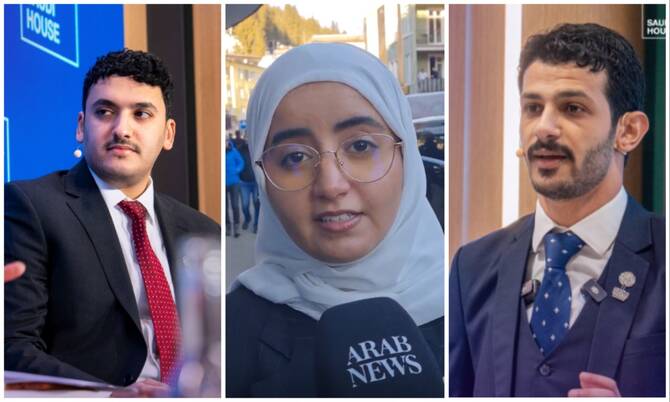

DAVOS: Saudi youth delegates from the Misk Foundation have been taking part in this year’s World Economic Forum in Davos, positioning the Kingdom’s next generation of leaders at the heart of global discussions on economic transformation, innovation and future decision-making.
Three delegates from the foundation spoke to Arab News about their journeys with Misk and how their trip to Davos has increased their passion for making a difference.
Abdulaziz Al-Jaloud, a member of the Misk youth delegation, said his journey began through the foundation’s leadership programs, which focus on equipping young Saudis with the skills and confidence to represent the Kingdom internationally.
“Part of my journey through Misk was joining the United Voices and the Fellowship programs,” he said. “The fellowship helps equip you to become a future leader, and the United Voices program helps you be a representative for Saudi Arabia in global events.”
In Davos, Al-Jaloud said the experience has been defined by exposure and engagement rather than observation from the sidelines.
“Being part of the … change that’s happening in the global conversation, and giving back through amplifying the youth voice,” he said.
Asked about the broader climate for young people in Saudi Arabia, Al-Jaloud said empowerment had become a defining feature of the current moment.
“I would say we’re very passionate, we’re very driven,” he said. “The empowerment that exists currently for the youth in Saudi is helping us reach our full potential.”
For Haifa Al-Mofareh, who is also part of the delegation, her involvement with Misk grew out of a desire to support young Saudis working in the space sector and to represent them on global platforms.
“I’m very passionate about space, and I wanted to empower the youth that are working in space,” Al-Mofareh said.
In Davos, she has been participating in discussions focused on ensuring youth play an active role in shaping the future, rather than being limited to symbolic participation.
“I’ve been engaging in discussions about youth that are helping us be part of building the future, not just participating in it or just talking about it,” she said. “That has been a really mind-altering experience.”
She added that international perceptions of Saudi youth often underestimate the scale of opportunity available at home.
“It’s incredible,” Al-Mofareh said. “Everyone I talk to here, especially foreigners, they are baffled by it. Many youth from other countries can’t even fathom the experiences and the opportunities that we have as Saudi youth now, even though it’s super normalized back home. That’s something I’m incredibly proud to share with the world.”
Meshal Al-Shalan, who joined Misk while completing a master’s degree in chemical engineering at the Massachusetts Institute of Technology, said that the foundation opened the door for him to attend Davos as part of the youth delegation and that he was “excited and thankful” for the opportunity.
One of the standout themes for Al-Shalan has been the growing recognition that young people must be involved directly in economic design and decision-making.
“The biggest highlight is that youth are ready to be building the future economy,” he said. “I moderated a session about involving youth early on in system-making and decision-making, and that message is coming from speakers from very different backgrounds,” he added.
Reflecting on opportunities back home, Al-Shalan said Saudi Arabia has created an environment where ideas can move quickly from concept to execution.
“I feel like the door is open in Saudi Arabia for anyone,” he said.
“If you have an idea, the government, companies and investors are there. They’ve invested a lot in youth, and you can see that clearly.”
With more than half the Saudi population under the age of 35, he added, the youth are not a marginal group but the country’s majority, adding: “You can see the future is very bright.”


