Africa ‘is no longer facing mpox

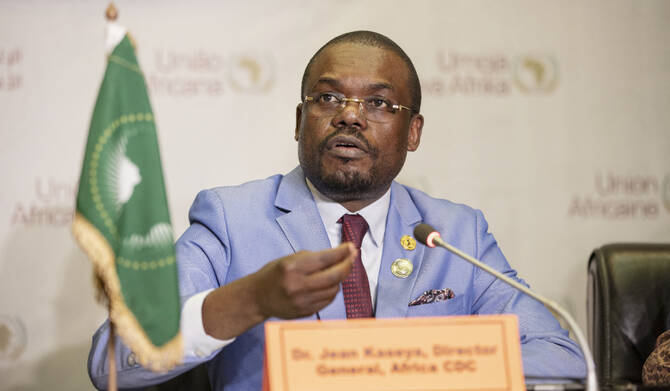
Director General of Africa Centres for Disease Control and Prevention (CDC) Jean Kaseya conducts a press conference in Addis Ababa on February 18, 2024. (AFP file photo)
Short Url
Updated 24 January 2026
Follow

Africa ‘is no longer facing mpox

  • WHO had declared its worldwide public health emergency over the viral infection — previously known as Monkeypox, and related to smallpox — in August 2024, after a two-pronged mpox epidemic broke out, primarily in the Democratic Republic of Congo

ADDIS ABABA: Africa is no longer in the grip of a public health emergency over mpox, though the viral infection “remains endemic in several settings,” the head of the region’s disease monitoring centers said on Saturday.
The announcement by Jean Kaseya, director general of the Africa Centers for Disease Control and Prevention, comes after the World Health Organization in September said mpox was no longer a global health emergency.

FASTFACT

The World Health Organization declared its worldwide public health emergency over the viral infection — previously known as Monkeypox, and related to smallpox — in August 2024.

WHO had declared its worldwide public health emergency over the viral infection — previously known as Monkeypox, and related to smallpox — in August 2024, after a two-pronged mpox epidemic broke out, primarily in the Democratic Republic of Congo.
Kaseya said Africa was lifting its regional emergency status for the illness due to enhanced detection, improved treatment, and the rollout of more than 5 million mpox vaccines in 16 countries since 2024.
The response contributed to a 60 percent drop in confirmed cases between early 2025 and late 2025, and to a drop in deaths among those infected from 2.6 percent to 0.6 percent, he said in a statement.
The lifting of the regional public health emergency status “does not mark the end of mpox in Africa,” he added.
“Rather, it signals a transition from emergency response to a sustained, country-led pathway toward elimination. Mpox remains endemic in several settings, and continued vigilance, targeted investment, and innovation will be essential to consolidate gains and prevent resurgence.”
According to the World Health Organization, 78 percent of mpox cases were detected in Africa, with the Democratic Republic of Congo, Guinea, and Madagascar most affected.


South Africa to withdraw its troops from UN peacekeeping mission in Congo

Updated 5 sec ago
Follow

South Africa to withdraw its troops from UN peacekeeping mission in Congo

  • South Africa to withdraw its troops from UN peacekeeping mission in Congo
JOHANNESBURG: South Africa will withdraw its troops from the United Nations peacekeeping mission in the ​Democratic Republic of Congo, President Cyril Ramaphosa’s office said in a statement late on Saturday.
Ramaphosa has told UN Secretary-General Antonio Guterres about the decision, which was influenced by the need ‌to “realign” the ‌resources of South ‌Africa’s ⁠armed ​forces, ‌the statement said.
South Africa has supported UN peacekeeping efforts in Congo for 27 years and has more than 700 soldiers deployed there.
The UN mission had a total of nearly ⁠11,000 troops and police deployed when its ‌mandate was extended in ‍December.
The UN ‍mission’s mandate is to counter ‍the many rebel groups active in Congo’s restive east, where conflict has raged for decades and where there has ​been a recent escalation in fighting.
“South Africa will work jointly ⁠with the UN to finalize the timelines and other modalities of the withdrawal, which will be completed before the end of 2026,” the statement added.
South Africa will continue to maintain close bilateral ties with Congo’s government and support other multilateral efforts to bring lasting ‌peace to Congo, Ramaphosa’s office said.