

Jeddah students get closer look at electric motorsport

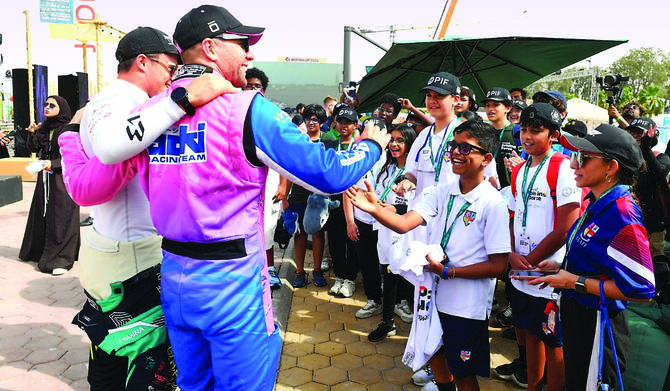
The sessions for students formed part of Driving Force Presented by the Public Investment Fund, an initiative run by Formula E and its electric racing series partners. (SPA)
Short Url
Updated 24 January 2026
Follow

Jeddah students get closer look at electric motorsport

  • A PIF-linked initiative highlights technical and engineering careers behind electric racing events

JEDDAH: Students from local and international schools in Jeddah were introduced to STEM-related career pathways in electric motorsport this week, as part of an education program linked to the UIM E1 World Championship held on the Red Sea.

The sessions formed part of Driving Force Presented by the Public Investment Fund, an initiative run by Formula E and its electric racing series partners, to familiarize students aged eight to 18 with science, technology, engineering and mathematics through electric racing and sustainability-focused industries.


The sessions for students formed part of Driving Force Presented by the Public Investment Fund, an initiative run by Formula E and its electric racing series partners. (Supplied)

The programme took place alongside the 2026 E1 Jeddah GP and included workshops, school visits and trackside access designed to show how engineering, data, broadcast technology and event operations function within professional motorsport.

According to organisers, the initiative reached more than 60,000 students globally in 2025, with further expansion planned this year. 

HIGHLIGHTS

• The program took place alongside the 2026 E1 Jeddah GP and included workshops, school visits and trackside access.

• Students learned about E1 races and their technical and environmental dimensions and discussed the engineering and marine aspects of electric boats.

• According to organisers, the initiative reached more than 60,000 students globally in 2025, with further expansion planned this year. 

John Williams, managing director at E1, told Arab News: “The PIF is absolutely vital to everything we do here at the E1. They were crucial initial investment partner since the start of the championship and they continue to support us in a number of ways and more specifically around the Driving Force program.”


The sessions for students formed part of Driving Force Presented by the Public Investment Fund, an initiative run by Formula E and its electric racing series partners. (Supplied)

Elaborating more on the program, he said: “What we are doing is presenting and showing these students the available careers of science, technology, engineering and mathematics, as well as careers in sports, not only pilots but also engineers and mechanics.”

Williams added that the main key to the program was bringing a new generation to the mechanism of sport.

“We are introducing to these exciting new technologies around the race but it could be our technology on the boat or our broadcast products, as well as how to manage the event its self. There are a range of opportunities to show it to the children in addition to enjoying the excitement of the race and meeting the pilots.”

The program’s Jeddah activities began at King Abdulaziz University’s faculty of maritime studies, where students took part in a hands-on workshop focused on STEM careers in the motorsport and sustainability areas conducted by technology experts and famous water pilots such as Dani Clos, Emma Kimilainen and Patricia Pita.

Students learned about E1 races and their technical and environmental dimensions and discussed the engineering and marine aspects of electric boats.

They also enjoyed exclusive behind-the-scenes access at the E1 Jeddah GP, pilot meet-and-greets, and front-row seats to watch the RaceBird boats in action.


Makkah’s urban shift enhances the city’s quality of life

Updated 08 February 2026
Follow

Makkah’s urban shift enhances the city’s quality of life

  • By harmonizing its religious heritage with modern urban development, Makkah is proving that a city can honor its past while vigorously embracing the future

MAKKAH: Islam’s holiest city is currently witnessing a qualitative urban shift, one that seamlessly blends its profound spiritual sanctity with a modern, vibrant lifestyle. By integrating cultural, educational, and entertainment initiatives, Makkah is redefining the visitor experience and significantly enhancing the quality of life for its residents, directly supporting the goals of Saudi Vision 2030.

The city’s transformation was recently highlighted by the success of the Makkah winter season. The event attracted approximately 400,000 visitors — over 60% of whom were locals — demonstrating a strong domestic demand for high-quality public spaces.

The season revitalized community interaction, driving a 35% increase in visits to recreational sites and creating more than 1,200 temporary jobs for the local workforce.

Central to this urban renaissance is the Hira Cultural District. Since opening its doors in January 2023 near the historic Mount Hira, the district has become a definitive landmark that bridges Islamic history with contemporary identity.

Makkah’s Hira Cultural District has become a definitive landmark that bridges Islamic history with contemporary identity. (SPA photo)

Far from being a static monument, the district has cultivated a thriving creative economy. Its craftsmanship program, which features over 100 artisans, has generated up to SAR 3 million in sales and attracted 130,000 visitors to live workshops. These interactive spaces allow visitors to engage directly with the region’s heritage, moving beyond passive observation to active participation.

A living legacy 

The shift extends to Makkah’s broader ecosystem of museums and cultural sites, which are now positioned as key pillars of cultural tourism. Facilities like the Revelation Exhibition use cutting-edge technology and multilingual content to narrate the story of the Holy Quran’s revelation, offering an immersive experience that complements the spiritual journey of pilgrims.

These efforts align with the “Makkah: A Living Legacy” campaign, which seeks to document the city’s historical narrative and preserve its collective memory. Recent months have seen a surge in educational workshops for university students and tour guides, ensuring that the human element of Makkah’s history is conveyed with accuracy and depth.

City’s transformation recently highlighted by the success of the Makkah winter season. (SPA photo)
 

Economic and social impact 

The results of this integrated approach are tangible. Specialized museums and restored historic sites now attract up to 1.6 million annual visitors. Crucially, this cultural enrichment is encouraging pilgrims to linger longer, increasing the average duration of stay by 18%.

By harmonizing its religious heritage with modern urban development, Makkah is proving that a city can honor its past while vigorously embracing the future, offering a holistic experience that nourishes both the soul and the community.