


Shutdown looms as US Senate, House advance separate spending plans

1 / 2
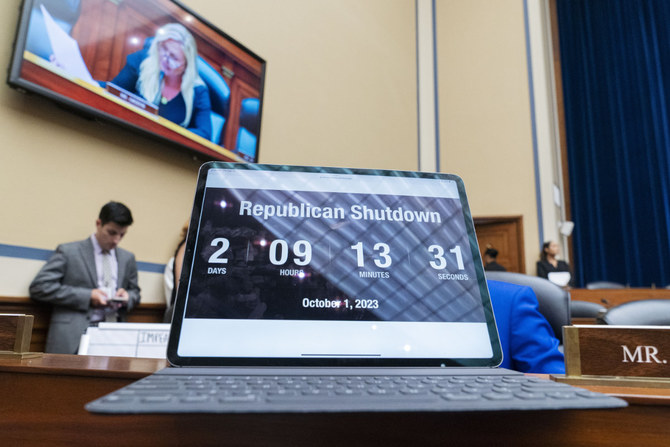
A countdown clock about the time left before a government shutdown is seen in the foreground as Rep. Marjorie Taylor Greene is seen on a screen during a House Oversight Committee impeachment inquiry into President Joe Biden on Sept. 28, 2023, in Washington. (AP)
2 / 2
Rep. Marjorie Taylor Greene stages a protest on the steps of the US Capitol building as the deadline to avert a government shutdown approaches in Washington on September 26, 2023. (Reuters)
Short Url
Updated 29 September 2023
Follow

Shutdown looms as US Senate, House advance separate spending plans

  • House Republicans are demanding a $120 billion cuts in an earlier agreed $1.59 trillion in discretionary spending in fiscal 2024
  • They also want tougher legislation that would stop the flow of immigrants at the US southern border with Mexico

WASHINGTON: The Democratic-led US Senate forged ahead on Thursday with a bipartisan stopgap funding bill aimed at averting a fourth partial government shutdown in a decade, while the House began voting on partisan Republican spending bills with no chance of becoming law.

The divergent paths of the two chambers appeared to increase the odds that federal agencies will run out of money on Sunday, furloughing hundreds of thousands of federal workers and halting a wide range of services from economic data releases to nutrition benefits.
The House of Representatives voted 216-212 on a bill funding the State Department and other aspects of foreign affairs, the first in a series of four partisan appropriations bills that would not alone prevent a shutdown, even if they could overcome strong opposition from Senate Democrats and become law.
The Senate earlier in the day had voted 76-22 to open debate on a stopgap bill known as a continuing resolution, or CR, which would extend federal spending until Nov. 17, and authorize roughly $6 billion each for domestic disaster response funding and aid to Ukraine to defend itself against Russia.
The Senate measure has already been rejected by Republicans, who control the House.
House Republicans, led by a small faction of hard-line conservatives in the chamber they control by a 221-212 margin, have rejected spending levels for fiscal year 2024 set in a deal Speaker Kevin McCarthy negotiated with Biden in May.
The agreement included $1.59 trillion in discretionary spending in fiscal 2024. House Republicans are demanding another $120 billion in cuts, plus tougher legislation that would stop the flow of immigrants at the US southern border with Mexico.
The funding fight focuses on a relatively small slice of the $6.4 trillion US budget for this fiscal year. Lawmakers are not considering cuts to popular benefit programs such as Social Security and Medicare.
McCarthy is facing intense pressure from his caucus to achieve their goals. Several hard-liners have threatened to oust him from his leadership role if he passes a spending bill that requires any Democratic votes to pass.
Former President Donald Trump has taken to social media to push his congressional allies toward a shutdown.
McCarthy, for his part, suggested on Thursday that a shutdown could be avoided if Senate Democrats agreed to address border issues in their stopgap measure.
“I talked this morning to some Democratic senators over there that are more aligned with what we want to do. They want to do something about the border,” McCarthy told reporters in the US Capitol.
“We’re trying to work to see, could we put some border provisions in that current Senate bill that would actually make things a lot better,” he said.
The House Freedom Caucus, home to the hard-liners forcing McCarthy’s hand, in an open letter to him on Thursday demanded a timeline for passing the seven remaining appropriations bills and a plan to further reduce the top-line discretionary spending figure, among other questions.

The Senate measure has passed two procedural hurdles this week with strong bipartisan support.
“Congress has only one option — one option — to avoid a shutdown: bipartisanship,” Senate Majority Leader Chuck Schumer said on Thursday. “With bipartisanship, we can responsibly fund the government and avoid the sharp and unnecessary pain for the American people and the economy that a shutdown will bring.”
Credit agencies have warned that brinkmanship and political polarization are harming the US financial outlook. Moody’s, the last major ratings agency to rate the US government “Aaa” with a stable outlook, said on Monday that a shutdown would harm the country’s credit rating.
Fitch, another major ratings agency, already downgraded the US government to “AA+” after Congress flirted with defaulting on the nation’s debt earlier this year.


US senators visit key Ukrainian port city as they push for fresh sanctions on Russia

Updated 5 sec ago
Follow

US senators visit key Ukrainian port city as they push for fresh sanctions on Russia

  • The visit and the push for Congress to take up sanctions on Russia come at a crucial moment in the conflict

WASHINGTON: A delegation of US senators was returning Wednesday from a trip to Ukraine, hoping to spur action in Congress for a series of sanctions meant to economically cripple Moscow and pressure President Vladimir Putin to make key concessions in peace talks.
It was the first time US senators have visited Odesa, Ukraine’s third-most populous city and an economically crucial Black Sea port that has been particularly targeted by Russia, since the war began nearly four years ago. Democratic Sens. Jeanne Shaheen, Chris Coons, Richard Blumenthal and Sheldon Whitehouse made the trip. Republican Sen. Thom Tillis had planned to join but was unable to for personal reasons.
“One of the things we heard wherever we stopped today was that the people of Ukraine want a peace deal, but they want a peace deal that preserves their sovereignty, that recognizes the importance of the integrity of Ukraine,” Shaheen said on a phone call with reporters.
The visit and the push for Congress to take up sanctions on Russia come at a crucial moment in the conflict. Delegations for the two sides were also meeting in Switzerland for two days of US-brokered talks, but neither side appeared ready to budge on key issues like territory and future security guarantees. The sanctions, senators hoped, could prod Putin toward settling for peace, as the US has set a June deadline for settlement.
“Literally nobody believes that Russia is acting in good faith in the negotiations with our government and with the Ukrainians,” Whitehouse said. “And so pressure becomes the key.”
Still, legislation to impose tough sanctions on Russia has been on hold in Congress for months.
Senators have put forward a range of sanction measures, including one sweeping bill that would allows the Trump administration to impose tariffs and secondary sanctions on countries that purchase Russia’s oil, gas, uranium and other exports, which are crucial to financing Russia’s military. The Senate Foreign Relations Committee has also advanced a series of more-targeted bills that would sanction China’s efforts to support Russia’s military, commandeer frozen Russian assets and go after what’s known as Moscow’s “shadow fleet” of oil tankers being used to circumvent sanctions already in place.
Republican Sen. Lindsey Graham, who has co-sponsored the Senate’s sweeping sanctions and tariff legislation, also released a statement during the Munich Security Conference this weekend saying that Senate Majority Leader John Thune had committed to bringing up the sanctions bill once it clearly has the 60 votes needed to move through the Senate.
“This legislation will be a game changer,” Graham said. “President Trump has embraced it. It is time to vote.”
Blumenthal, who co-sponsored that bill alongside Graham, also said there is bipartisan support for the legislation, which he called a “very tough sledgehammer of sanctions and tariffs,” but he also noted that “we need to work out some of the remaining details.” Democrats, and a handful of Republicans, have been opposed to President Donald Trump’s campaign to impose tariffs around the world in an effort to strike trade deals and spur more manufacturing in the US
In the House, Democrats are opposed to the tariff provisions of that bill. Instead, a bipartisan group of lawmakers, led by Republican Rep. Brian Fitzpatrick, has proposed separate legislation that makes it more difficult for Trump to waive sanctions, but does away with the tariff provisions.
A separate bill, led by the top Democrat on the House Foreign Affairs Committee, Rep. Gregory Meeks, would bolster US military support for Ukraine by $8 billion. Democrats currently need one more Republican to support an effort to force a vote on that bill.
Once they return to the US, the senators said they would detail how US businesses based in Ukraine have been attacked by Russia. The Democrats are also hoping to build pressure on Trump to send more US weapons to Ukraine. “Putin understands weapons, not words,” Blumenthal said.
Still, the lawmakers will soon return to a Washington where the Trump administration is ambivalent about its long-term commitments to securing peace in Ukraine, as well as Europe. For now, at least, they were buoyed by the conversations from their European counterparts and Republican colleagues.
“We and the Republican senators who were with us in Munich spoke with one voice about our determination to continue to support Ukraine,” Coons said.