DHAKA: Bangladesh Prime Minister Sheikh Hasina imposed a nationwide curfew last week and used the army to quell protests against job quotas that killed nearly 150 people, but anger against her government does not seem to have abated.
The protests, which started in universities and colleges earlier this month, quickly turned into a more widespread agitation against Hasina and her government.
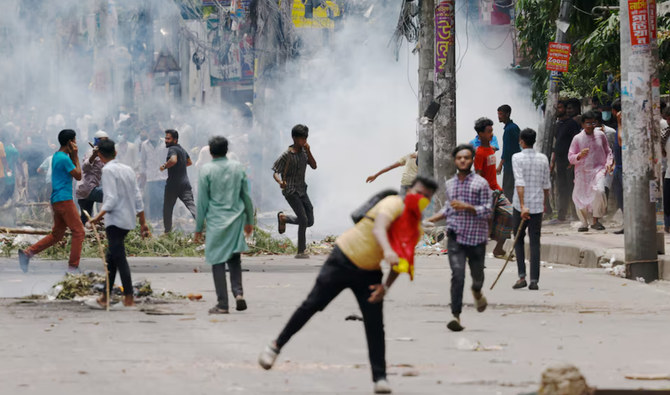
Police fired rubber bullets, tear gas and lobbed sound grenades to disperse tens of thousands of protesters who came out on the streets. The government denied any live rounds were fired, but hospital sources said dead and injured people had wounds from bullets and shot gun pellets.
Rights groups and critics say Hasina has become increasingly autocratic during her last 15 years in power and her rule has been marked by mass arrests of political opponents and activists, forced disappearances and extrajudicial killings, charges she denies.
Badiul Alam Majumdar, the secretary of Shushahoner Jonno Nagorik, a Dhaka-based civil society platform for good governance, said the protests were “just the tip of the iceberg” and the use of force against students will breed further discontent against Hasina’s government.
“People are being deprived of their basic rights, with a significant lack of human rights and justice. They can’t cast their votes freely,” he said. “This widespread frustration and anger among the people is evident in the protests.”
Government official were not immediately available for comment. But officials have said previously no students were involved in arson or violence, and instead blamed opposition parties.
Hasina, 76, first led her Awami League party to victory in elections in 1996, serving one five-year term before regaining power in 2009, never to lose again.
She won a fourth straight term in office in January elections that were boycotted by the main opposition party and also marred by deadly protests.
While Hasina managed to overcome discontent and return the country toward some normalcy this week, it will not be “business as usual” going forward, said Zafar Sobhan, the editor of English daily Dhaka Tribune.
“This crisis shows that the government needs to listen to the young people of the country and take their concerns seriously,” said Sobhan, adding that the quota issue served as a proxy for several other key issues.
“The government has been put on notice that enough is enough and it needs to address the legitimate concerns of the public,” he said.
‘MURDERS SHOULD BE INVESTIGATED’
Asif Mahmud, a student leader, told Reuters that he was abducted and abused by authorities for four days and then dumped on the road this week. His allegations could not be independently verified and government officials could not be immediately reached for comment on a holiday.
“There have been killings, nobody is addressing that,” Mahmud said. “These murders should be investigated. Those who ran this massacre, we will demand their prompt punishment.”
The United Nations, international rights groups, the US and Britain have criticized the use of force and asked Dhaka to uphold the right to peaceful protests.
Hasina said she was forced to impose the curfew to protect citizens and state property, blaming the main opposition Bangladesh Nationalist Party (BNP) and the Jamaat-e-Islami party for the violence, charges they denied.
Tarique Rahman, the exiled acting chairman of BNP, said that Hasina was involved in “mass murder” during the protests.
The daughter of the country’s founding father Sheikh Mujibur Rahman, who led Bangladesh’s independence from Pakistan, Hasina has been credited with turning around the economy and the massive garments industry.
But the economy has also slowed sharply since the Russia-Ukraine war pushed up prices of fuel and food imports, forcing Bangladesh to turn last year to the International Monetary Fund for a $4.7 billion bailout.
Experts have blamed the latest unrest on stagnant job growth in the private sector and high rates of youth unemployment that have made government jobs, with their regular wage hikes and other privileges, more attractive.
Failing to tame inflation, which currently hovers around 10 percent, and unemployment was not due to a dearth of options but rather due to a lack of political will, the experts said.
“One critical policy approach could have been to increase investment into the services sectors like health and education where it would be possible to create more decent jobs, especially for the educated and relatively young people,” said Mohammad Abdur Razzaque, chairman of Dhaka think tank Research and Policy Integration for Development.


![]()

Bangladesh protests quelled but anger, discontent remain
Short Url
https://arab.news/2xbn3
Bangladesh protests quelled but anger, discontent remain
- The protests, which started in universities and colleges this month, quickly turned into a more widespread agitation against government
- Police fired rubber bullets, tear gas and lobbed sound grenades to disperse tens of thousands of protesters who came out on the streets
Latest updates





© 2026 SAUDI RESEARCH & PUBLISHING COMPANY, All Rights Reserved And subject to Terms of Use Agreement.