PARIS: France’s interior minister said on Saturday he could not rule out foreign involvement in an attack that sabotaged signal stations and cables on the country’s high-speed rail network, causing travel chaos on the opening day of the Olympic Games.
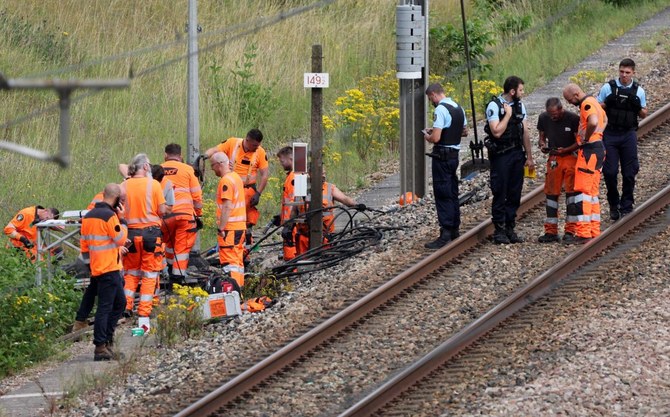
Friday’s pre-dawn attacks damaged infrastructure along the lines connecting Paris with cities such as Lille in the north, Bordeaux in the west and Strasbourg in the east. Another attack on the Paris-Marseille line was foiled, SNCF has said.
There has been no immediate claim of responsibility.
“Who is responsible? Either it’s from within, or it’s been ordered from abroad, it’s too early to say,” Interior Minister Gerald Darmanin told France 2 television.
He added: “We have uncovered a certain number of elements which lead us to believe that we will know fairly quickly who is responsible.”
Two security sources said on Friday the modus operandi meant initial suspicions fell on leftist militants or environmental activists, but that there was not yet any evidence.
Traffic on France’s high-speed rail network should be back to normal by Monday, Transport Minister Patrice Vergriete and rail operator SNCF’s chief Jean-Pierre Farandou told reporters on Saturday.
SNCF reiterated that transport plans for teams competing in the Paris 2024 Olympics would be guaranteed.
On Friday, 100,000 people could not take their trains, and another 150,000 faced delays but eventually got to their destinations, Vergriete said.
“There will still be disruptions tomorrow,” Vergriete said. “From Monday, there is no need to worry.”


![]()

French minister says foreign involvement not ruled out in rail sabotage
Short Url
https://arab.news/j328w
French minister says foreign involvement not ruled out in rail sabotage
- “Who is responsible? Either it’s from within, or it’s been ordered from abroad, it’s too early to say,” Interior Minister Gerald Darmanin said
- Two security sources said on Friday the modus operandi meant initial suspicions fell on leftist militants or environmental activists


Latest updates




Recommended


© 2026 SAUDI RESEARCH & PUBLISHING COMPANY, All Rights Reserved And subject to Terms of Use Agreement.