DHAKA: Bangladeshi police detectives on Friday forced the discharge from hospital of three student protest leaders blamed for deadly unrest, taking them to an unknown location, staff told AFP.
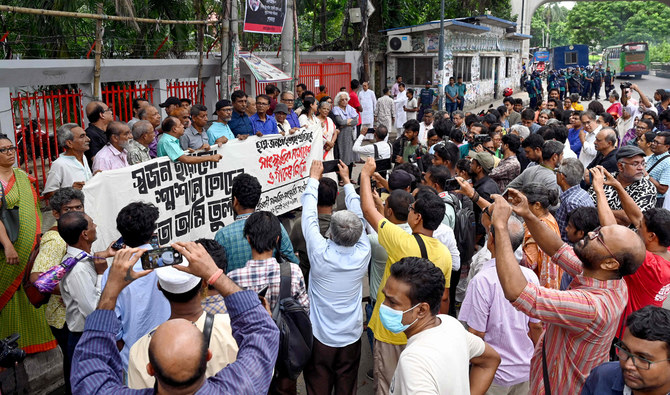
Nahid Islam, Asif Mahmud and Abu Baker Majumder are all members of Students Against Discrimination, the group responsible for organizing this month’s street rallies against civil service hiring rules.
At least 195 people were killed in the ensuing police crackdown and clashes, according to an AFP count of victims reported by police and hospitals, in some of the worst unrest of Prime Minister Sheikh Hasina’s tenure.
All three were patients at a hospital in the capital Dhaka, and at least two of them said their injuries were caused by torture in earlier police custody.
“They took them from us,” Gonoshasthaya hospital supervisor Anwara Begum Lucky told AFP. “The men were from the Detective Branch.”
She added that she had not wanted to discharge the student leaders but police had pressured the hospital chief to do so.
Islam’s elder sister Fatema Tasnim told AFP from the hospital that six plainclothes detectives had taken all three men.
The trio’s student group had suspended fresh protests at the start of this week, saying they had wanted the reform of government job quotas but not “at the expense of so much blood.”
The pause was due to expire earlier on Friday but the group had given no indication of its future course of action.
Islam, 26, the chief coordinator of Students Against Discrimination, told AFP from his hospital bed on Monday that he feared for his life.
He said that two days beforehand, a group of people identifying themselves as police detectives blindfolded and handcuffed him and took him to an unknown location.
Islam added that he had come to his senses the following morning on a roadside in Dhaka.
Mahmud earlier told AFP that he had also been detained by police and beaten at the height of last week’s unrest.
Three senior police officers in Dhaka all denied that the trio had been taken from the hospital and into custody on Friday.
Police told AFP on Thursday that they had arrested at least 4,000 people since the unrest began last week, including 2,500 in Dhaka.
On Friday police said they had arrested David Hasanat, the founder and chief executive of one of Bangladesh’s biggest garment factory enterprises.
His Viyellatex Group employs more than 15,000 people according to its website, and its annual turnover was estimated at $400 million by the Daily Star newspaper last year.
Dhaka Metropolitan Police inspector Abu Sayed Miah said Hasanat and several others were suspected of financing the “anarchy, arson and vandalism” of last week.
Bangladesh makes around $50 billion in annual export earnings from the textile trade, which services leading global brands including H&M, Gap and others.
Student protests began this month after the reintroduction in June of a scheme reserving more than half of government jobs for certain candidates.
With around 18 million young people in Bangladesh out of work, according to government figures, the move deeply upset graduates facing an acute jobs crisis.
Critics say the quota is used to stack public jobs with loyalists to Hasina’s Awami League.
The Supreme Court cut the number of reserved jobs on Sunday but fell short of protesters’ demands to scrap the quotas entirely.
Hasina has ruled Bangladesh since 2009 and won her fourth consecutive election in January after a vote without genuine opposition.
Her government is also accused by rights groups of misusing state institutions to entrench its hold on power and stamp out dissent, including the extrajudicial killing of opposition activists.
Hasina continued a tour of government buildings that had been ransacked by protesters, on Friday visiting state broadcaster Bangladesh Television, which was partly set ablaze last week.
“Find those who were involved in this,” she said, according to state news agency BSS.
“Cooperate with us to ensure their punishment. I am making this call to the nation.”


![]()

Bangladesh protest leaders taken from hospital by police
Short Url
https://arab.news/ccaxh
Bangladesh protest leaders taken from hospital by police
- The Students Against Discrimination group organized this month’s street rallies against civil service hiring rules in Bangladesh
- At least 195 people were killed in ensuing police crackdown, clashes in some of the worst unrest of PM Sheikh Hasina’s tenure
Latest updates


© 2026 SAUDI RESEARCH & PUBLISHING COMPANY, All Rights Reserved And subject to Terms of Use Agreement.