Biden, US officials warn of hunger for millions in a government shutdown

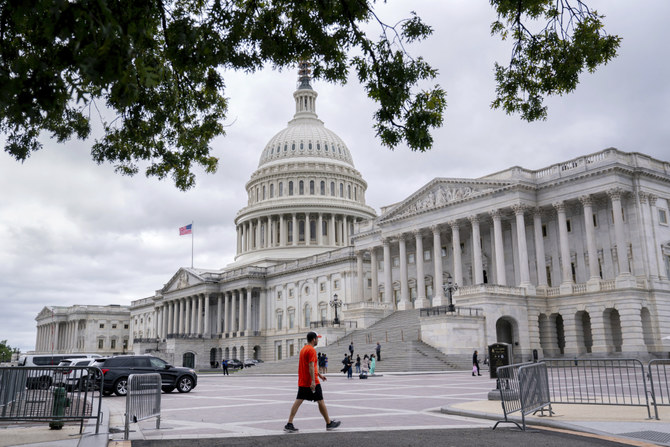
Visitors tour the Capitol grounds in Washington, Monday, Sept. 25, 2023. (AP)
Short Url
Updated 26 September 2023
Follow

Biden, US officials warn of hunger for millions in a government shutdown

  • More than 40 million Americans relied on SNAP to make ends meet in 2022; inflation has put new pressure on household budgets, with prices higher since the COVID-19 pandemic for goods from bread to fresh vegetables and baby formula

WASHINGTON: US President Joe Biden and one of his top aides warned on Monday that a federal government shutdown could cause widespread suffering, including a rapid loss of food benefits for nearly 7 million low-income women and children.
Biden told a meeting on Historically Black Colleges and Universities that failure by Congress to fund the federal government would have dire consequences for the Black community, including by reducing nutritional benefits, inspections of hazardous waste sites and enforcement of fair housing laws.
He said he and House Speaker Kevin McCarthy had agreed a few months ago on spending levels for the government.
“We made a deal, we shook hands,” he said. “Now a small group of extreme House Republicans .. don’t want to live up to that deal, and everyone in America could be faced with paying the price for it.”
Asked if he had spoken with McCarthy, Biden said, “I haven’t.” He shook his head when asked when they would speak.
US Agriculture Secretary Tom Vilsack told reporters earlier that the “vast majority” of the 7 million participants in the Special Supplemental Nutrition Program for Women, Infants, and Children (WIC) program would see an immediate reduction in benefits in the days and weeks after a shutdown starts.
Nearly half of US newborns rely on WIC, the USDA says.
A separate benefits program, Supplemental Nutrition Assistance Program (SNAP), will continue as normal for the month of October but could be affected afterward, he said.
More than 40 million Americans relied on SNAP to make ends meet in 2022; inflation has put new pressure on household budgets, with prices higher since the COVID-19 pandemic for goods from bread to fresh vegetables and baby formula.
During a shutdown, farm service agencies will also stop making loans to farmers during harvest time, and new homebuyers will not be able to get loans in rural areas, Vilsack said. More than 50,000 Department of Agriculture workers will be furloughed, meaning they will not receive a paycheck.
The Republican-controlled House of Representatives may move to advance steep spending cuts this week that would almost certainly be rejected by the Democratic-controlled Senate. While the cuts would not become law, a failure by both chambers to agree could force a partial shutdown of the US government by next Sunday.
House lawmakers on Tuesday were set to take up four spending bills for the coming fiscal year that would also impose new restrictions on abortion access, undo an $11 billion Biden administration climate initiative, and resume construction of the Mexico-US border wall, a signature initiative of former President Donald Trump. Biden has vowed to veto at least two of the bills.
Vilsack called Republican fiscal plans “punitive” and “petty.” 


Only 4% women on ballot as Bangladesh prepares for post-Hasina vote

Updated 26 January 2026
Follow

Only 4% women on ballot as Bangladesh prepares for post-Hasina vote

  • Women PMs have ruled Bangladesh for over half of its independent history
  • For 2026 vote, only 20 out of 51 political parties nominated female candidates

DHAKA: As Bangladesh prepares for the first election since the ouster of its long-serving ex-prime minister Sheikh Hasina, only 4 percent of the registered candidates are women, as more than half of the political parties did not field female candidates.

The vote on Feb. 12 will bring in new leadership after an 18-month rule of the caretaker administration that took control following the student-led uprising that ended 15 years in power of Hasina’s Awami League party.

Nearly 128 million Bangladeshis will head to the polls, but while more than 62 million of them are women, the percentage of female candidates in the race is incomparably lower, despite last year’s consensus reached by political parties to have at least 5 percent women on their lists.

According to the Election Commission, among 1,981 candidates only 81 are women, in a country that in its 54 years of independence had for 32 years been led by women prime ministers — Hasina and her late rival Khaleda Zia.

According to Dr. Rasheda Rawnak Khan from the Department of Anthropology at Dhaka University, women’s political participation was neither reflected by the rule of Hasina nor Zia.

“Bangladesh has had women rulers, not women’s rule,” Khan told Arab News. “The structure of party politics in Bangladesh is deeply patriarchal.”

Only 20 out of 51 political parties nominated female candidates for the 2026 vote. Percentage-wise, the Bangladesh Socialist Party was leading with nine women, or 34 percent of its candidates.

The election’s main contender, the Bangladesh Nationalist Party, whose former leader Zia in 1991 became the second woman prime minister of a predominantly Muslim nation — after Pakistan’s Benazir Bhutto — was the party that last year put forward the 5 percent quota for women.

For the upcoming vote, however, it ended up nominating only 10 women, or 3.5 percent of its 288 candidates.

The second-largest party, Jamaat-e-Islami, has not nominated a single woman.

The 4 percent participation is lower than in the previous election in 2024, when it was slightly above 5 percent, but there was no decreasing trend. In 2019, the rate was 5.9 percent, and 4 percent in 2014.

“We have not seen any independent women’s political movement or institutional activities earlier, from where women could now participate in the election independently,” Khan said.

“Real political participation is different and difficult as well in this patriarchal society, where we need to establish internal party democracy, protection from political violence, ensure direct election, and cultural shifts around female leadership.”

While the 2024 student-led uprising featured a prominent presence of women activists, Election Commission data shows that this has not translated into their political participation, with very few women contesting the upcoming polls.

“In the student movement, women were recruited because they were useful, presentable for rallies and protests both on campus and in the field of political legitimacy. Women were kept at the forefront for exhibiting some sort of ‘inclusive’ images to the media and the people,” Khan said.

“To become a candidate in the general election, one needs to have a powerful mentor, money, muscle power, control over party people, activists, and locals. Within the male-dominated networks, it’s very difficult for women to get all these things.”