Bangladeshi police arrest student protest leaders from hospital

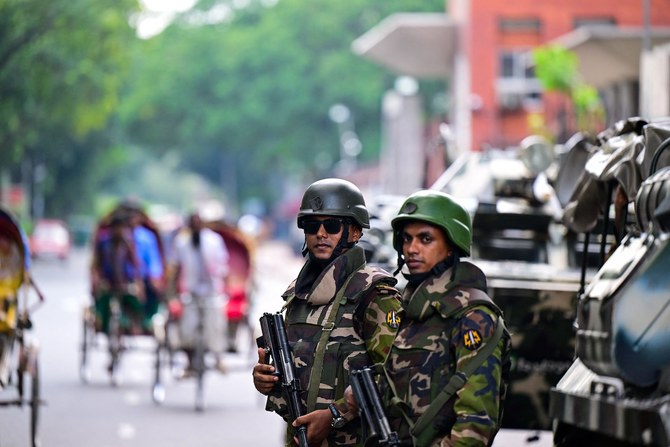
Bangladeshi security forces stand guard near the country's Secretariat as a curfew is relaxed after days of protests, in Dhaka. (AFP)
Short Url
Updated 27 July 2024
Follow

Bangladeshi police arrest student protest leaders from hospital

  • Police say they arrested three student leaders ‘to keep them safe’
  • Two of them were still undergoing treatment, hospital worker says

DHAKA: Bangladeshi police have discharged from hospital and arrested the leaders of a student protest that led to nationwide unrest last week, when security forces clashed with demonstrators.

Students have been demonstrating since the beginning of July against a rule that reserves a bulk of government jobs for the descendants of those who fought in the country’s 1971 liberation war.

At least 209 people have been killed and thousands injured, according to a count based on reports in the local media after the protests turned violent last week.

Most of the casualties were reported in Dhaka, which saw intense clashes between protesters, government supporters, police and paramilitary troops, when the country went into a communications blackout for six days.

Among the injured were student leaders Nahid Islam and Asif Mahmud, coordinators of Students Against Discrimination, the main protest organizing group. They were patients at Gonoshasthya Hospital in Dhaka, from where they were arrested by the Detective Branch of Dhaka Metropolitan Police on Friday evening. Another student leader visiting Islam and Mahmud, Abu Baker Majumder, was detained as well.

Detective Branch chief Harun Or-Rashid told reporters in Dhaka on Saturday that the trio had been detained “for security reasons” as their families were worried about their safety.

“We took them in our custody to keep them safe,” he said.

The student leaders were arrested by a group of more than a dozen plainclothes officers despite objections from medical staff, a hospital worker told Arab News.

“At first, we tried to make them understand that without proper protocols, admitted patients couldn’t be released from the hospital. Later on, they talked with our authorities, and the students were taken from the hospital. There was no way we could hold them further,” the hospital worker said on condition of anonymity.

“The students’ health was not so good ... Asif was dealing with low blood pressure, and Nahid was suffering from blood clots and bruises on different parts of his body. Both of them needed further treatment.”

The arrests come in a crackdown launched by police in Dhaka, where a curfew imposed last week was still in place.

Liton Kumar Saha, joint commissioner of the Dhaka Metropolitan Police, said that 2,284 people have been arrested in Dhaka over the protest-related clashes, in which numerous administration offices were set on fire.

“We are analyzing the footage of different places and identifying the miscreants. When we get confirmed about someone’s involvement in the anarchy, we conduct the operations to arrest them. It has been conducted with transparency, and we are checking the people who were involved with sabotage,” he told Arab News.

“In the last 24 hours, 245 persons were arrested in Dhaka. Our drive will continue until the situation gets normal.”

International rights groups have repeatedly raised concerns over Bangladesh’s handling of the protests, with Amnesty International saying that witness testimonies and video and photographic evidence “confirm the use of unlawful force by the police against student protesters.”

The protests broke out after the High Court upheld a controversial quota system, in which 56 percent of public service jobs were reserved for specific groups, including women, marginalized communities and children and grandchildren of freedom fighters — for whom the government earmarks 30 percent of the posts.

The Supreme Court last week scaled back the quota system, ordering 93 percent of government jobs to be allocated on merit.


US House of Representatives passes war powers resolution backing Trump’s attacks on Iran

Updated 2 min 30 sec ago
Follow

US House of Representatives passes war powers resolution backing Trump’s attacks on Iran

  • It’s the second vote in as many days, after the Senate defeated a similar measure
  • Republicans largely back Trump, and most Democrats oppose the war
WASHINGTON: The House narrowly rejected a war powers resolution Thursday to halt President Donald Trump’s attacks on Iran, an early sign of unease in Congress over the rapidly widening conflict that is reordering US priorities at home and abroad.
It’s the second vote in as many days, after the Senate defeated a similar measure. Lawmakers are confronting the sudden reality of representing wary Americans in wartime and all that entails — with lives lost, dollars spent and alliances tested by a president’s unilateral decision to go to war with Iran.
While the tally in the House, 212-219, was expected to be tight, the outcome provided a clarifying snapshot of political support for, and opposition to, the US-Israel military operation and Trump’s rationale for bypassing Congress, which alone has the power to declare war. At the Capitol, the conflict has quickly carried echoes of the long wars in Afghanistan and Iraq, and many Sept. 11-era veterans now serve in Congress.
“Donald Trump is not a king, and if he believes the war with Iran is in our national interest, then he must come to Congress and make the case,” said Rep. Gregory Meeks, the top Democrat on the House Foreign Affairs Committee.
House Speaker Mike Johnson warned that it would be “dangerous” to limit the president’s authority while the US military is already in conflict.
“We are not at war,” said Johnson, R-Louisiana, a close ally of Trump, contradicting others. He said the operation is limited in scope and duration, and the “mission is nearly accomplished.”
Republicans largely back Trump, and most Democrats oppose the war
Trump’s Republican Party, which narrowly controls the House and Senate, largely sees the conflict with Iran not as the start of a new war, but the end of a government that has long menaced the West. The operation has killed Iran’s Supreme Leader Ayatollah Ali Khamenei, which some view as an opportunity for regime change, though others warn of a chaotic power vacuum.
Republican Rep. Brian Mast of Florida, chairman of the House Foreign Affairs Committee, publicly thanked Trump for taking action against Iran, saying the president is using his own constitutional authority to defend the US against the “imminent threat” the country posed.
Mast, an Army veteran who worked as a bomb disposal expert in Afghanistan, said the war powers resolution was effectively asking “that the president do nothing.”
For Democrats, Trump’s attack on Iran, influenced by Israeli Prime Minister Benjamin Netanyahu, is a war of choice that is testing the balance of powers in the Constitution.
“The framers weren’t fooling around,” said Rep. Jamie Raskin, D-Md., arguing that the Constitution is clear that only Congress can decide matters of war. “It’s up to us.”
Crossover coalitions emerged among those in Congress. Two Republicans joined most Democrats in voting for the war powers resolution, while four Democrats joined Republicans to reject it.
The war powers resolution, if signed into law, would have immediately halted Trump’s ability to conduct the war unless Congress approved the military action. The president would likely veto it.
Trump officials provide shifting rationale for war
Trump has scrambled to win support for the nearly week-old conflict as Americans of all political persuasions take stock. Administration officials spent hours behind closed doors on Capitol Hill this week trying to reassure lawmakers that they have the situation under control.
Six US military members were killed over the weekend in a drone strike in Kuwait, and Trump has said more Americans could die. Thousands of Americans abroad have scrambled for flights, many lighting up phone lines at congressional offices as they sought help trying to flee the Middle East.
Trump said Thursday he must be involved in choosing Iran’s new leader. Yet Johnson, R-Louisiana, said this week that America has enough problems at home and is not about to be in the “nation-building business.”
Defense Secretary Pete Hegseth said that the war could extend eight weeks, twice as long as the president first estimated. Trump has left open the possibility of sending US troops into what has largely been a bombing campaign. More than 1,230 people in Iran have died.
The administration said the goal is to destroy Iran’s ballistic missiles that it believes are shielding its nuclear program. It has also said Israel was ready to act, and American bases would face retaliation if the US did not strike Iran first. The US said Wednesday it torpedoed an Iranian warship near Sri Lanka.
“This administration can’t even give us a straight answer of as to why we launched this preemptive war,” said Rep. Thomas Massie, the Republican from Kentucky, an outlier in his party.
Massie and Rep. Ro Khanna, D-Calif., who had teamed up to force the release the Jeffrey Epstein files, also pushed the war powers resolution to the floor, past objections from Johnson’s GOP leadership. Republican Rep. Warren Davidson of Ohio, a former Army Ranger, also voted for it. Democratic Reps. Henry Cuellar of Texas, Jared Golden of Maine, Greg Landsman of Ohio and Juan Vargas of California voted against.
“Congress must stand with the president to finally close, once and for all, this dark chapter of history,” said Rep. Michael McCaul, R-Texas.
Rep. Yassamin Ansari, D-Arizona, said that as the daughter of Iranian immigrants who fled their homeland, she opposes the regime but is concerned that a democratic transition for the people of Iran never seems to a priority for Trump or the officials who briefed Congress.
“War carries profound and deadly consequences for our troops, for the American people and for the entire world,” she said. “It’s the most serious decision that a nation can make.”
Other Democrats have proposed an alternative resolution that would allow the president to continue the war for 30 days before he must seek congressional approval. The House also approved a separate measure affirming that Iran is the largest state sponsor of terrorism.
Senators sit in their desks for solemn vote
In the Senate, Republican leaders have successfully, though narrowly, defeated a series of war powers resolutions pertaining to several other conflicts during Trump’s second term. This one, however, was different.
Underscoring the gravity Wednesday, Democratic senators sat at their desks as the voting got underway.
Senate Democratic leader Chuck Schumer of New York said that every senator will pick a side. “Do you stand with the American people who are exhausted with forever wars in the Middle East?” he asked. Or with Trump and Hegseth “as they bumble us headfirst into another war?”
Sen. John Barrasso, second in Senate Republican leadership, said, “Democrats would rather obstruct Donald Trump than obliterate Iran’s national nuclear program.”
The legislation failed on a 47-53 tally mostly along party lines, with Sen. Rand Paul, R-Kentucky, in favor and Sen. John Fetterman, D-Pennsylvania, against.