HAVANA: Havana residents watched from shore on Saturday as Russian warships arrived for the second time in as many months, in a visit that Cuba called routine.
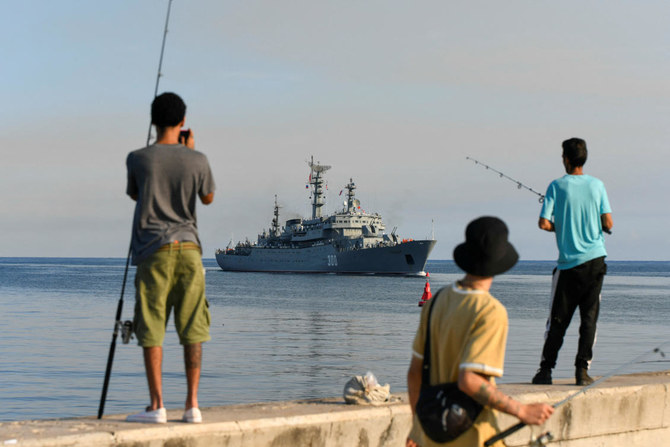
Cuban authorities sent shots into the air to signal their welcome, while curious fishermen watched from Havana’s waterside promenade as the ships advanced up the bay. Russian residents were also among the few up early to see the fleet’s arrival.
The patrol ship Neustrahimiy, training vessel Smolniy and support vessels, all from the Baltic Fleet, are scheduled to depart on Tuesday.
A brief statement by the Cuban Revolutionary Armed Forces described their arrival as routine.
The US State Department and Pentagon did not immediately respond to a request for comment.
A Russian nuclear submarine, frigate and support ships in June also flexed Moscow’s muscles in the port of Havana, less than 100 miles (160 km) from Florida.
Tensions between the United States and Russia have increased since Russia’s 2022 invasion of Ukraine, and Russian naval activity — though routine in the Atlantic — has ratcheted up because of US support for Ukraine, US officials say.
Simultaneously, relations between Cold War allies Russia and Cuba have markedly improved as the Communist-run country battles an economic crisis it charges is due mainly to US sanctions.
High-level contacts between the two countries have increased to a level not seen since the fall of former benefactor the Soviet Union with Cuban President Miguel Diaz-Canel visiting Moscow four times.
Russia has sent oil, flour and increasing numbers of tourists to the cash and goods short Caribbean nation as citizens suffer through daily power outages and other travails resulting in scattered protests and record migration.
Ana Garces, a 78-year-old retiree, told Reuters she remembered the then-Soviet Union was the only country to help Cuba during the 1962 missile crisis, the peak of tensions with Washington when the world teetered on the brink of nuclear war.
“We are very grateful,” she said. “Why should we not receive it with open arms? This is friendship. All kinds of ships have entered here.”
“It shows how other countries do support us and takes away a little of the world’s mentality about our country,” added her husband, 71-year-old retiree Rolando Perez.

Russian warships make routine visit to Cuba
Short Url
https://arab.news/8jxd4
Russian warships make routine visit to Cuba
- Russian residents were also among the few up early to see the fleet’s arrival
- The patrol ship Neustrahimiy, training vessel Smolniy and support vessels, all from the Baltic Fleet, are scheduled to depart on Tuesday
Indian security forces kill 16 Maoist rebels
NEW DELHI: Indian security forces have killed 16 Maoist rebel fighters, including a senior commander, in the eastern state of Jharkhand as authorities step up efforts to quash the long-running insurgency.
More than 10,000 people have died in the decades-long rebellion waged by the guerrillas, who say they are fighting for the rights of marginalized indigenous people in resource-rich pockets of India.
New Delhi has launched an all-out campaign against the insurgents, also known as Naxalites after the village in the Himalayan foothills where the Maoist-inspired insurgency began nearly six decades ago, and vowed to end the rebellion by March 2026.
Since 2024, more than 500 Maoist rebels have been killed, including some of the top commanders, according to government figures.
The latest gunfight was reported from West Singhbhum district in Jharkhand state, home minister Amit Shah said in a social media post late Thursday.
One of those killed was a “notorious bounty-wanted Naxal Central Committee member” named Patiram Manjhi, Shah said. He had a bounty of over $100,000 on his head.
“We are committed to eradicating Naxalism, which has been synonymous with fear and terror for decades, before March 31, 2026,” he said.
“I once again appeal to the remaining Naxals to abandon the ideology that connects to violence, terror, and arms, and join the mainstream of development and trust.”
The Naxalite rebellion once held sway across nearly a third of the country, with an estimated 15,000 to 20,000 fighters at its peak in the mid-2000s, but it has been dramatically weakened in recent years.
More than 10,000 people have died in the decades-long rebellion waged by the guerrillas, who say they are fighting for the rights of marginalized indigenous people in resource-rich pockets of India.
New Delhi has launched an all-out campaign against the insurgents, also known as Naxalites after the village in the Himalayan foothills where the Maoist-inspired insurgency began nearly six decades ago, and vowed to end the rebellion by March 2026.
Since 2024, more than 500 Maoist rebels have been killed, including some of the top commanders, according to government figures.
The latest gunfight was reported from West Singhbhum district in Jharkhand state, home minister Amit Shah said in a social media post late Thursday.
One of those killed was a “notorious bounty-wanted Naxal Central Committee member” named Patiram Manjhi, Shah said. He had a bounty of over $100,000 on his head.
“We are committed to eradicating Naxalism, which has been synonymous with fear and terror for decades, before March 31, 2026,” he said.
“I once again appeal to the remaining Naxals to abandon the ideology that connects to violence, terror, and arms, and join the mainstream of development and trust.”
The Naxalite rebellion once held sway across nearly a third of the country, with an estimated 15,000 to 20,000 fighters at its peak in the mid-2000s, but it has been dramatically weakened in recent years.
© 2026 SAUDI RESEARCH & PUBLISHING COMPANY, All Rights Reserved And subject to Terms of Use Agreement.


