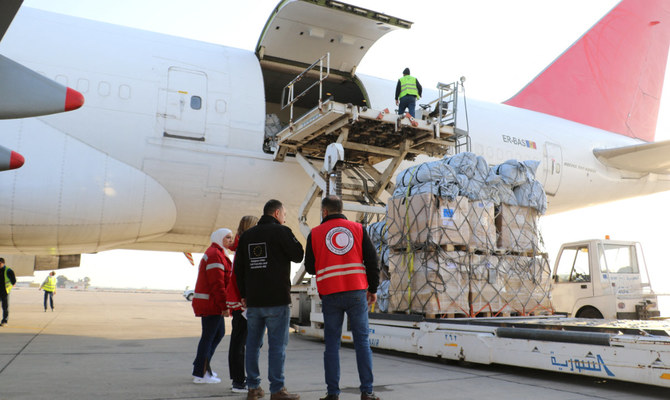

NEW YORK CITY: The US on Tuesday accused the Syrian regime of President Bashar Assad of diverting lifesaving international humanitarian aid intended to help earthquake victims, that is instead being sold in markets or benefiting the Syrian authorities.
Ambassador Robert Wood, the alternate representative of the US for special political affairs in the UN, similarly accused “other actors” of blocking deliveries as he called on all sides to refrain from politicizing aid.
Responding to accusations that US sanctions are hampering the delivery of aid, Wood said that the sanctions only target individuals and entities that have “brutalized the people of Syria for over a decade.”
He added: “These are individuals who have tortured Syrians, dropped chemical weapons on Syrians, or stolen from the Syrian people through rampant corruption. US sanctions do not target humanitarian assistance to those in need and we have made that clear through our actions.”
Wood was speaking at a meeting of the Security Council to discuss the latest international efforts to help Syrians deal with the aftermath of the earthquakes that hit Turkiye and Syria on Feb. 6. They claimed at least 50,000 lives, 6,000 of them in Syria. Thousands more were injured and tens of thousands are missing.
Martin Griffiths, the UN’s humanitarian chief, told the council that even before “this immense tragedy, (about) 15.3 million people, that’s 70 per cent of (Syria’s) population, needed humanitarian assistance.”
Geir Pedersen, the UN’s special envoy for Syria, told council members that the earthquakes struck at a time when the needs of Syrian people were at their greatest, “when services were scarcest, when the economy was lowest, and when their infrastructure was already heavily damaged.”
He added: “It hit many areas where refugees and IDPs (internally displaced people) live, and in areas with heavy war damage or where conflict conditions remain acute.”
Calling for the depoliticization of the humanitarian response, he said: “This means access; this is not the time to play politics with crossings across borders or front lines.
“This means resources; this is the time for everybody to give quickly and generously to Syria and remove all hindrances to relief reaching Syrians in all affected areas. And this means calm; this is not the time for military action or violence.”
As he told the members of the Security Council of the sense of frustration he witnessed in northwestern Syria over the slow pace of the humanitarian response, Pedersen said it has been hampered in part by “challenges that relate directly to the unresolved issues at the heart of the conflict.”
He continued: “I have long said that the situation in Syria is unsustainable, that the status quo is totally unacceptable, and that the Syrian people are acutely vulnerable to issues not solely in their hands. It has taken tragic earthquakes to reveal this clearly. And the Syrian people, again, are the ones who pay a heavy price.”
Although there has been a lull in hostilities across front lines, Pedersen highlighted reports of “concerning incidents” involving shelling and mortar fire in regime and rebel-controlled areas,
Turkish drone strikes, Israeli attacks in Central Damascus, and Daesh attacks in the desert. He called for an immediate end to all violence.
The envoy also warned that the political challenges will increase as Syrians move from the initial emergency response phase of the disaster to recovery efforts.
“It will require navigating through one of the most complex political landscapes on the planet: A territory split into several zones of control; a government under sanctions from key donors; de facto authorities elsewhere; more than one listed terrorist group; five foreign armies; interlocking violent conflicts; mass displacement; systemic human rights violations and abuses; institutions that are degraded, corrupted or absent; destroyed infrastructure; a collapsed economy; growing illicit drug trafficking; grinding poverty; and skyrocketing needs,” he said.
“And it will require navigating these complexities in a context where the international community is itself deeply divided.”
Taking his inspiration from the Syrian people, he called for good leadership and a “cooperative spirit” because the way forward will require “less posturing, less rhetoric and more pragmatism” from stakeholders.
He added: “It will require realism and frankness from the Syrian government and the Syrian opposition, and all key outside actors. It will require firewalling Syria from wider geopolitical disputes among key players.
“Because, let’s be honest, the earthquakes have exposed and aggravated many of the core issues related to Security Council Resolution 2254: Issues of governance, sovereignty, territorial integrity; a nationwide ceasefire; building a safe, calm and neutral environment; the file of the detained, disappeared and missing; the safe, dignified and voluntary return of refugees and IDPs, many of whom have been displaced again by the earthquakes and have nowhere to go; and post-conflict reconstruction and rehabilitation, for which the earthquakes have only created new needs.”