

G20 financial chiefs flag global economic ‘soft landing’, warn of risks from war

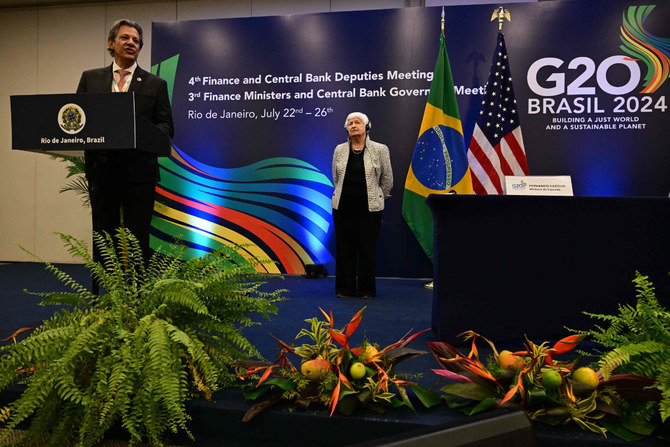
Brazil's Economy Minister Fernando Haddad (L) speaks next to US Treasury Secretary Janet Yellen after signing an agreement during the G20 economic ministers' meeting in Rio de Janeiro on July 26, 2024. (AFP)
Short Url
Updated 27 July 2024
Follow

G20 financial chiefs flag global economic ‘soft landing’, warn of risks from war

  • Communique avoids mention of wars in Gaza and Ukraine, to sidestep disagreements between Russia and major Western nations
  • Communique avoids mention of wars in Gaza and Ukraine, to sidestep disagreements between Russia and major Western nations

RIO DE JANEIRO: G20 financial leaders said on Friday the global economy was likely heading for a “soft landing,” but warned wars and escalating conflicts could endanger this outlook, while more global cooperation could make growth stronger.
In a joint communique after a two-day meeting in Brazil, finance ministers and central bankers from the Group of 20 major economies also committed to resist protectionism in trade and stressed the need to reduce economic inequalities.
Last month, the World Bank forecast that the global economy would avoid a third consecutive decline in growth since a major post-pandemic jump in 2021, with 2024 growth stabilising at 2.6 percent, in line with 2023, but warned that overall output would remain well below pre-pandemic levels through 2026.
“We are encouraged by the increasing likelihood of a soft landing of the global economy, although multiple challenges remain,” the communique said. “Downside risks include wars and escalating conflicts,” it said.
By avoiding explicit mention of the conflicts in Ukraine and Gaza, diplomats have worked to sidestep the disagreements between Russia and major Western nations that derailed a consensus at the finance chiefs’ gathering in February.
To defuse the disagreement, Brazil drafted a chair statement on geopolitical issues, stressing that these matters will be addressed by G20 leaders in November.
“The G20 made a wise decision to put geopolitical issues in their place to allow the cooperation agenda to move forward,” Brazil Finance Minister Fernando Haddad told a news conference.
Haddad also hailed the group’s first-ever declaration calling for cooperation to effectively tax the world’s largest fortunes, although that separate joint statement papered over disagreements about the right forum to advance the agenda.
The G20 communique said economic activity had proved to be more resilient than expected in many parts of the world, but the recovery had been highly uneven across countries, contributing to the risk of economic divergence.

Balance of risks
The document flagged risks to the economic outlook that remain broadly balanced, with more economic cooperation, faster-than-expected disinflation and technological innovations, like the safe development of Artificial Intelligence (AI), cited among upside risks.
But at the same AI tech could also turn out to be a downside risk to growth, the document said, along with economic fragmentation and persistent inflation keeping interest rates higher for longer, extreme weather events, and excessive debt.
Climate change and significant loss of biodiversity were key topics of concern, the G20 financial leaders agreed, warning that if poorer nations had to shoulder more of the cost of fighting climate change, it would make global inequality worse.
“We reiterate the understanding that the cost of inaction is greater than the cost of action,” the communique said.
The document also stepped-up language calling for a reform of the International Monetary Fund, that would give emerging and developing economies a bigger say in the lender of last resort.
The G20 communique underlined the “urgency and importance of realignment in quota shares to better reflect members’ relative positions in the world economy.” G20

Supreme Court ruling offers little relief for Republicans divided on Trump’s tariffs

Updated 7 sec ago
Follow

Supreme Court ruling offers little relief for Republicans divided on Trump’s tariffs

  • “I have the right to do tariffs, and I’ve always had the right to do tariffs,” Trump said at a news conference, adding that he doesn’t need Congress

WASHINGTON: For a few hours on Friday, congressional Republicans seemed to get some relief from one of the largest points of friction they have had with the Trump administration. It didn’t last.
The Supreme Court struck down a significant portion of President Donald Trump’s global tariff regime, ruling that the power to impose taxes lies with Congress. Many Republicans greeted the Friday morning decision with measured statements, some even praising it, and party leaders said they would work with Trump on tariffs going forward.
But by the afternoon, Trump made clear he had no intention of working with Congress and would instead go it alone by imposing a new global 10 percent import tax. On Saturday morning, he went further by saying he would raise that new tariff to 15 percent.
He’s doing so under a law that restricts the tariffs to 150 days and has never been invoked this way before. His decision could not only have major implications for the global economy, but also ensure that Republicans will have to keep answering for Trump’s tariffs for months to come, especially as the midterm elections near.
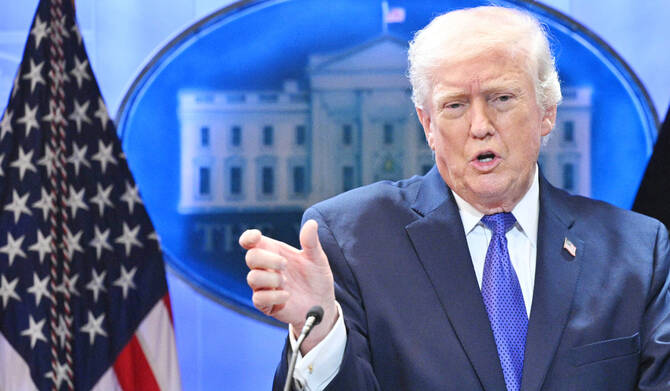
“I have the right to do tariffs, and I’ve always had the right to do tariffs,” Trump said at a news conference, adding that he doesn’t need Congress.
Tariffs have been one of the only areas where the Republican-controlled Congress has broken with Trump. Both the House and Senate at various points have passed resolutions intended to rebuke the tariffs being imposed on trade partners like Canada.
It’s the rare issue where Republican lawmakers who came of age in a party that largely championed free trade have voiced criticism of Trump’s economic policies.
“The empty merits of sweeping trade wars with America’s friends were evident long before today’s decision,” Sen. Mitch McConnell, the former longtime Senate Republican leader, said in a statement, adding that tariffs raise the prices of houses and disrupt other industries important to his home state of Kentucky.
At least one Republican congressman who last week voted against Trump’s tariffs on Canada is now facing political consequences. Trump on Saturday posted on his Truth Social platform that he was rescinding his endorsement of Colorado Rep. Jeff Hurd for reelection over his lack of support for tariffs and instead supporting Hurd’s Republican primary competitor, Hope Scheppelman.
“Congressman Hurd is one of a small number of Legislators who have let me and our Country down,” Trump wrote. “He is more interested in protecting Foreign Countries that have been ripping us off for decades than he is the United States of America.”
How Democrats plan to leverage Trump’s trade war
Democrats, looking to win back control of Congress, intend to make McConnell’s point their own. At a news conference Friday, Senate Democratic Leader Chuck Schumer said Trump’s new tariffs “will still raise people’s costs and they will hurt the American people as much as his old tariffs did.”
Schumer challenged Republicans to stop Trump from imposing his new global tariff. Democrats on Friday also called for refunds to be sent to US consumers for the tariffs struck down by the Supreme Court.
“The American people paid for these tariffs and the American people should get their money back,” Sen. Elizabeth Warren, D-Mass., said on social media.
It all played into one of the Democrats’ central messages for the midterm campaign: that Trump has failed to make the cost of living more affordable and has inflamed prices with tariffs.
Midsize US businesses have had to absorb the import taxes by passing them along to customers in the form of higher prices, employing fewer workers or accepting lower profits, according to an analysis by the JPMorganChase Institute.
Will Congress act on Trump’s new tariffs?
The Supreme Court decision on Friday made it clear that a majority of justices believe that Congress alone is granted authority under the Constitution to levy tariffs. Yet Trump quickly signed an executive order citing the Trade Act of 1974, which grants the president the power to impose temporary import taxes when there are “large and serious United States balance-of-payments deficits” or other international payment problems. The authority has never been used and therefore never tested in court.
Republicans at times have warned Trump about the potential economic fallout of his tariff plans. Yet before Trump’s “Liberation Day” of global tariffs in April last year, Republican leaders declined to directly defy the president.
Some GOP lawmakers cheered on the new tariff policy, highlighting a generational divide among Republicans, with a mostly younger group of Republicans fiercely backing Trump’s strategy. Rather than adhering to traditional free trade doctrine, they advocate for “America First” protectionism, hoping it will revive US manufacturing.
Republican Sen. Bernie Moreno, an Ohio freshman, slammed the Supreme Court’s ruling on Friday and called for GOP lawmakers to “codify the tariffs that had made our country the hottest country on earth!”
A few Republican opponents of the tariffs, meanwhile, openly cheered the Supreme Court’s decision. Rep. Don Bacon, a critic of the administration who is not seeking reelection, said on social media that “Congress must stand on its own two feet, take tough votes and defend its authorities.”
Bacon predicted there would be more Republican pushback coming. He and a handful of other GOP members were instrumental earlier this month in forcing a House vote on Trump’s tariffs on Canada. As that measure passed, Trump vowed political retribution for any Republican who voted to oppose his tariff plans.