Arab League chief backs Somalia over controversial Ethiopia-Somaliland agreement

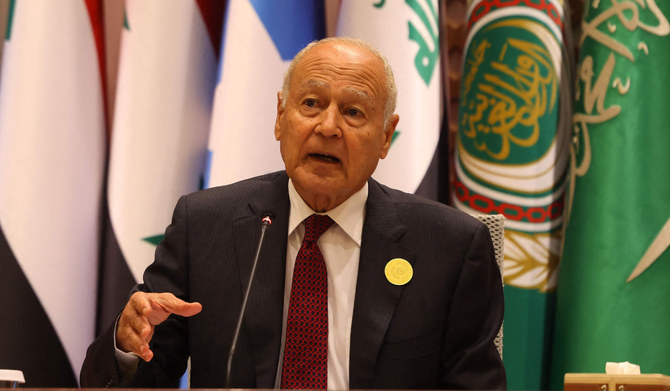
Arab League Secretary-General Ahmed Aboul Gheit speaks during a press conference held at the end of the Arab League Summit in Jeddah on May 19, 2023. (AFP)
Short Url
Updated 22 January 2024
Follow

Arab League chief backs Somalia over controversial Ethiopia-Somaliland agreement

  • A resolution issued by the Arab League’s ministerial council on Jan. 17 declared backing for Somalia’s diplomatic efforts to tackle “this perilous situation”

CAIRO: Arab League Secretary-General Ahmed Aboul Gheit has pledged the organization’s support for Somalia against Ethiopia’s controversial recognition of Somaliland as an independent state.

During a meeting in Egypt with Somali President Hassan Sheikh Mohamud, Aboul Gheit described a memorandum of understanding signed between Ethiopia and the Somaliland region as null, void, and unacceptable.

Ethiopian Prime Minister Abiy Ahmed inked the MoU with Somaliland’s leader Muse Bihi Abdi in exchange for being granted commercial and naval access to the Red Sea port of Berbera.

BACKGROUND

Ethiopia and Somalia have a history of stormy relations and territorial feuds, fighting two wars in the late 20th century.

A resolution issued by the Arab League’s ministerial council on Jan. 17 declared backing for Somalia’s diplomatic efforts to tackle “this perilous situation.”

Jamal Rushdi, spokesman for the Arab League chief, said Aboul Gheit and Mohamud discussed ways to secure Arab, African, and international support for Somalia in upholding its unity, sovereignty, and territorial integrity.

They also considered how to help Somalia combat terrorism and strengthen its national institutions and economy.

Mohamud thanked the Arab League for its ongoing backing.


Syria’s Kurds hail ‘positive impact’ of Turkiye peace talks

Updated 8 sec ago
Follow

Syria’s Kurds hail ‘positive impact’ of Turkiye peace talks

  • “The peace initiative in Turkiye has had a direct impact on northern and eastern Syria,” said Elham Ahmad
  • “We want a dialogue process with Turkiye, a dialogue that we understand as Kurds in Syria”

ISTANBUL: Efforts to broker peace between Turkiye and the Kurdish militant group PKK have had a “positive impact” on Syria’s Kurds who also want dialogue with Ankara, one of its top officials said Saturday.
Earlier this year, the Kurdistan Workers’ Party (PKK) ended its four-decade armed struggle against Turkiye at the urging of its jailed founder Abdullah Ocalan, shifting its focus to a democratic political struggle for the rights of Turkiye’s Kurdish minority.
The ongoing process has raised hopes among Kurds across the region, notably in Syria where the Kurds control swathes of territory in the north and northeast.
“The peace initiative in Turkiye has had a direct impact on northern and eastern Syria,” said Elham Ahmad, a senior official in the Kurdish administration in Syria’s northeast.
“We want a dialogue process with Turkiye, a dialogue that we understand as Kurds in Syria... We want the borders between us to be opened,” she said, speaking by video link to an Istanbul peace conference organized by Turkiye’s pro-Kurdish opposition DEM party.
Speaking in Kurdish, she hailed Turkiye for initiating the peace moves, but said releasing Ocalan — who has led the process from his cell on Imrali prison island near Istanbul where he has been serving life in solitary since 1999 — would speed things up.
“We believe that Abdullah Ocalan being released will let him play a much greater role... that this peace and resolution process will happen faster and better.”
She also hailed Ankara for its sensitive approach to dialogue with the new regime in Damascus that emerged after the ousting of Syrian strongman Bashar Assad a year ago.
“The Turkish government has a dialogue and a relationship with the Syrian government. They also have open channels with us. We see that there is a careful approach to this matter,” she said.
Turkiye has long been hostile to the Kurdish SDF force that controls swathes of northeastern Syria, seeing it as an extension of PKK, and pushing for the US-backed force to integrate into the Syrian military and security apparatus.
Although a deal was reached to that end in March, its terms were never implemented.
“In this historic process, as the Middle East is being reorganized, Turkiye has a very important role. Peace in both countries — within Turkish society, Kurdish society and Arab society.. will impact the entire Middle East,” Ahmad said.
Syria’s Kurdish community believed coexistence was “fundamental” and did not want to see the nation divided, she said.
“We do not support the division of Syria or any other country. Such divisions pave the way for new wars. That is why we advocate for peace.”