

Security forces kill militant in intelligence-based operation in Pakistan’s northwest

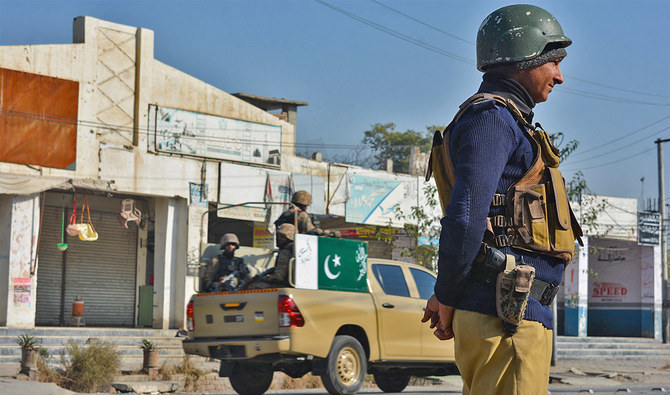
A policeman (R) and army soldiers (L) stand guard along a road in Bannu on December 21, 2022, a day after the seize of a Pakistan police station ended. (AFP/File)
Short Url
Updated 26 July 2024
Follow

Security forces kill militant in intelligence-based operation in Pakistan’s northwest

  • ISPR calls the slain militant a close associate of Hafiz Gul Bahadur, a high-value target
  • It says he facilitated a suicide bombing that killed seven Pakistani security personnel

ISLAMABAD: Security forces have killed a militant in an intelligence-based operation in Pakistan’s northwestern Khyber Pakhtunkhwa province, the military’s media wing, Inter-Services Public Relations (ISPR), said on Friday, adding that he facilitated suicide bombings and was involved in target killings.

KP, which borders Afghanistan, has seen a surge in attacks on security forces, government officials and anti-polio vaccination teams in recent weeks. In a major attack in the province’s Bannu district, ten soldiers were killed when militants launched a coordinated attack on a military cantonment on July 15.

Islamabad blames the recent surge in attacks, including the attack on the army cantonment in Bannu, on Tehreek-e-Taliban Pakistan (TTP), a proscribed armed network, which it says operates out of neighboring Afghanistan. Kabul denies the allegations and says rising violence in Pakistan is a domestic issue for Islamabad.

“Security forces conducted an intelligence-based operation in the North Waziristan district on the reported presence of terrorists,” the ISPR said, adding that during the course of the operation, a militant named Razzaq was killed.

The slain militant was a close associate of Hafiz Gul Bahadur, a high-value target, and remained involved in numerous militant activities in the area including the target killing of Malik Sher Muhammad, a local leader, earlier this year apart from facilitating a suicide bombing in March that resulted in the killing of seven soldiers.

The ISPR said a “sanitization operation” was being conducted to eliminate any other militant found in the area, adding that the security forces remained determined to eliminate extremist violence from the country.


Pakistani, Bangladeshi officials discuss trade, investment and aviation as ties thaw

Updated 28 December 2025
Follow

Pakistani, Bangladeshi officials discuss trade, investment and aviation as ties thaw

  • Pakistan and Bangladesh were once one nation, but they split in 1971 as a result of a bloody civil war
  • Ties between Pakistan, Bangladesh have warmed up since last year and both nations have resumed sea trade

ISLAMABAD: Pakistan's High Commissioner to Bangladesh Imran Haider on Sunday met Chief Adviser Muhammad Yunus in Dhaka, the latter's office said on, with the two figures discussing trade, investment and aviation.

Pakistan and Bangladesh were once one nation, but they split in 1971 as a result of a bloody civil war, which saw the part previously referred to as East Pakistan seceding to form the independent nation of Bangladesh.

Ties between Pakistan and Bangladesh have warmed up since former prime minister Sheikh Hasina’s ouster as a result of a student-led uprising in August 2024. Relations remain frosty between Dhaka and New Delhi over India’s decision to grant asylum to Hasina.

Pakistan has attempted to forge closer ties with Bangladesh in recent months and both South Asian nations last year began sea trade, followed by efforts to expand government-to-government commerce.

"During the meeting, both sides discussed ways to expand cooperation in trade, investment, and aviation as well as scaling up cultural, educational and medical exchanges to further strengthen bilateral relations between the two South Asian nations," Yunus's office said in a statement on X.

In 2023-24 Pakistan exported goods worth $661 million to Bangladesh, while its imports were only $57 million, according to the Trade Development Authority of Pakistan. In Aug. this year, the Pakistani and Bangladeshi commerce ministries signed a memorandum of understanding to establish a Joint Working Group on Trade, aiming to raise their bilateral trade volume to $1 billion in the financial year that began in July.

The Pakistani high commissioner noted that bilateral trade has recorded a 20 percent growth compared to last year, with business communities from both countries actively exploring new investment opportunities, according to the statement.

He highlighted a significant increase in cultural exchanges, adding that Bangladeshi students have shown strong interest in higher education opportunities in Pakistan, particularly in medical sciences, nanotechnology, and artificial intelligence. Haider also said that Dhaka-Karachi direct flights are expected to start in January.

"Chief Adviser Professor Muhammad Yunus welcomed the growing interactions between the two countries and emphasized the importance of increased visits as well as cultural, educational and people-to-people exchanges among SAARC (South Asian Association for Regional Cooperation) member states," the statement read.

"Professor Yunus also underscored the need to further boost Bangladesh–Pakistan trade and expressed hope that during Mr. Haider’s tenure, both countries would explore new avenues for investment and joint venture businesses."