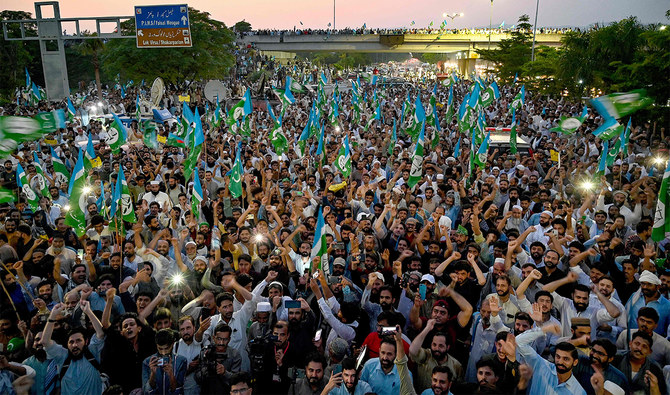
ISLAMABAD: Protest caravans of a Pakistani religious party entered the federal capital on Friday, planning to stage a sit-in against the rising cost of living and additional taxes imposed in the latest budget presented last month, as the government formed a negotiation committee to engage with its leadership.
The Jamaat-e-Islami (JI) party, led by Hafiz Naeem-ur-Rehman, announced the sit-in in Islamabad to forcefully call for a reduction in the power tariff amid soaring inflation and to review Pakistan’s agreements with independent power producers.
The party’s caravans entered the capital from different directions, as the district administration closed the Red Zone — a sensitive neighborhood of the city housing top government offices and the diplomatic enclave — with shipping containers and all other main routes leading to the Parliament House.
“We are ready for negotiations, but don’t disrupt public life,” Federal Information Minister Attaullah Tarar said while addressing the situation in a news conference.
He said the government had formed a three-member committee to talk to the JI leadership, which included him and two senior members of the ruling Pakistan Muslim League-Nawaz (PML-N) party.
“The government’s three-member committee will talk to you. Amir Muqam, Tariq Fazal Chaudhry and I will negotiate with you,” he continued, naming two other members of the ruling Pakistan Muslim League-Nawaz (PML-N) party.
“Whenever you express willingness, we are ready for the negotiations,” he added.
Meanwhile, JI’s spokesperson in Islamabad said the party would continue with its protest.
“Hafiz Naeem-ur-Rehman will be joining the sit-in at Zero Point shortly,” Aamir Baloch told Arab News, mentioning a major intersection in the city where various key roads and highways connect with each other.
He said thousands of JI workers had already reached the area to stage the sit-in despite the government’s “brutalities.”
“The police have arrested dozens of our peaceful workers from D-Chowk,” he said, referring to another spot in the city located near the parliament building. “The government wants to incite the peaceful protesters through such strong-arm tactics. It will be responsible for any law and order situation if our workers are not released immediately.”
Police in the capital have deployed additional contingents, including its personnel with riot gears, to prevent any untoward incident. The Rawalpindi-Islamabad Express Highway has also been closed with the shipping containers near the Zero Point bridge where the JI protesters have gathered.
Baloch said the party leadership would announce their agenda after reaching Zero Point.
“One thing is for sure,” he continued. “We are here to stay and will definitely stage a sit-in to press the government to meet our legitimate demands regarding inflation and taxes.”


![]()

Government forms negotiation committee as Islamabad faces sit-in by religious party over inflation
Short Url
https://arab.news/y98qv
Government forms negotiation committee as Islamabad faces sit-in by religious party over inflation
- Jamaat-e-Islami workers have reached a key intersection in the federal capital to hold their demonstration
- They want the government to address the cost-of-living crisis, remove additional taxes in the federal budget
Latest updates


Recommended


© 2026 SAUDI RESEARCH & PUBLISHING COMPANY, All Rights Reserved And subject to Terms of Use Agreement.