

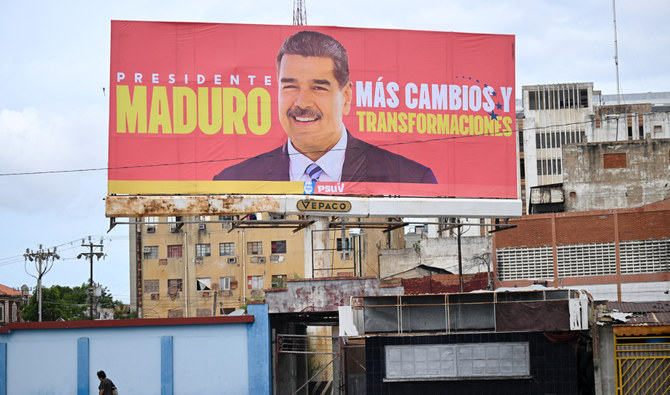

CARACAS: Venezuela’s President Nicolas Maduro is omnipresent in the runup to elections Sunday — shaking his fist on state TV, smiling on building facades in Caracas, beaming from the night sky over Maracaibo.
Unlimited access to state media and propaganda funding has allowed non-stop appearances on television, radio, murals, toll booth signage and even ambulances.
The opposition, in comparison, has been all but absent from traditional campaigning platforms in a political climate widely denounced as authoritarian. Nevertheless, polls show the opposition leaving Maduro in the dust.
It is not for a lack of trying on his part.
A well-oiled spin machine has worked 24-7 to portray the 61-year-old as an anti-imperialist strongman, but caring and convivial.
Maduro is shown alternately railing against capitalist “fascists,” dancing salsa with his wife, and promising prosperity after years of economic crisis that has sent more than seven million Venezuelans fleeing — almost a quarter of the population.
“There is a saturation that allows him to survive in the minds of people,” Leon Hernandez of the Andres Bello Catholic University’s Institute for Information and Communication Research told AFP.
And importantly, to remind them that he is the heir of the late socialist icon Hugo Chavez. Unlike Maduro, he remains wildly popular and is hailed by many as a revolutionary hero.
With no independent TV channels left, images of opposition candidate Edmundo Gonzalez Urrutia do not make it into people’s living rooms.
Instead, the opposition communicates on YouTube and TikTok, a space they also have to share with Maduro’s 24-hour spin machine.
The president, seeking a third six-year term at the helm, blares at his people in numerous daily broadcasts of his campaign “pilgrimage” through Venezuela.
He is also the subject of a film that recently premiered at a Caracas theater, based on a book about his life.
To augment his real-life presence, Maduro also has a cartoon character in his image — a caped hero named Super-Bigote (Super Moustache) fighting monsters sent by the United States.
And he has recently embraced the emblem of a fighting cock with feathers in Venezuela’s yellow, blue and red, that is meant to highlight his sprightliness relative to the soft-spoken 74-year-old Gonzalez Urrutia.
Cock crows can be heard echoing over Maduro’s live election events, and campaign songs glorify the pugilist bird.
The cock has also featured, along with Maduro’s face, in a drone light show over Maracaibo, once the epicenter of the petro-state’s oil riches but today battling constant fuel shortages among other ills.
On the other side of the spectrum, there has been little space for opposition voices in an independent media.
More than 400 private newspapers, radio and television stations have closed in over two decades of Chavista rule — a social movement named after Chavez.
Others were bought by business people close to the regime. Yet more opted for self-censorship to continue operating semi-independently.
Foreign networks such as CNN Spanish and Deutsche Welle (DW) were taken off air by cable providers on the government’s orders.
On platforms like YouTube, from which the opposition cannot be banned, the onslaught has been relentless.
Videos accuse Gonzalez Urrutia — a stand-in for wildly popular opposition leader Maria Corina Machado, barred from the race by institutions loyal to Maduro — of fomenting plots and wanting to “give” Venezuelan oil to the United States.
In a country where the electoral authority is aligned to the regime, there are no posters bearing Gonzalez Urrutia’s face, and few alluding to the opposition at all.
During the campaign, which officially closes on Thursday, Gonzalez Urrutia was able to secure only a handful of interviews in national media, conducted in a climate of strict regime oversight and self-censorship.
Disinformation, too, has been a popular tool.
Military leaders recently spread a video of a talk given by Machado and Gonzalez Urrutia in front of a screen listing proposals to privatize the PDVSA state oil company and the education system.
AFP has established that the video was altered, and the screen had in fact been blank.


