

Ivory Coast records first case of Ebola: health minister

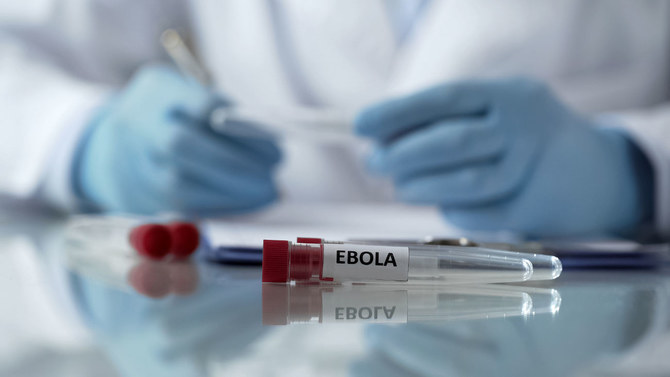
According to the World Health Organization, this is the first case of Ebola in Ivory Coast sinced 1994. (Shutterstock)
Short Url
Updated 15 August 2021
Follow

Ivory Coast records first case of Ebola: health minister

  • On June 19, the World Health Organization declared an end to a four-month outbreak of Ebola in Guinea that claimed the lives of 12 people there

ABIDJAN: Ivory Coast has recorded a first case of Ebola, the health minister announced late Saturday, the first occurence of the deadly disease in nearly three decades.
Officials at the Institut Pasteur had confirmed the case after testing samples taken from an 18-year-old Guinean woman, Health Minister Pierre N’Gou Demba said on RTI state television.
She had left the city of Labe in Guinea by road, arriving in Ivory Coast on Wednesday, he added.
“This is an isolated and imported case,” he said, adding that the patient was currently being treated in intensive care in Abidjan.
Ivory Coast already had doses of the vaccine against Ebola, which go to anyone who had been in contact with her, such as the medical staff treating her.
Prime Minister Patrick Achi had chaired an emergency interministerial meeting earlier Saturday, the minister added.
Appealing for calm, he said the authorities had already activated an emergency plan which included the identification and surveillance of anyone who had come into contact with the patient.
According to the World Health Organization, this is the first case of Ebola in Ivory Coast sinced 1994.

On June 19, the World Health Organization declared an end to a four-month outbreak of Ebola in Guinea that claimed the lives of 12 people there.
But a statement from WHO Africa on Saturday said: “There is no indication that the current case in Cote d’Ivoire (Ivory Coast) is linked to the earlier outbreak in Guinea.
“Further investigation and genomic sequencing will identify the strain and determine if there is a connection between the two outbreaks,” the statement added.
“It is of immense concern that this outbreak has been declared in Abidjan, a metropolis of more than four million people,” Matshidiso Moeti, the WHO’s Africa regional director, said in the statement.
“However, much of the world’s expertise in tackling Ebola is here on the continent and Cote d’Ivoire can tap into this experience and bring the response to full speed.”
The WHO said it was helping to coordinate a cross-border response, which included transferring 5,000 doses of Ebola vaccine from Guinea to Ivory Coast.
Ebola causes severe fever and, in the worst cases, unstoppable bleeding.
It is transmitted through close contact with bodily fluids, and people who live with or care for patients are most at risk.
In four decades, periodic Ebola outbreaks have killed around 15,000 people, all in Africa.
Its fatality rate in past outbreaks has varied between 25 and 90 percent.
But as the WHO pointed out: “There is now effective treatment available and if patients receive treatment early, as well as supportive care, their chances of survival improve significantly.”


Bangladesh begins exhuming mass grave from 2024 uprising

Updated 07 December 2025
Follow

Bangladesh begins exhuming mass grave from 2024 uprising

  • The United Nations says up to 1,400 people were killed in crackdowns as Hasina attempted to cling to power — deaths that formed part of her conviction last month for crimes against humanity

DHAKA: Bangladeshi police began exhuming on Sunday a mass grave believed to contain around 114 unidentified victims of a mass uprising that toppled autocratic former prime minister Sheikh Hasina last year.
The UN-supported effort is being advised by Argentine forensic anthropologist Luis Fondebrider, who has led recovery and identification missions at mass graves worldwide for decades.
The bodies were buried at the Rayerbazar Graveyard in Dhaka by the volunteer group Anjuman Mufidul Islam, which said it handled 80 unclaimed bodies in July and another 34 in August 2024 — all people reported to have been killed during weeks of deadly protests.
The United Nations says up to 1,400 people were killed in crackdowns as Hasina attempted to cling to power — deaths that formed part of her conviction last month for crimes against humanity.
Criminal Investigation Department (CID) chief Md Sibgat Ullah said investigators believed the mass grave held roughly 114 bodies, but the exact number would only be known once exhumations were complete.
“We can only confirm once we dig the graves and exhume the bodies,” Ullah told reporters.

- ‘Searched for him’ -

Among those hoping for answers is Mohammed Nabil, who is searching for the remains of his brother Sohel Rana, 28, who vanished in July 2024.
“We searched for him everywhere,” Nabil told AFP.
He said his family first suspected Rana’s death after seeing a Facebook video, then recognized his clothing — a blue T-shirt and black trousers — in a photograph taken by burial volunteers.
Exhumed bodies will be given post-mortem examinations and DNA testing. The process is expected to take several weeks to complete.
“It’s been more than a year, so it won’t be possible to extract DNA from the soft tissues,” senior police officer Abu Taleb told AFP. “Working with bones would be more time-consuming.”
Forensic experts from four Dhaka medical colleges are part of the team, with Fondebrider brought in to offer support as part of an agreement with the UN rights body the OHCHR.
“The process is complex and unique,” Fondebrider told reporters. “We will guarantee that international standards will be followed.”
Fondebrider previously headed the Argentine Forensic Anthropology Team, founded in 1984 to investigate the tens of thousands who disappeared during Argentina’s former military dictatorship.
Authorities say the exhumed bodies will be reburied in accordance with religious rites and their families’ wishes.
Hasina, convicted in absentia last month and sentenced to death, remains in self-imposed exile in India.