MADRID: Spanish Prime Minister Pedro Sanchez, who will on Monday announce whether he remains in his post, is an expert in political survival who has built a career on taking political gambles.
“I have learned to push myself until the referee blows the final whistle,” the head of Spain’s Socialist party and a former basketball player wrote in his 2019 autobiography, “Resistance Manual.”
On Wednesday, he said that he was considering stepping down after a Madrid court announced an investigation into his wife Begona Gomez for alleged influence-peddling and corruption.
“I need to stop and think,” he wrote in a four-page letter posted on X.
With a charming smile and affable personality, the 52-year-old — often referred to as Mr.Handsome early in his career — has been written off politically on several occasions, only to bounce back.
He “has never had it easy,” said Paloma Roman, a political scientist at Madrid’s Complutense University, noting his “political flair” for getting out of complicated situations.
Sanchez emerged from obscurity in 2014 as a little-known MP to seize the reins of Spain’s oldest political party.
A leap-year baby born in Madrid on February 29, 1972, he grew up in a well-off family, the son of an entrepreneur father and civil servant mother.
He studied economics before obtaining a master’s degree in political economy at the Free University of Brussels and a doctorate from a private Spanish university.
Elected to the Socialist Party leadership in 2014, Sanchez’s future was quickly put in doubt after he led the party to its worst-ever electoral defeats in 2015 and 2016.
Ejected from the leadership, he unexpectedly won his job back in a primary in May 2017 after a cross-country campaign in his 2005 Peugeot to rally support.
Within barely a year, the father of two teenage girls took over as premier in June 2018 after an ambitious gamble that saw him topple conservative Popular Party leader Mariano Rajoy in a no-confidence vote.
Always immaculately dressed, the telegenic politician — who likes running and looms over his rivals at 1.90 meters (6 foot 2 inches) tall — has earned a reputation as being tenacious to the point of stubbornness.
Over the past six years, he has had to play a delicate balancing act to stay in power.
In February 2019, the fragile alliance of left-wing factions and pro-independence Basque and Catalan parties that had catapulted him to the premiership cracked, prompting him to call early elections.
Although his Socialists won, they fell short of an absolute majority, and Sanchez was unable to secure support to stay in power, so he called a repeat election later that year.
He was then forced into a marriage of convenience with the hard-left Podemos, despite much gnashing of teeth inside his own party.
Deemed politically dead after his party again suffered a drubbing in local and regional elections in 2023, Sanchez surprised the country by calling an early general election for July.
While his Socialists finished second in the general election, behind the conservative Popular Party (PP), Sanchez cobbled together a majority in parliament with the support of the far-left party Sumar and smaller regional parties, including Catalan separatists.
In exchange for their support, Catalonia’s two main separatist parties demanded a controversial amnesty for hundreds of people facing legal action over their roles in the northeastern region’s failed push for independence in 2017.
Sanchez had previously opposed such a move but he now agreed to it to remain in power, sparking several mass protests staged by the right.
On the international stage, Sanchez, Spain’s first premier fluent in English, has made a name for himself by criticizing the operation Israel launched in Gaza in retaliation for the Hamas attack on October 7, and by promising Spain’s swift recognition of a Palestinian state.


![]()

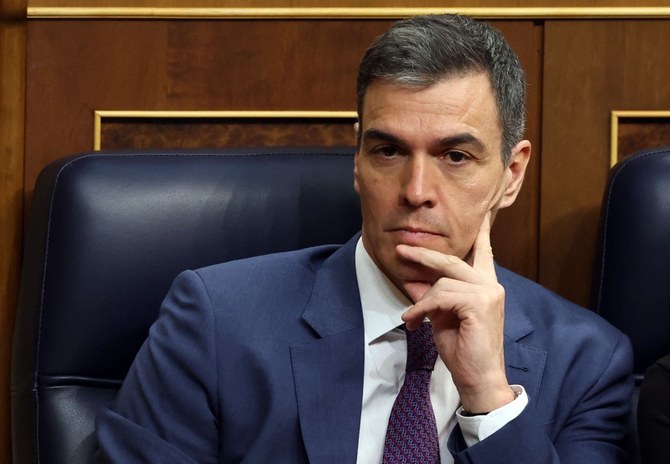
Pedro Sanchez, a risk-taker with a flair for survival
Short Url
https://arab.news/rt9hc
Pedro Sanchez, a risk-taker with a flair for survival
- Sanchez said on Wednesday that he was considering stepping down


Latest updates


© 2026 SAUDI RESEARCH & PUBLISHING COMPANY, All Rights Reserved And subject to Terms of Use Agreement.