Saudi Arabia, UAE have world’s most ambitious decarbonization programs: WEF panel

Abdulaziz bin Salman Al Saud, Saudi Arabia's Minister of Energy speaks during the World Economic Forum (WEF) in Riyadh, Saudi Arabia, April 28, 2024. (Reuters)
Short Url
Updated 28 April 2024
Follow

Saudi Arabia, UAE have world’s most ambitious decarbonization programs: WEF panel

  • “Solving sustainability problems requires technology and China has contributed greatly by increasing technical progress and making the cheapest energy available to the world”

DUBAI: A panel of ministers and experts gathered at the World Economic Forum in Riyadh on Sunday to discuss the road map for tripling renewables by 2030.

The UAE’s Minister of Energy and Infrastructure Suhail Mohamed Al-Mazrouei said his country’s goal would not only be reached but possibly exceeded by 2030.

“The UAE has been offering solar power to aid the world in reaching the goal of tripling renewables,” he said. “We have very few years until 2030, we need to work alongside and encourage countries to make the achievement by then.”

Li Zhenguo, president of Longi Green Energy Technology, said the Chinese government had been at the forefront of efforts to develop renewables.

“In 2023, China installed 216 solar power plants, which is more than 50 percent of the global capability,” he said.

“Solving sustainability problems requires technology and China has contributed greatly by increasing technical progress and making the cheapest energy available to the world.”

Marco Arcelli, CEO of Saudi-based ACWA Power, said he was surprised by the momentum in the region.

“Saudi and UAE have the most ambitious decarbs programs in the world. There is a speed and dimension you don’t see much elsewhere,” he said.

“There is leadership with a vision, there is cheap energy available and I believe you will start seeing greenshoring in the Kingdom by 2030. Lots of upcoming projects in the country, be it NEOM or others, will be solar driven and using renewable energy.”

Kuwait’s Minister of Electricity, Water and Renewable Energy Salem Alhajraf said there was a need to increase global production capacity.

“Innovative financing is key,” he said. “We need to move from small giga-sized projects to deploying renewables. Cities or towns with small populations can possibly have all their needs met by solar power.”

Stephanie Jamison, global Resources Industry Practices chair at Accenture, said her company had been developing guidelines for community engagement and nature transition.

“By conducting surveys and interviewing various CEOs, it has become clear that companies understand the impact they are making on nature. And so, partnerships between companies and proactive partnerships between companies and the community is one way to tackle challenges.”


Education spending surges 251% as students return from autumn break: SAMA

Updated 12 December 2025
Follow

Education spending surges 251% as students return from autumn break: SAMA

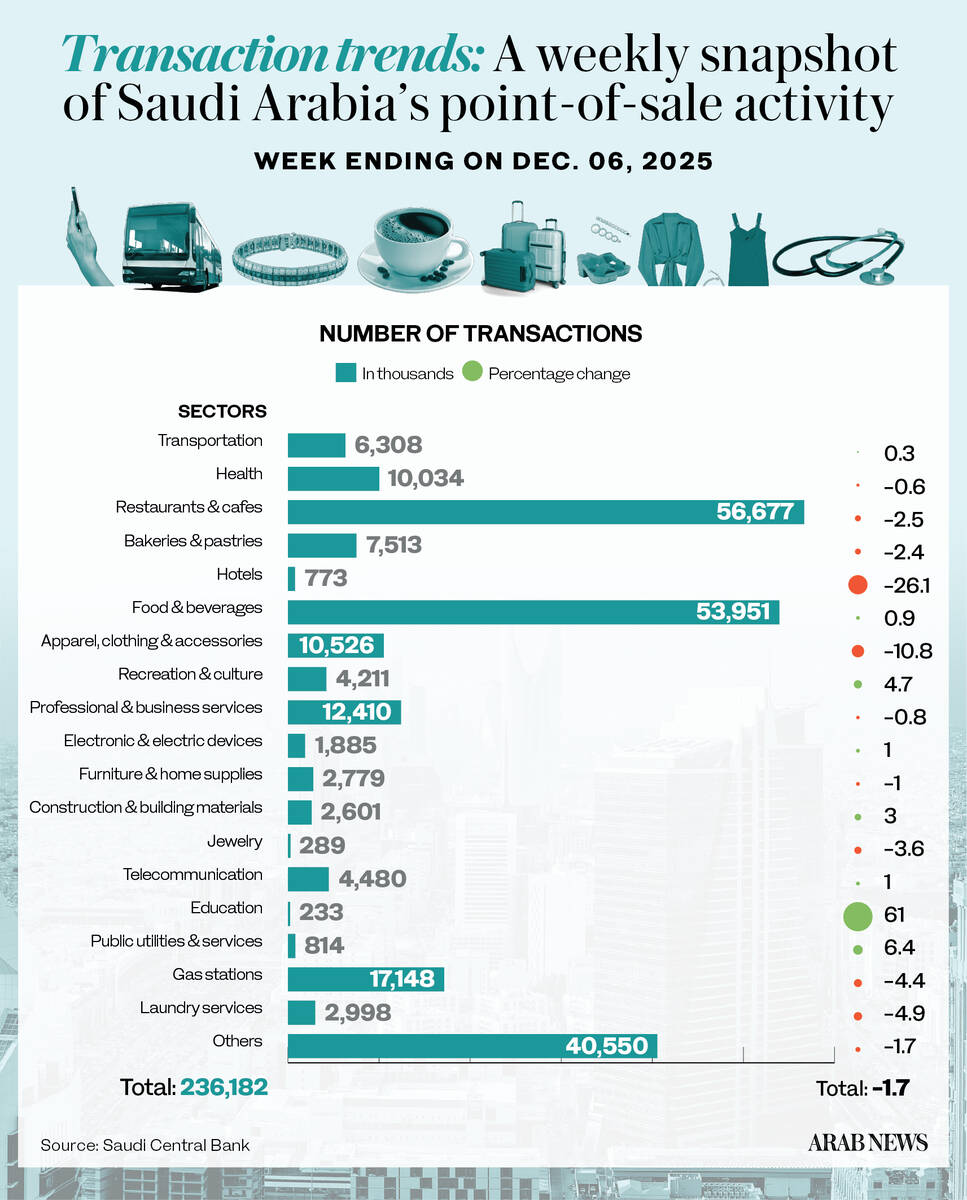
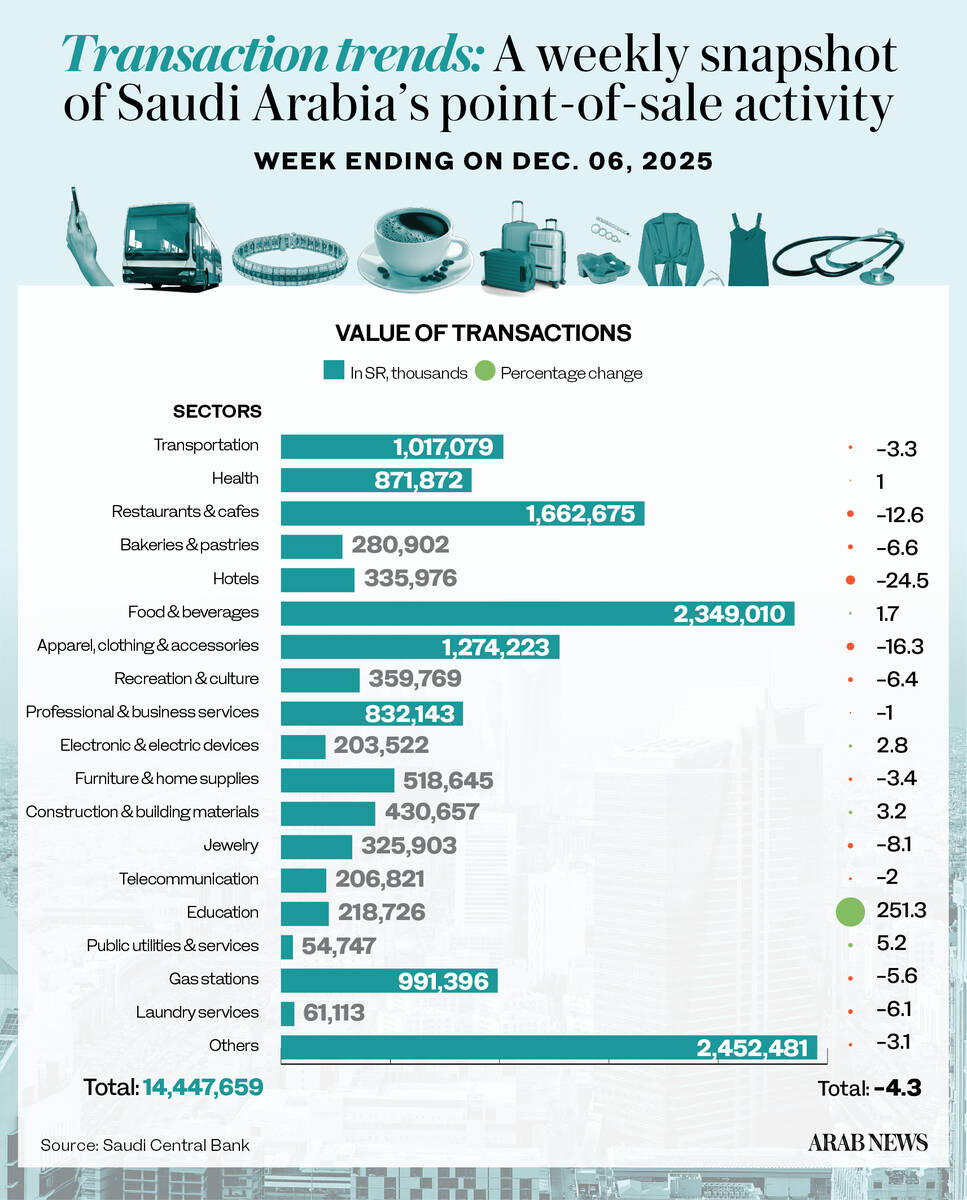
RIYADH: Education spending in Saudi Arabia surged 251.3 percent in the week ending Dec. 6, reflecting the sharp uptick in purchases as students returned from the autumn break.

According to the latest data from the Saudi Central Bank, expenditure in the sector reached SR218.73 million ($58.2 million), with the number of transactions increasing by 61 percent to 233,000.

Despite this surge, overall point-of-sale spending fell 4.3 percent to SR14.45 billion, while the number of transactions dipped 1.7 percent to 236.18 million week on week.

The week saw mixed changes between the sectors. Spending on freight transport, postal and courier services saw the second-biggest uptick at 33.3 percent to SR60.93 million, followed by medical services, which saw an 8.1 percent increase to SR505.35 million.

Expenditure on apparel and clothing saw a decrease of 16.3 percent, followed by a 2 percent reduction in spending on telecommunication.

Jewelry outlays witnessed an 8.1 percent decline to reach SR325.90 million. Data revealed decreases across many other sectors, led by hotels, which saw the largest dip at 24.5 percent to reach SR335.98 million. 

Spending on car rentals in the Kingdom fell by 12.6 percent, while airlines saw a 3.7 percent increase to SR46.28 million.

Expenditure on food and beverages saw a 1.7 percent increase to SR2.35 billion, claiming the largest share of the POS. Restaurants and cafes retained the second position despite a 12.6 percent dip to SR1.66 billion.

Saudi Arabia’s key urban centers mirrored the national decline. Riyadh, which accounted for the largest share of total POS spending, saw a 3.9 percent dip to SR4.89 billion, down from SR5.08 billion the previous week.

The number of transactions in the capital settled at 74.16 million, down 1.4 percent week on week.

In Jeddah, transaction values decreased by 5.9 percent to SR1.91 billion, while Dammam reported a 0.8 percent surge to SR713.71 million.

POS data, tracked weekly by SAMA, provides an indicator of consumer spending trends and the ongoing growth of digital payments in Saudi Arabia. 

The data also highlights the expanding reach of POS infrastructure, extending beyond major retail hubs to smaller cities and service sectors, supporting broader digital inclusion initiatives. 

The growth of digital payment technologies aligns with the Kingdom’s Vision 2030 objectives, promoting electronic transactions and contributing to the nation’s broader digital economy.