



ATLANTA: As Donald Trump campaigns for a return to the White House, he often reaches back more than 40 years and seven administrations to belittle President Joe Biden by comparing him to 99-year-old Jimmy Carter.
Most recently, Trump used his first campaign stop after the start of his criminal hush money trial in New York to needle the 46th president by saying the 39th president, a recently widowed hospice patient who left office in 1981, was selfishly pleased with Biden’s record.
“Biden is the worst president in the history of our country, worse than Jimmy Carter by a long shot,” Trump said in a variation of a quip he has used throughout the 2024 campaign, including as former first lady Rosalynn Carter was on her deathbed. “Jimmy Carter is happy,” Trump continued about the two Democrats, “because he had a brilliant presidency compared to Biden.”
It was once common for Republicans like Trump to lampoon Carter. Many Democrats, including Presidents Bill Clinton and Barack Obama, kept their distance for years, too, after a roiled economy, energy shortages and an extended American hostage crisis led to Carter’s landslide defeat in 1980. The negative vibes waned, though, with the passage of time and reconsideration of Carter’s legacy as a political leader, Nobel laureate and global humanitarian.
That leaves some observers, Democrats especially, questioning Trump’s attempts to saddle Biden with the decades-old baggage of a frail man who closed his public life last November by silently leading the mourning for his wife of 77 years.
“It’s just a very dated reference,” said pollster Zac McCrary, whose Alabama-based firm has worked for Biden. “It’s akin to a Democrat launching an attack on Gerald Ford or Herbert Hoover or William McKinley. It doesn’t signify anything to voters except Trump taking a cheap shot at a figure that most Americans at this point believe has given a lot to his country and to the world.”
Trump loyalists insist that even a near-centenarian is fair game in the rough-and-tumble reality of presidential politics.
“I was saying it probably before President Trump: Joe Biden’s worse than Jimmy Carter,” said Georgia resident Debbie Dooley, an early national tea party organizer during Obama’s first term and a Trump supporter since early in his 2016 campaign. Dooley said inflation under Biden justifies the parallel: “I’m old enough to remember the gas lines under President Carter.”
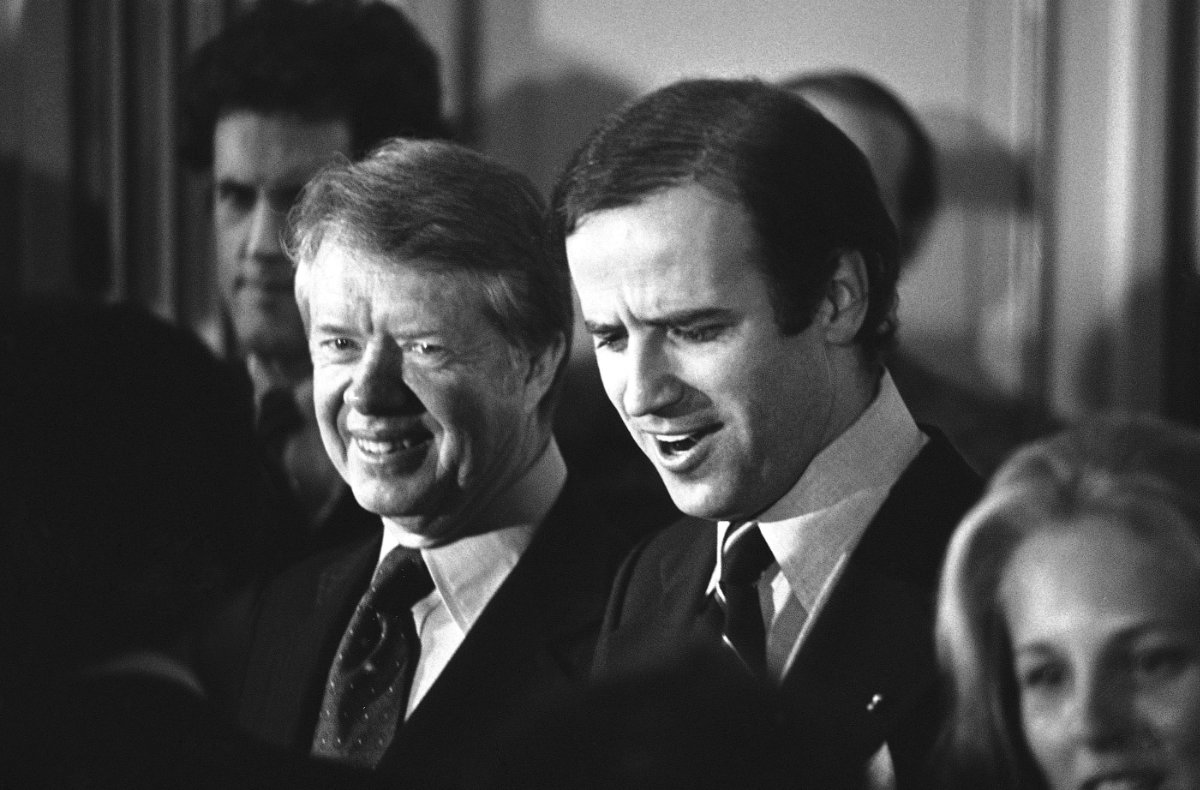
President Jimmy Carter, left, and Sen. Joseph R. Biden Jr., greet Biden supporters at a reception in Wilmington, Delaware on Feb. 20, 1978. (AP)
Any comparison, of course, involves selective interpretation, and Trump’s decision to bring a third president into the campaign carries complications for all three –- and perhaps some irony for Trump, who, like Carter, was rejected by voters after one term.
Trump’s campaign did not respond to a request for comment about his comparisons; Biden’s campaign was dismissive of them.
“Donald Trump is flailing and struggling to land coherent attacks on President Biden,” spokesman Seth Schuster said.
Carter remains at home in Plains, Georgia, where those close to him say he has kept up with the campaign. Biden is unquestionably the closest friend Carter has had in the White House since he left it. Biden was a first-term lawmaker from Delaware when he became the first US senator to endorse Carter’s underdog campaign. After he won the White House, Biden and first lady Jill Biden visited the Carters in Plains. They saw a grieving Carter privately before Rosalynn Carter’s funeral in Atlanta last year.
Like Carter, Biden is seeking reelection at a time when Americans are worried about inflation. But today’s economy is not the same as the one Carter faced.
The post-pandemic rebound, fueled by stimulus spending from the US and other governments, has been blamed for global inflation. The Federal Reserve has raised interest rates in response.
But the effective federal funds rate is 5.33 percent right now, while the benchmark was above 17 percent for a key period before the 1980 election. Rates for a 30-year mortgage are about half what they were at the peak of Carter’s administration; unemployment is less than half the Carter peak. The average per-gallon gas price in the US, topping $3.60 this month, is higher than the $3 peak under Trump. It reached $4.50 (adjusted for inflation) during Carter’s last year in office.
Carter and Trump actually share common ground. They are the clearest Washington outsiders in modern history to win the presidency, each fueled by voter discontent with the establishment.
A little-known Georgia governor and peanut farmer, Carter leveraged fallout from Vietnam and the Watergate scandal. Trump was the populist businessman and reality TV star who pledged to “Make America Great Again.” Both men defy ideological labels, standing out for their willingness to talk to dictators and isolated nations such as North Korea, even if they offered differing explanations for why.
Carter cautioned his party about underestimating Trump’s appeal, and the Carters attended Trump’s 2017 inauguration. Jimmy Carter, however, openly criticized Trump’s penchant for lies. After Carter suggested Russian propaganda helped elect Trump over Democrat Hillary Clinton in 2016, Trump began to insult Carter as a failure.
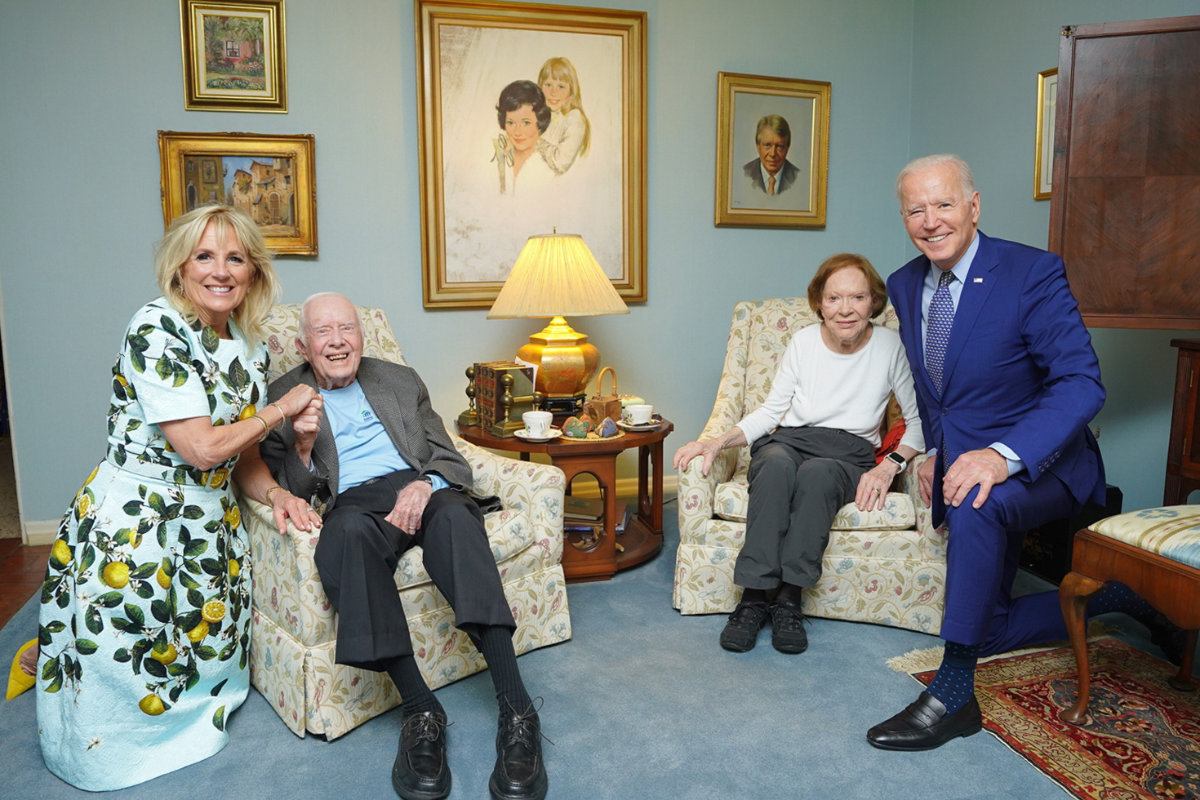
In this photo released by The White House, former President Jimmy Carter, center left, and former first lady Rosalynn Carter, center right, pose for a photo with President Joe Biden, right, and first lady Jill Biden at the home of the Carter's in Plains, Georgia, on April 30, 2021. (AP)
Unlike Carter, Trump never accepted defeat. He falsely claimed the 2020 election was stolen, then promoted debunked theories about the election that were repeated by supporters in the mob that stormed the US Capitol on Jan. 6, 2021, as Congress convened to certify Biden’s victory. Trump left Washington the morning Biden took office, becoming the first president since Andrew Johnson in 1869 to skip his successor’s inauguration.
Carter conceded to Republican Ronald Reagan, attended his inauguration, then returned to Georgia. There, he and Rosalynn Carter established The Carter Center in 1982. They spent decades advocating for democracy, mediating international conflict and advancing public health in the developing world. They built houses for low-income people with Habitat for Humanity. Jimmy Carter was awarded the Nobel Peace Prize in 2002.
Many historians’ judgment of Carter’s presidency has softened.
He is credited with deregulating much of the transportation industry, making air travel far more accessible to Americans, and creating the Department of Energy to streamline and coordinate the nation’s energy research. He negotiated the Camp David peace deal between Egypt and Israel. He diversified the federal judiciary and executive branch. He appointed the Federal Reserve chairman, Paul Volcker, who, along with Reagan, would get credit for the economic growth of the 1980s. Carter was the first president to raise concerns about rising global temperatures. And it was Carter, along with his diplomatic team, who negotiated the release of American hostages in Tehran, though they were not freed until minutes after Carter’s term expired.
Biographies, documentaries and news coverage across Carter’s 10th decade have reassessed that record.
By 2015, a Quinnipiac University poll found 40 percent of registered voters viewed Carter as having done the best work since leaving office among presidents from Carter through George W. Bush. When Gallup asked voters last year to rate Carter’s handling of his presidency, 57 percent approved and 36 percent disapproved. (Trump measured 46 percent approval and 54 percent disapproval at the time, the first retroactive measure Gallup had conducted for him.)
“There has long been a general consensus of admiration for Carter as a person — that sentiment that he was a good and decent man,” said Amber Roessner, a University of Tennessee professor who studies collective public memory and has written extensively on Carter. The more recent conclusions about Carter as a president, she added, suggest “we should consider Carter’s presidency as a lens to think about reevaluating about how we gauge the failure or success of any administration.”
How that plays into Biden’s rematch with Trump, Roessner said, “remains to be seen.”
Regardless, the ties between the 39th and 46th presidents endure, whatever the 45th president might say. When the time comes for Carter’s state funeral, Trump is expected to be invited alongside Carter’s other living successors. But it will be Biden who delivers the eulogy.


