

Saudi Arabia committed to preserving environment, water resources, minister tells WEF

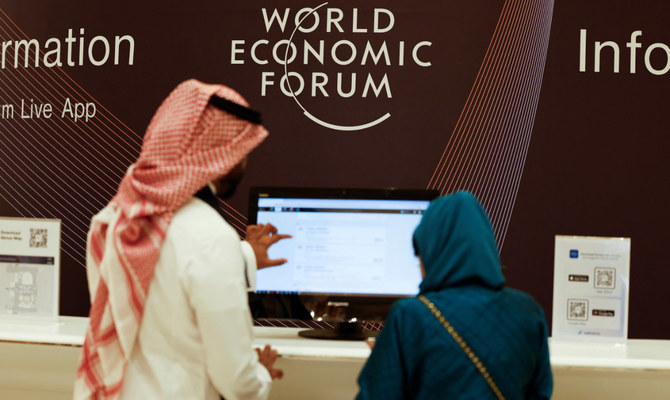
Visitors attend the World Economic Forum (WEF) in Riyadh, Saudi Arabia, April 28, 2024. (Reuters)
Short Url
Updated 28 April 2024
Follow

Saudi Arabia committed to preserving environment, water resources, minister tells WEF

  • Nation providing incentives for private sector to become more engaged, Abdulrahman Al-Fadley says

DUBAI: Saudi Arabia has detailed plans for the protection of its lands and environmental resources, the Minister of Environment, Water and Agriculture said on Sunday.

Speaking at the World Economic Forum in Riyadh, Abdulrahman Al-Fadley said: “We have devised our plans based on the preservation of our environment and the management of our water resources. The Kingdom is also providing incentives for the private sector to become more engaged and more responsible toward the environment.”

With 40 percent of lands around the world degraded and further degrading at an alarming rate, critical action is needed as the UN Convention to Combat Desertification COP16 is set to take place in Riyadh in December.

Al-Fadley said Saudi Arabia had preserved millions of hectares of land and set up programs for cloud seeding and increasing the number of dams in the country.

“This will not only be beneficial to the Kingdom but for the whole region,” he said. “With us hosting COP16 we are hoping to give the meeting the importance it commands. We don’t want matters to go back to the status quo after COP16 ends.”

Tariq Al-Olaimy, a member of the Global Shapers Community Foundation Board at the WEF, commended King Salman for his land restoration efforts.

“When you put nature first, you are equally putting people first,” he said. “Nature is our greatest collaborator … There is no successful growth story without successful land restoration and this starts inwardly, through our religion, community, values and moral clarity.”

Ibrahim Thiaw, secretary of the UNCCD, warned of global repercussions if the world did not pay heed to environmental safekeeping.

“Entire ecosystems are being destroyed through actions and inactions,” he said. “There has been a 29 percent increase in droughts in the past few years and that is affecting 1.8 billion people around the world. For poor nations that is disastrous and carries a large death toll of animals, people and agriculture. We have to be more proactive and not just emergency-ready. We must attempt to avoid emergencies.”

Thiaw said the Panama Canal’s functionality had been reduced by 12 percent, which was causing a problem for supplies.

“Demand is increasing while resources are shrinking,” he said. “As humanity we have been looking at resources as if they are unlimited. We have not been managing them. Companies need to reset their relationship with nature and we need to focus on land restoration to keep going.”

Naoki Ishii, director of the Center for Global Commons, had similar concerns.

“We are on a collision course,” he said. “The only solution is to modify our economic system. COP16 must be transformative for all of us. We need the political momentum to implement positive changes.

“If we are able to push those efforts, economically and ideally speaking, that will be a game changer.”


Saudi POS transactions see 20% surge to hit $4bn: SAMA

Updated 05 December 2025
Follow

Saudi POS transactions see 20% surge to hit $4bn: SAMA

RIYADH: Saudi Arabia’s total point-of-sale transactions surged by 20.4 percent in the week ending Nov. 29, to reach SR15.1 billion ($4 billion).

According to the latest data from the Saudi Central Bank, the number of POS transactions represented a 9.1 percent week-on-week increase to 240.25 million compared to 220.15 million the week before.

Most categories saw positive change across the period, with spending on laundry services registering the biggest uptick at 36 percent to SR65.1 million. Recreation followed, with a 35.3 percent increase to SR255.99 million. 

Expenditure on apparel and clothing saw an increase of 34.6 percent, followed by a 27.8 percent increase in spending on telecommunication. Jewelry outlays rose 5.6 percent to SR354.45 million.

Data revealed decreases across only three sectors, led by education, which saw the largest dip at 40.4 percent to reach SR62.26 million. 

Spending on airlines in Saudi Arabia fell by 25.2 percent, coinciding with major global flight disruptions. This followed an urgent Airbus recall of 6,000 A320-family aircraft after solar radiation was linked to potential flight-control data corruption. Saudi carriers moved swiftly to implement the mandatory fixes.

Flyadeal completed all updates and rebooked affected passengers, while flynas updated 20 aircraft with no schedule impact. Their rapid response contained the disruption, allowing operations to return to normal quickly.

Expenditure on food and beverages saw a 28.4 percent increase to SR2.31 billion, claiming the largest share of the POS. Spending on restaurants and cafes followed with an uptick of 22.3 percent to SR1.90 billion.

The Kingdom’s key urban centers mirrored the national decline. Riyadh, which accounted for the largest share of total POS spending, saw a 14.1 percent surge to SR5.08 billion, up from SR4.46 billion the previous week. The number of transactions in the capital reached 75.2 million, up 4.4 percent week-on-week.

In Jeddah, transaction values increased by 18.1 percent to SR2.03 billion, while Dammam reported a 14 percent surge to SR708.08 million.

POS data, tracked weekly by SAMA, provides an indicator of consumer spending trends and the ongoing growth of digital payments in Saudi Arabia. 

The data also highlights the expanding reach of POS infrastructure, extending beyond major retail hubs to smaller cities and service sectors, supporting broader digital inclusion initiatives. 

The growth of digital payment technologies aligns with the Kingdom’s Vision 2030 objectives, promoting electronic transactions and contributing to the nation’s broader digital economy.