

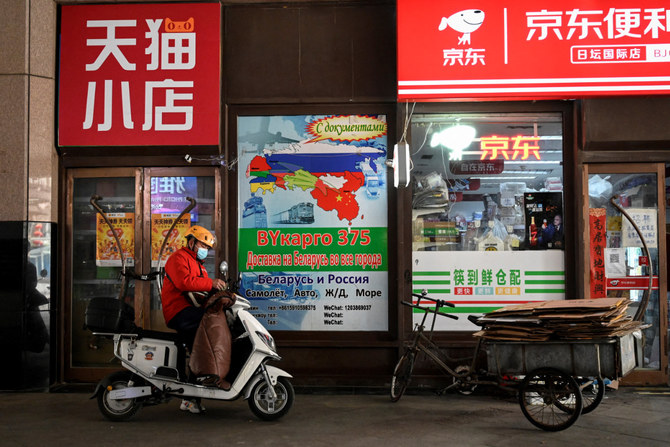

An appliance maker in southern China is finding it hard to ship its products to Russia, not because of any problems with the gadgets but because China’s big banks are throttling payments for such transactions out of concern over US sanctions.
To settle payments for its electrical goods, the Guangdong-based company is considering using currency brokers active along China’s border with Russia, said the company’s founder, Wang, who asked to be identified only by his family name.
The US has imposed an array of sanctions on Russia and Russian entities since the country invaded Ukraine in 2022.
Now the threat of extending these to banks in China — a country Washington blames for “powering” Moscow’s war effort — is chilling the finance that lubricates even non-military trade from China to Russia.
This is posing a growing problem for small Chinese exporters, said seven trading and banking sources familiar with the situation.

Ukrainian firefighters work to contain a fire at the Economy Department building of Karazin Kharkiv National University, hit during recent Russian shelling. (AFP/File)
As China’s big banks pull back from financing Russia-related transactions, some Chinese companies are turning to small banks on the border and underground financing channels such as money brokers — even banned cryptocurrency — the sources told Reuters.
Others have retreated entirely from the Russian market, the sources said.
“You simply cannot do business properly using the official channels,” Wang said, as big banks now take months rather than days to clear payments from Russia, forcing him to tap unorthodox payment channels or shrink his business.
Going ‘underground’
A manager at a large state-owned bank he previously used told Wang the lender was worried about possible US sanctions in dealing with Russian transactions, Wang said.
A banker at one of China’s Big Four state banks said it had tightened scrutiny of Russia-related businesses to avert sanctions risk. “The main reason is to avoid unnecessary troubles,” said the banker, who asked not to be named.
Since last month, Chinese banks have intensified their scrutiny of Russia-related transactions or halted business altogether to avoid being targeted by US sanctions, the sources said.
“Transactions between China and Russia will increasingly go through underground channels,” said the head of a trade body in a southeastern province that represents Chinese businesses with Russian interests. “But these methods carry significant risks.”
Making payments in crypto, banned in China since 2021, might be the only option, said a Moscow-based Russian banker, as “it’s impossible to pass through KYC (know-your-customer) at Chinese banks, big or small.”
The sources spoke on condition of anonymity, citing the sensitivity of the topic. Reuters could not determine the extent of transactions that had shifted from major banks to more obscure routes.
China’s foreign ministry is not aware of the practices described by the businesspeople to arrange payments or troubles in settling payments through major Chinese banks, a spokesperson said, referring questions to “the relevant authorities.”
The People’s Bank of China and the National Financial Regulatory Administration, the country’s banking sector regulator, did not respond to Reuters requests for comment.
Sanctions warning
US Secretary of State Antony Blinken, after meeting China’s top diplomat Wang Yi for five and a half hours in Beijing on Friday, said he had expressed “serious concern” that Beijing was “powering Russia’s brutal war of aggression against Ukraine.”
Still, his visit, which included meeting President Xi Jinping, was the latest in a series of steps that have tempered the public acrimony that drove relations between the world’s biggest economies to historic lows last year.
While officials have warned that the United States was ready to take action against Chinese financial institutions facilitating trade in goods with dual civilian and military applications and the US preliminarily has discussed sanctions on some Chinese banks, a US official told Reuters last week Washington does not yet have a plan to implement such measures.
The Chinese foreign ministry spokesperson said, “China does not accept any illegal, unilateral sanctions. Normal trade cooperation between China and Russia is not subject to disruption by any third party.”
A State Department spokesperson, asked about Reuters findings that Chinese banks were curbing payments from Russia and the impact on some Chinese companies, said, “Fuelling Russia’s defense industrial base not only threatens Ukrainian security, it threatens European security.
“Beijing cannot achieve better relations with Europe while supporting the greatest threat to European security since the end of the Cold War,” the spokesperson said.
Blinken made clear to Chinese officials “that ensuring transatlantic security is a core US interest,” the spokesperson said. “If China does not address this problem, the United States will.”
Nearly all major Chinese banks have suspended settlements from Russia since the beginning of March, said a manager at a listed electronics company in Guangdong.
Some of the biggest state-owned lenders have reported drops in Russia-related business, reversing a surge in assets after Russia’s invasion.
Among the Big Four, China Construction Bank posted a drop of 14 percent in its Russian subsidiary’s assets last year and Agricultural Bank of China a 7 percent decline, according to their latest filings.
By contrast, Industrial and Commercial Bank of China , the country’s biggest lender, reported a 43 percent jump in assets of its Russian unit. Bank of China (BOC), the fourth-largest, did not give the breakdown.

This photo taken on June 25, 2015 shows residents in the main shopping street in Hunchun, which shares a border with both Russia and North Korea, in China's northeast Jilin province. (AFP/File)
‘Channel can be shut’
The four banks did not respond to requests for comment on their Russian businesses or the impact on Chinese companies.
Some rural banks in northeast China along the Russian border can still collect payments, but this has led to a bottleneck, with some businesspeople saying they have been lining up for months to open accounts.
A chemical and machinery company in Jiangsu province has been waiting for three months to open an account at Jilin Hunchun Rural Commercial Bank in the northeastern province of Jilin, said Liu, who works at the firm and also asked to be identified by family name.
Calls to the bank seeking comment went unanswered.
BOC has blocked a payment from Liu’s Russian clients since February, and a bank loan officer said firms exporting heavy equipment face more stringent reviews in receiving payments, Liu said.
The manager at the listed Guangdong company said their firm had opened accounts at seven banks since last month but none agreed to accept payments from Russia.
“We gave up on the Russian market,” the manager said. “We eventually didn’t receive more than 10 million yuan ($1.4 million) in payments from the Russian side, and we just gave up. The process of collecting payments is extremely annoying.”
Wang is also having second thoughts about his Russian business.
“I may gradually shrink my business in Russia as the slow process of collecting money is not good for the company’s liquidity management,” he said.
“What’s more, you don’t know what will happen in the future. The channel can be shut completely one day.”


