WASHINGTON: President Joe Biden on Wednesday misstated key details about his uncle’s death in World War II as he honored the man’s wartime service and said Donald Trump was unworthy of serving as commander in chief.
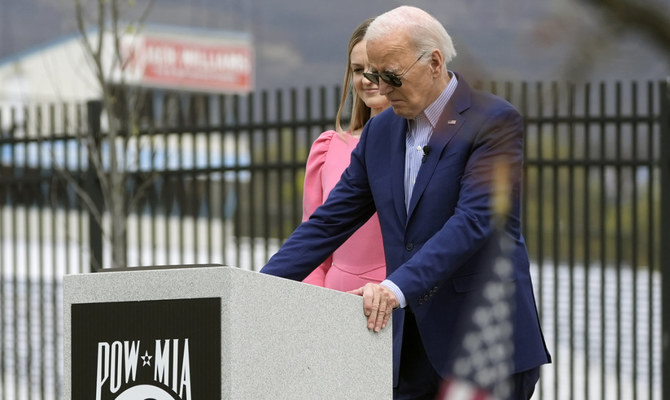
While in Pittsburgh, Biden spoke about his uncle, 2nd Lt. Ambrose J. Finnegan Jr., aiming to draw a contrast with reports that Trump, while president, had called fallen service members “suckers” and “losers.”
Finnegan, the brother of Biden’s mother, “got shot down in New Guinea,” Biden said. The president said Finnegan’s body was never recovered and “there used to be a lot of cannibals” in the area. Biden, who also relayed a version of the story earlier in the day after stopping by the memorial in Scranton, was off on the particulars.
The US government’s record of missing service members does not attribute Finnegan’s death to hostile action or indicate cannibals were any factor.
“We have a tradition in my family my grandfather started,” said Biden, a toddler at the time of his uncle’s death in 1944. “When you visit a gravesite of a family member — it’s going to sound strange to you — but you say three Hail Marys. And that’s what I was doing at the site.”
Referring to Trump, the presumptive GOP presidential nominee, Biden said, “That man doesn’t deserve to have been the commander in chief for my son, my uncle.”
Biden’s elder son, Beau, died in 2015 of brain cancer, which the president has stated he believes was linked to his son’s yearlong deployment in Iraq, where the military used burn pits to dispose of waste.
Some former Trump officials have claimed the then-president disparaged fallen service members as “suckers” and “losers” when, they said, he did not want to travel in 2018 to a cemetery for American war dead in France. Trump denied the allegation, saying, “What animal would say such a thing?”
According to the Pentagon’s Defense POW/MIA Accounting Agency, Biden’s uncle, known by the family as “Bosie,” died on May 14, 1944, while a passenger on an Army Air Forces plane that, “for unknown reasons,” was forced to ditch in the Pacific Ocean off the northern coast of New Guinea. “Both engines failed at low altitude, and the aircraft’s nose hit the water hard,” the agency states in its listing of Finnegan. “Three men failed to emerge from the sinking wreck and were lost in the crash.”
The agency said Finnegan was a passenger on the plane when it was lost. “He has not been associated with any remains recovered from the area after the war and is still unaccounted-for,” according to the agency.
White House spokesman Andrew Bates did not address the discrepancy between the agency’s records and Biden’s account when he issued a statement on the matter.
“President Biden is proud of his uncle’s service in uniform,” Bates said, adding Finnegan ”lost his life when the military aircraft he was on crashed in the Pacific after taking off near New Guinea.”
Biden “highlighted his uncle’s story as he made the case for honoring our ‘sacred commitment ... to equip those we send to war and take care of them and their families when they come home,’ and as he reiterated that the last thing American veterans are is ‘suckers’ or ‘losers.’”
The Democratic president also misstated when uncles enlisted in the military, saying they joined “when D-Day occurred, the next day,” in June 1944, when they actually joined weeks after the Dec. 7, 1941, attack on Pearl Harbor.
After Finnegan’s death, a local newspaper published a telegram from Gen. Douglas MacArthur expressing condolences to Finnegan’s family:
“Dear Mr. Finnegan: In the death of your son, Second Lt. Ambrose J. Finnegan Jr., while in service of his country, you have my profound sympathy. Your consolation may be that he died in the uniform of our beloved country, serving in a crusade from which a better world for all will come. Very faithfully, Douglas MacArthur.”
Biden, in his 2008 book “Promises to Keep,” made only brief mention of his uncle, describing him as flyer who was killed in New Guinea.

Biden is off on details of his uncle’s WWII death as he calls Trump unfit to lead the military
https://arab.news/2g4a8
Biden is off on details of his uncle’s WWII death as he calls Trump unfit to lead the military
- The US government’s record of missing service members does not attribute Finnegan’s death to hostile action or indicate cannibals were any factor
Germany’s Merz hails China ties as he seeks reset with Beijing
- Merz, who was accompanied by a large business delegation, told President Xi Jinping that he wanted to deepen economic ties with China
- “There are challenges, which we should talk about today, but the framework in which we operate is exceptionally good,” he said
BEIJING: German Chancellor Friedrich Merz won a pledge by China to import more high-quality goods from Germany on Wednesday, as he visited Beijing aiming to reset relations that have been clouded by a yawning trade deficit with the world’s second-largest economy.
On his first visit to China as Chancellor, Merz, who was accompanied by a large business delegation, told President Xi Jinping that he wanted to deepen economic ties with China, Germany’s largest trading partner last year.
“There are challenges, which we should talk about today, but the framework in which we operate is exceptionally good and we have worked together very well over the past decades,” he said.
Xi welcomed the comments from Merz, who faces a tough balancing act of redefining an economic relationship that is increasingly unfavorable to German interests.
“The more turbulent and intertwined the world becomes, the more China and Germany need to strengthen strategic communication and enhance strategic mutual trust,” he said.
CHINA’S MASSIVE TRADE SURPLUS
Merz’s visit follows his warning this month that the postwar international order underwritten by the US alliance with Europe was no more and that Europe must stand on its own in a world of great power rivalry.
In an earlier meeting with Premier Li Qiang, Merz said there were “very specific concerns regarding our cooperation, which we want to improve and make fair.”
Merz’s comments reflect longstanding German concerns about what Berlin sees as an undervalued yuan, market-distorting subsidies and overcapacity among Chinese exporters that have built massive trade surpluses with Europe’s largest economy, amounting to 90 billion euros ($106 billion) last year.
He noted that the deficit had increased fourfold since 2020, and said this was largely due to overcapacity. “This dynamic is not healthy,” he told reporters after the meetings.
German business has been deeply concerned by its dependence on strategic commodities from China including rare earths and basic chips after Beijing tightened export controls last year, sending shockwaves through Western manufacturers.
At the same time, Merz’s visit underlined the vital importance of China’s huge consumer market and the technical sophistication of its all-conquering manufacturers.
“We want Chinese investment in Germany,” Merz said at a business event attended by senior German and Chinese business leaders from the tech and auto sectors.
Li told Merz that China wished to cooperate in areas like automobiles and chemicals as well as emerging fields including artificial intelligence and biomedicine.
He also said China was willing to import more high-quality products from Germany and encouraged Chinese companies to invest in Germany, according to a readout from the meeting released by Xinhua news agency.
“China will unswervingly expand high-level opening-up and actively address the reasonable demands of foreign-invested enterprises from Germany and other countries,” he said.
“JUST AND FAIR GLOBAL GOVERNANCE“
Merz is accompanied by top executives from 30 German firms including top carmakers such as Volkswagen and BMW which are acutely feeling the strain of Chinese competition — contributing to the growing trade imbalance.
China has been seeking to present itself as a reliable economic partner, as Europe struggles with a new, less certain relationship with Washington and vulnerabilities in its supply chains exposed during a bout of trade turbulence last year.
China’s market, once coveted by foreign businesses for its wide consumer base and rising spending power, has changed in recent years with a slowing economy capping consumer demand and manufacturing overcapacity increasingly pushing domestic firms to look for opportunities abroad.
Li called on both sides to work together to safeguard multilateralism and free trade, in a comment seen as a reference to US President Donald Trump’s trade war and said they should “strive to build a more just and fair global governance system.”
Despite their calls for deeper engagement, the agreements Merz and Li formalized after their meeting were narrowly targeted and in industries peripheral to both economies.
The five documents signed covered continued efforts in climate change and green transition, cooperation in animal disease prevention and a poultry products protocol, as well as sports collaboration agreements for football and table tennis.
That paled in comparison with Canada and Britain, which respectively signed eight and 12 documents with China last month during visits by Canadian Prime Minister Mark Carney and British Prime Minister Keir Starmer.


