

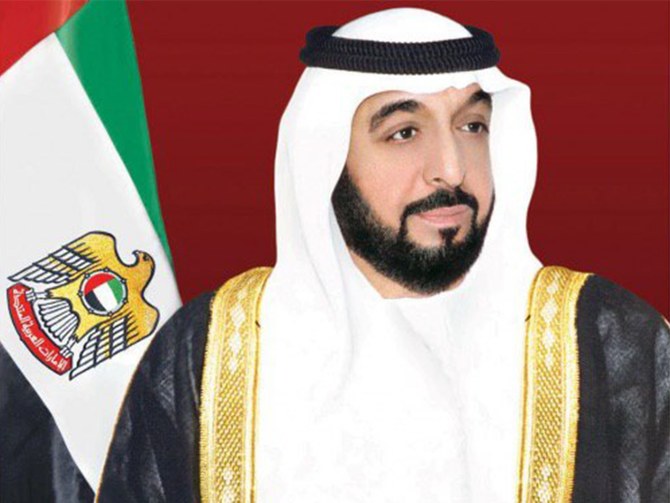
‘Abrahamic Agreement’ supports people’s aspirations to achieve progress: UAE President

The President addressed the nation on the occasion of the opening of the second session of the Federal National Council’s 17th legislative chapter, state news agency WAM reported. (WAM)
Short Url
Updated 26 November 2020
Follow

‘Abrahamic Agreement’ supports people’s aspirations to achieve progress: UAE President

  • Sheikh Khalifa added that the world had been facing the coronavirus pandemic and its implications which have changed everything in human lives and state conditions

DUBAI: The “Abrahamic agreement” came as a tributary of peace that supports the aspirations of people across the region to achieve progress and prosperity, the United Arab Emirate’s President Sheikh Khalifa bin Zayed Al-Nahyan said.
The UAE and Israel reached a historic deal on Aug. 13 that will lead to a full normalization of diplomatic relations between the two nations.

The President addressed the nation on the occasion of the opening of the second session of the Federal National Council’s 17th legislative chapter, state news agency WAM reported.
We had to always adapt our policy to what supports the foundations of a stable country and region on the basis of adherence to the principles of international law, peaceful coexistence and resolving differences through dialogue, he added.
Sheikh Khalifa added that the world had been facing the coronavirus pandemic and its implications which have changed everything in human lives and state conditions, and caused stagnation in the global economy.
He added that the UAE’s performance in curbing COVID-19 was exemplary, as it also continued its approach to giving by providing medical aids to over 100 countries across the globe.
The UAE’s performance was also strengthened, as it moved forward with the peaceful nuclear energy program, and started operating the reactors of the Barakah plant, he said.
The Barakah plant, which is being built by Korea Electric Power Corporation (KEPCO), will be the first nuclear energy plant in the Arab World.
The president further said the country also proceeded by launching its space program to Mars.


Iran unrest persists, top judge warns protesters

Updated 6 sec ago
Follow

Iran unrest persists, top judge warns protesters

  • Demonstrations sparked by soaring inflation
  • Western provinces worst affected

DUBAI: Iran’s top judge warned protesters on Wednesday there would be “no ​leniency for those who help the enemy against the Islamic Republic,” while accusing Israel and the US of pursuing hybrid methods to disrupt the country.
The current protests, the biggest wave of dissent in three years, began last month in Tehran’s Grand Bazaar by shopkeepers condemning the currency’s free fall. 
Unrest has since spread nationwide amid deepening distress over economic hardships, including rocketing inflation driven by mismanagement and Western sanctions, and curbs on political and ‌social freedoms.
“Following announcements ‌by Israel and the US president, there is no excuse for those coming ‌to the ​streets for ‌riots and unrest, chief justice Gholamhossein Mohseni Ejei, the head of Iran’s judiciary, was quoted as saying by state media.
“From now on, there will be no leniency for whoever helps the enemy against the Islamic Republic and the calm of the people,” Ejei said.
Iranian authorities have not given ‌a death toll for protesters, but have said at least two members of the security services have died and more than a dozen have been injured.
Iran’s western provinces have witnessed the most violent protests.
“During the funeral of two people ​in Malekshahi on Tuesday, a number of attendees began chanting harsh, anti-system slogans,” said Iran’s Fars, news agency.
After the funeral, Fars said, “about 100 mourners went into the city and trashed three banks ... Some started shooting at the police trying to disperse them.”
The semi-official Mehr news agency said protesters stormed a food store and emptied bags of rice, which has been affected by galloping inflation that has made ordinary staples increasingly unaffordable for many Iranians.