

Italian scientists claim world-first coronavirus vaccine breakthrough

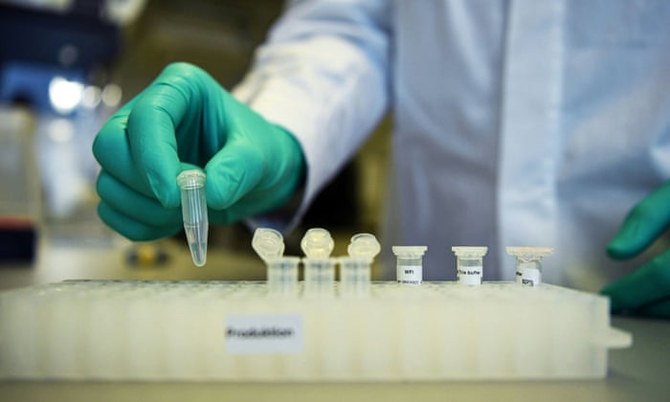
An Italian coronavirus vaccine has antibodies generated in mice that work on human cells, according to tests carried out at Rome’s infectious-disease Spallanzani Hospital. (Reuters/File Photo)
Short Url
Updated 05 May 2020
Follow

Italian scientists claim world-first coronavirus vaccine breakthrough

  • A coronavirus disease (COVID-19) candidate vaccine has neutralized the virus in human cells for the first time

ROME: An Italian coronavirus vaccine has antibodies generated in mice that work on human cells, according to tests carried out at Rome’s infectious-disease Spallanzani Hospital.

Luigi Aurisicchio, CEO of  Takis, the firm developing the medication, said that a coronavirus disease (COVID-19) candidate vaccine has neutralized the virus in human cells for the first time.

“This is the most advanced stage of testing of a candidate vaccine created in Italy,” Aurisicchio told the Italian newsagency ANSA. “Human tests are expected after this summer,” he added.

“According to Spallanzani Hospital, as far as we know we are the first in the world so far to have demonstrated a neutralization of the coronavirus by a vaccine. We expect this to happen in humans too,” said Aurisicchio.

Opinion

This section contains relevant reference points, placed in (Opinion field)

He explains that Takis is exploring “more interesting technological platforms with LineaRx, an American company.

“We are working hard for a vaccine coming from Italian research, with an all-Italian and innovative technology, tested in Italy and made available to everyone. In order to reach this goal we need the support of national and international institutions and partners who may help us speed up the process.”

Aurisicchio added: “This is not a competition. If we join our forces and skills together we can all win against coronavirus.”

Italian researchers describe the results “encouraging and well beyond expectations.”

After a single vaccination, the mice developed antibodies that can block the virus from infecting human cells, Aurisicchio said.

After observing that the five vaccine candidates generated a large number of antibodies, researchers selected the two with the best results.

Serum was isolated from the antibody-rich blood; it was then analyzed in the virology laboratory of the Spallanzani Institute, one of the most advanced establishments in Europe. The next step now is to understand how much the immune response lasts.

All of the vaccine candidates currently being developed are based on the material genetic of DNA protein “spike”, the molecular tip used by the coronavirus to enter human cells.

They are injected with the so-called “electroporation” technique, which consists of an intramuscular injection followed by a brief electrical impulse, helping the vaccine break into the cells and activating the immune system.

Researchers believe that this makes their vaccine particularly effective for generating functional antibodies against the “spike” protein, in particular in the lung cells, which are the most vulnerable to coronavirus.  

“So far, the immunity generated by most of our five vaccine candidates has an effect on the virus. We expect even better results after the second vaccination,” said Dr Emanuele Marra from Takis.

Marra added that those vaccine candidates could adapt to any COVID-19 evolutions and its possible mutations.

“We are already working on a trial version in case the virus accumulates mutations and becomes invisible to the immune system. For this purpose, we use the same concept we use in developing cancer vaccines,” he said.


Philippines probes Bondi Beach suspects’ visit, downplays militant training reports

Updated 12 sec ago
Follow

Philippines probes Bondi Beach suspects’ visit, downplays militant training reports

  • Suspects spent 4 weeks in the Philippines last month
  • Govt says no evidence visit linked to militant activity

MANILA: The Philippine National Police launched on Wednesday a probe into the recent visit to the country of a father and son whom Australian authorities have identified as suspects in last week’s mass shooting in Sydney.

Two gunmen killed 15 people and wounded dozens of others during Hanukkah celebrations at Sydney’s Bondi Beach on Sunday.

The suspected shooters, identified by Australian authorities as Sajid Akram and his son Naveed Akram, traveled to the Philippines last month.

The news has prompted various media outlets to speculate that there are links between their visit and the Sydney attack — an allegation Manila has since denied.

The investigation launched by the Philippine police seeks to establish the purpose of the suspects’ travel and their movement while in the country.

“This matter is being investigated as we seek to determine the reason behind their visit to the Philippines. We are finding out which places they went to, who they talked to, and where they stayed while they were in the country,” Philippine National Police acting chief Lt. Gen. Jose Melencio Nartatez Jr. said in a statement.

Bureau of Immigration data shows that 50-year-old Akram and his 24-year-old son arrived in the Philippines from Sydney on Nov. 1. They left the country on Nov. 28 via a connecting flight from Davao in the southern Philippines to Manila, with Sydney as their final destination.

According to a police statement, Philippine authorities, including the government and military, said there was no evidence the trip was related to any militant activity in the country and was “not considered as a serious security concern.”

Australian media reports linking the suspects to Daesh and alleging the group used the Philippines as its training ground were denied by the Philippine government.

“Information from operating units on the ground indicates no ongoing training and recruitment,” Department of National Defense spokesperson Arsenio Andolong told Arab News.

“There is no indication of imminent domestic terrorist threats.”

Presidential Communications Office Undersecretary and Palace Press Officer Claire Castro also dismissed the claims as “misleading” and “portraying the Philippines as a training hotspot for violent extremist groups.”

She told reporters that the National Security Council “maintained there is no confirmation to allegations that the father-and-son suspects in the recent mass shooting in Bondi Beach, Sydney, Australia, received training in the Philippines.”

Castro added that Philippine security forces “have significantly weakened” Daesh-affiliated groups since the 2017 Marawi siege.

The southern Philippine city in Mindanao island was in 2017 taken over by groups affiliated with Daesh. After five months of fighting and hundreds of deaths, the Philippine army reclaimed the area.

“Both UN and the US government assessments indicate that these groups now operate in a fragmented and diminished capacity,” Castro said.

“Violence in Mindanao is largely driven by historical conflicts and local clan disputes rather than the operational capacity of ISIS-affiliated organizations.”