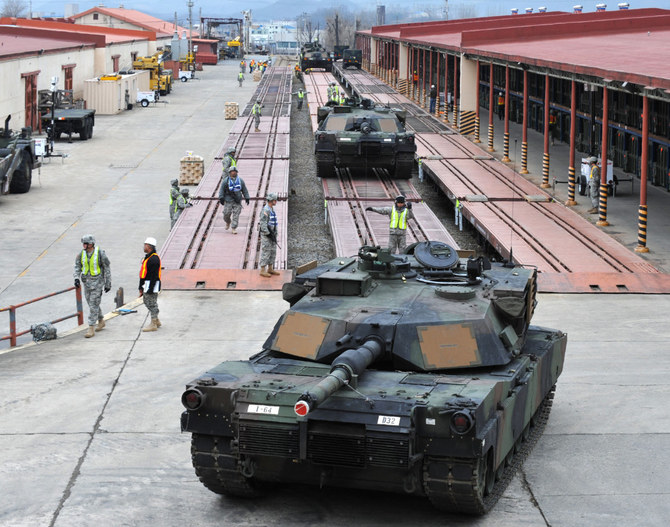

WASHINGTON: Ukraine has sidelined US-provided Abrams M1A1 battle tanks for now in its fight against Russia, in part because Russian drone warfare has made it too difficult for them to operate without detection or coming under attack, two US military officials told The Associated Press.
The US agreed to send 31 Abrams to Ukraine in January 2023 after an aggressive monthslong campaign by Kyiv arguing that the tanks, which cost about $10 million apiece, were vital to its ability to breach Russian lines.
But the battlefield has changed substantially since then, notably by the ubiquitous use of Russian surveillance drones and hunter-killer drones. Those weapons have made it more difficult for Ukraine to protect the tanks when they are quickly detected and hunted by Russian drones or rounds.
Five of the 31 tanks have already been lost to Russian attacks.
The proliferation of drones on the Ukrainian battlefield means “there isn’t open ground that you can just drive across without fear of detection,” a senior defense official told reporters Thursday.
The official spoke on the condition of anonymity to provide an update on US weapons support for Ukraine before Friday’s Ukraine Defense Contact Group meeting.
For now, the tanks have been moved from the front lines, and the US will work with the Ukrainians to reset tactics, said Joint Chiefs of Staff Vice Chairman Adm. Christopher Grady and a third defense official who confirmed the move on the condition of anonymity.
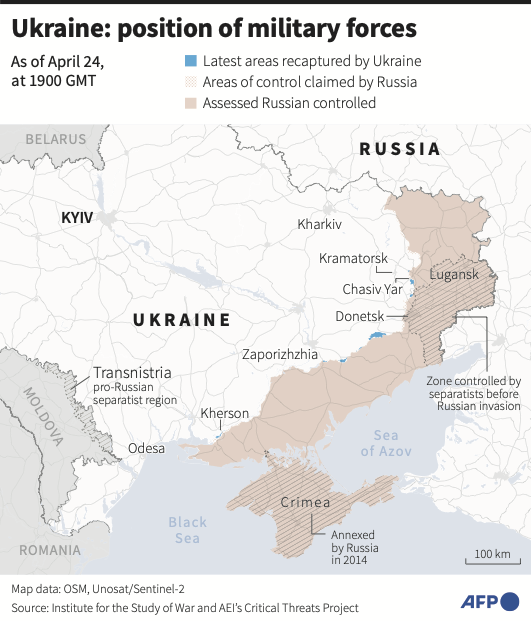
“When you think about the way the fight has evolved, massed armor in an environment where unmanned aerial systems are ubiquitous can be at risk,” Grady told the AP in an interview this week, adding that tanks are still important.
“Now, there is a way to do it,” he said. “We’ll work with our Ukrainian partners, and other partners on the ground, to help them think through how they might use that, in that kind of changed environment now, where everything is seen immediately.”
News of the sidelined tanks comes as the US marks the two-year anniversary of the Ukraine Defense Contact Group, a coalition of about 50 countries that meets monthly to assess Ukraine’s battlefield needs and identify where to find needed ammunition, weapons or maintenance to keep Ukraine’s troops equipped.
Recent aid packages, including the $1 billion military assistance package signed by President Joe Biden on Wednesday, also reflect a wider reset for Ukrainian forces in the evolving fight.
The US is expected to announce Friday that it also will provide about $6 billion in long-term military aid to Ukraine, US officials said, adding that it will include much sought after munitions for Patriot air defense systems. The officials spoke on condition of anonymity to discuss details not yet made public.
The $1 billion package emphasized counter-drone capabilities, including .50-caliber rounds specifically modified to counter drone systems; additional air defenses and ammunition; and a host of alternative, and cheaper, vehicles, including Humvees, Bradley Infantry Fighting Vehicles and Mine Resistant Ambush Protected Vehicles.
The US also confirmed for the first time that it is providing long-range ballistic missiles known as ATACMs, which allow Ukraine to strike deep into Russian-occupied areas without having to advance and be further exposed to either drone detection or fortified Russian defenses.
While drones are a significant threat, the Ukrainians also have not adopted tactics that could have made the tanks more effective, one of the US defense officials said.
After announcing it would provide Ukraine the Abrams tanks in January 2023, the US began training Ukrainians at Grafenwoehr Army base in Germany that spring on how to maintain and operate them. They also taught the Ukrainians how to use them in combined arms warfare — where the tanks operate as part of a system of advancing armored forces, coordinating movements with overhead offensive fires, infantry troops and air assets.
As the spring progressed and Ukraine’s highly anticipated counteroffensive stalled, shifting from tank training in Germany to getting Abrams on the battlefield was seen as an imperative to breach fortified Russian lines. Ukrainian President Volodymyr Zelensky announced on his Telegram channel in September that the Abrams had arrived in Ukraine.
Since then, however, Ukraine has only employed them in a limited fashion and has not made combined arms warfare part of its operations, the defense official said.
During its recent withdrawal from Avdiivka, a city in eastern Ukraine that was the focus of intense fighting for months, several tanks were lost to Russian attacks, the official said.
A long delay by Congress in passing new funding for Ukraine meant its forces had to ration ammunition, and in some cases they were only able to shoot back once for every five or more times they were targeted by Russian forces.
In Avdiivka, Ukrainian forces were badly outgunned and fighting back against Russian glide bombs and hunter-killer drones with whatever ammunition they had left.