China’s Shenzhou-18 mission docks with space station

1 / 2
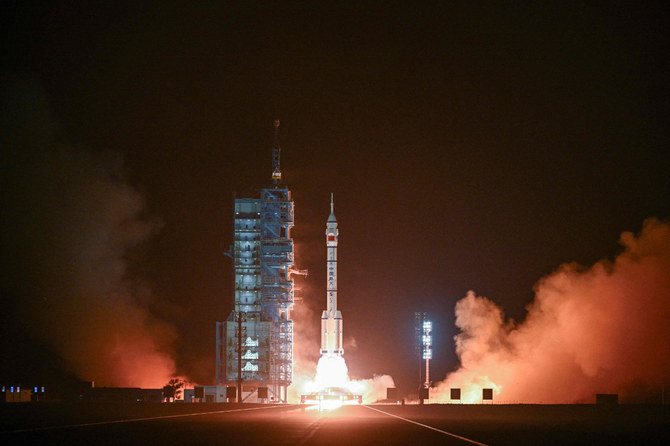
A Long March-2F carrier rocket, carrying the Shenzhou-18 spacecraft and a crew of three astronauts, lifts off from the Jiuquan Satellite Launch Center in the Gobi desert in northwest China on April 25, 2024. (AFP)
2 / 2
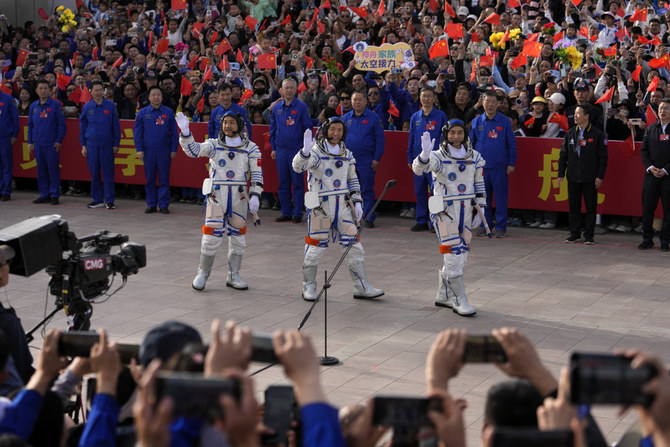
Chinese astronauts for the Shenzhou-18 mission, from left, Li Guangsu, Li Cong and Ye Guangfu wave to spectators as they attend a send-off ceremony for their manned space mission at the Jiuquan Satellite Launch Center in northwestern China on April 25, 2024. (AP Photo)
Short Url
Updated 26 April 2024
Follow

China’s Shenzhou-18 mission docks with space station

  • The astronauts took off from the Jiuquan Satellite Launch Center in China’s northwest at 8:59 p.m. local time Thursday
  • The astronauts will stay at the Tiangong space station for six months, carrying out experiments

JIUQUAN, China: A spaceship carrying three astronauts from China’s Shenzhou-18 mission safely docked at Tiangong space station Friday, state-run media reported, the latest step in Beijing’s space program that aims to send astronauts to the Moon by 2030.

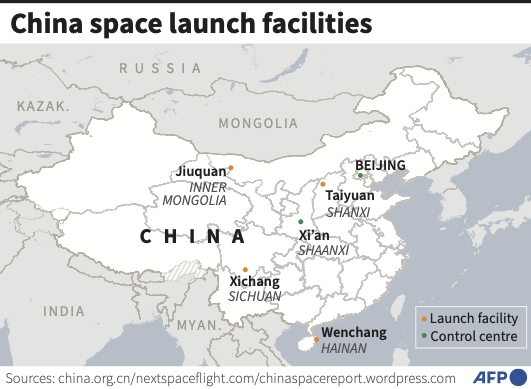
The crew took off in a capsule atop a Long March-2F rocket from the Jiuquan Satellite Launch Center in China’s northwest at 8:59 p.m. local time 1259 GMT) Thursday.
By early Friday the spacecraft had “successfully docked” with the space station, state-run news agency Xinhua reported, citing the China Manned Space Agency.
The mission is led by Ye Guangfu, a fighter pilot and astronaut who was previously part of the Shenzhou-13 crew in 2021.
He is joined by astronauts Li Cong and Li Guangsu, who are heading into space for the first time.
Onlookers cheered as the rocket blasted off into the night sky, an AFP journalist at the scene said.
Xinhua said the launch had been declared a “complete success.”
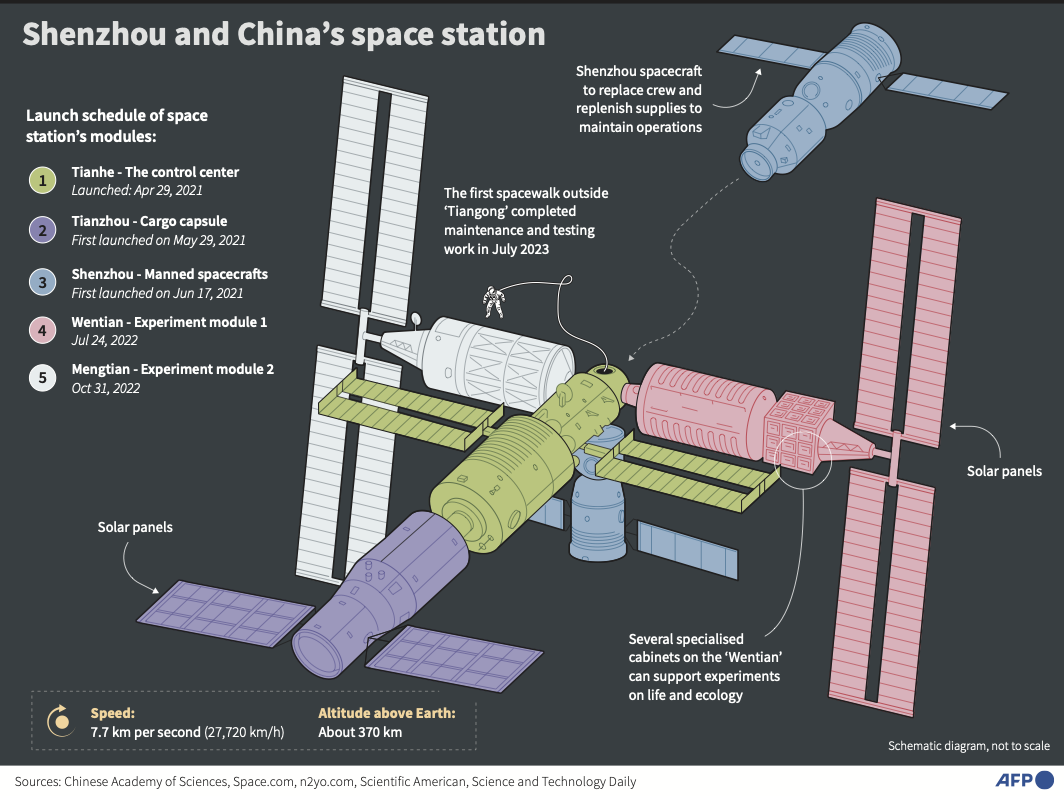
The astronauts will stay at the Tiangong space station for six months.

There they plan to carry out experiments “in the fields of basic physics in microgravity, space material science, space life science, space medicine and space technology,” the China Manned Space Agency has said.
They will also try and create an aquarium onboard and seek to raise fish in zero gravity, according to Xinhua.
“Not only will the taikonauts find joy in the space ‘aquarium,’ but it may also pave the way for their future counterparts to enjoy nutritious fish from their own in-orbit harvests,” it added.
They will also conduct experiments on “fruit flies and mice,” a researcher quoted by the agency said.
The new crew will replace the Shenzhou-17 team, who were sent to the station in October.
Plans for China’s “space dream” have been put into overdrive under President Xi Jinping.
The world’s second-largest economy has pumped billions of dollars into its military-run space program in an effort to catch up with the United States and Russia.
Beijing also aims to send a crewed mission to the Moon by 2030, and plans to build a base on the lunar surface.
China has been effectively excluded from the International Space Station since 2011, when the United States banned NASA from engaging with the country — pushing Beijing to develop its own orbital outpost.
That station is the Tiangong, which means “heavenly palace” — the crown jewel of a space program that has landed robotic rovers on Mars and the Moon, and made China the third country to independently put humans in orbit.
It is constantly crewed by rotating teams of three astronauts, with construction completed in 2022.
The Tiangong is expected to remain in low Earth orbit at between 400 and 450 kilometers (250 and 280 miles) above the planet for at least 10 years.


Second doctor in Matthew Perry overdose case sentenced to home confinement

Updated 17 December 2025
Follow

Second doctor in Matthew Perry overdose case sentenced to home confinement

  • Dr. Mark Chavez, 55, a onetime San Diego-based physician, pleaded guilty in federal court in October
  • Judge Sherilyn Peace Garnett also sentenced Chavez to 300 hours of community service

LOS ANGELES: A second California doctor was sentenced on Tuesday to eight months of home confinement for illegally supplying “Friends” star Matthew Perry with ketamine, the powerful sedative that caused the actor’s fatal drug overdose in a hot tub in 2023.
Dr. Mark Chavez, 55, a onetime San Diego-based physician, pleaded guilty in federal court in October to a single felony count of conspiracy to distribute the prescription anesthetic and surrendered his medical license in November.
Judge Sherilyn Peace Garnett also sentenced Chavez to 300 hours of community service. As part of his plea agreement, Chavez admitted to selling ketamine to another physician Dr. Salvador Plasencia, 44, who in turn supplied the drug to Perry, though not the dose that ultimately killed the performer. Plasencia, who pleaded guilty to four counts of unlawful drug distribution, was sentenced earlier this month to 2 1/2 years behind bars.
He and Chavez were the first two of five people convicted in connection with Perry’s ketamine-induced death to be sent off to prison.
The three others scheduled to be sentenced in the coming weeks — Jasveen Sangha, 42, a drug dealer known as the “Ketamine Queen;” a go-between dealer Erik Fleming, 56; and Perry’s former personal assistant, Iwamasa, 60.
Sangha admitted to supplying the ketamine dose that killed Perry, and Iwamasa acknowledged injecting Perry with it. It was Iwamasa who later found Perry, aged 54, face down and lifeless, in the jacuzzi of his Los Angeles home on October 28, 2023.
An autopsy report concluded the actor died from the acute effects of ketamine,” which combined with other factors in causing him to lose consciousness and drown.
Perry had publicly acknowledged decades of substance abuse, including the years he starred as Chandler Bing on the hit 1990s NBC television series “Friends.”
According to federal law enforcement officials, Perry had been receiving ketamine infusions for treatment of depression and anxiety at a clinic where he became addicted to the drug.
When doctors there refused to increase his dosage, he turned to unscrupulous providers elsewhere willing to exploit Perry’s drug dependency as a way to make quick money, authorities said. Ketamine is a short-acting anesthetic with hallucinogenic properties that is sometimes prescribed to treat depression and other psychiatric disorders. It also has seen widespread abuse as an illicit party drug.